



Intent: research — an athletic award database surrogate key policy defines the rules for assigning, protecting, and maintaining system-generated record identifiers for athletic recognition entries. A surrogate key is a stable, system-generated ID — a sequential integer or UUID — assigned at the moment a record is created and never derived from athlete names, season labels, or award titles. Because surrogate keys carry no real-world meaning, they remain unchanged when any descriptive field is later corrected: an athlete’s name can be updated, an award title can be renamed after a program rebrand, and a season format can be standardized without breaking display links, cross-system references, or correction log entries tied to the original record.
This guide is written for athletic directors, school administrators, IT and database teams, and recognition-program owners responsible for the long-term stability of athletic honor records. It covers what surrogate keys are, why natural keys fail for long-lived recognition programs, a surrogate key versus natural key comparison table, the six components of a complete policy, an implementation checklist, and a Q&A section on the most common policy questions.
A school’s athletic archive is an institutional record that outlasts the people who create it. A hall of fame inductee profile created today may still appear on a lobby touchscreen in 30 years. A records board entry may stand for a generation before it is broken. Over that span, names change — athletes marry, adopt new surnames, or correct legal spellings. Award titles evolve as programs rebrand. Season labels get reformatted when administrative systems are upgraded. Every one of those changes is legitimate. The question is whether the underlying record can absorb each change without losing its connection to the correction history, the photo archive, and the recognition display that depend on it.

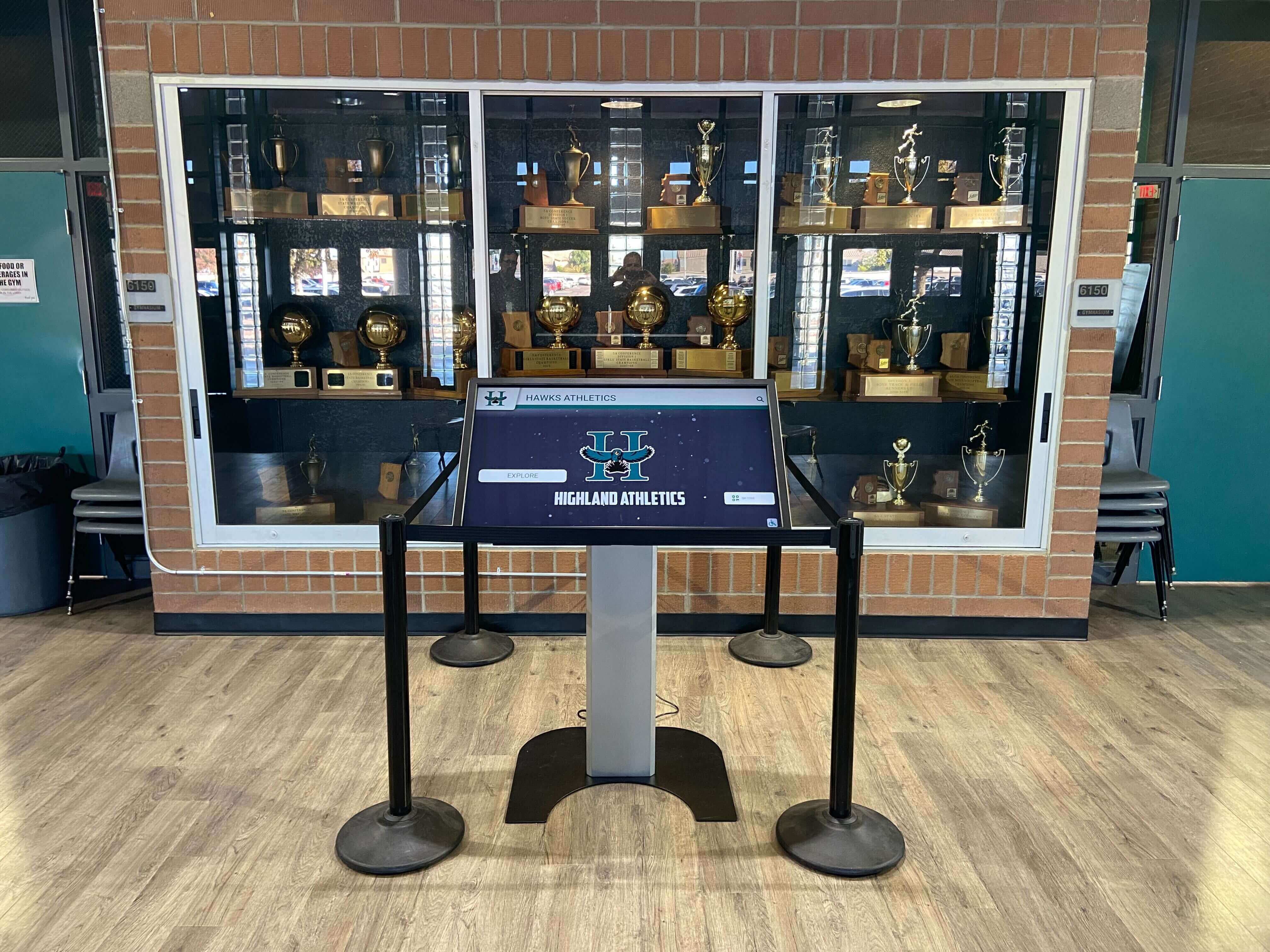
Recognition records visible in a trophy case kiosk today must remain identifiable even after athlete names, award labels, and season formats change — a surrogate key policy protects that stability at the database layer
What Is a Surrogate Key in an Athletic Awards Database?
A surrogate key is a system-generated identifier assigned to a record at the moment of creation that has no meaning outside the database. It does not encode the athlete’s name, the sport, the season, or the award title. It exists for one purpose: to give the record a permanent, stable identity that no real-world change can invalidate.
In a school athletic records system, a surrogate key might be a sequential integer — record ID 4,182 — or a UUID such as a3f7c019-88b2-4d1a-bc3f-5e6901d44f7c. Either format works, provided the policy enforces two rules: the key is assigned automatically at record creation, and it is never modified after assignment.
The practical benefit becomes clear the first time a name correction is needed. When an athlete’s name is updated from a misspelled entry to the correct spelling, every system reference — the recognition display, the digital archive, the correction log, the associated photo — remains linked to the same surrogate key. The correction changes a descriptive field; it does not change the record’s identity. The record was, is, and will always be ID 4,182, regardless of how many corrections its name field receives over the life of the archive.
Why Natural Keys Fail for Long-Lived Athletic Records
A natural key uses one or more real-world values to identify a record. In athletic recognition, the most common attempt combines athlete name, sport, season, and award title — four fields that together seem to define a unique honor. This approach works until any of those values changes, at which point the key itself changes and every reference built on that key must be updated simultaneously — or it silently points to an invalid or inconsistent record.
Four patterns of natural key failure that occur regularly in school athletic programs:
1. Athlete name changes. Marriage, legal name corrections, and preferred-name updates are routine over the life of an athletic archive. If the natural key includes the athlete’s name, every system that uses that name as an identifier must be updated in lockstep — or the record splits into two inconsistent identities.
2. Award title rebranding. Programs rename honors as recognition programs evolve: “Most Valuable Player” becomes “Team MVP,” “Scholar-Athlete Award” becomes “Academic Excellence Award.” When the award title is part of the natural key, the renamed honor creates a new key, severing the historical record chain for that category.
3. Season label reformatting. Administrative systems reformat season labels as they are upgraded: “2019-20” becomes “2019-2020,” or “Fall 2019” becomes “2019 Fall.” A natural key built on the season label as originally formatted becomes inconsistent with records entered after the format changed — even when the underlying season is identical.
4. Program restructuring. When a sport is reorganized — a JV program is discontinued, a team is reclassified — the program identifier that formed part of the natural key no longer exists in its original form. Records entered under the old structure have keys that do not map cleanly to the reorganized program.
For programs that host sports banquets and similar award ceremonies where records are formally presented and then entered into the recognition archive, the entry point matters: the record created at that event is the first link in a decades-long chain. For context on how schools structure athletic award ceremonies as the starting point for formal recognition records, what a sports banquet is and how award recognition is organized covers the event context that precedes database entry.
Surrogate Key vs. Natural Key: Comparison Table
| Characteristic | Surrogate Key | Natural Key |
|---|---|---|
| Source of value | System-generated at record creation | Derived from real-world field values |
| Stability when athlete name changes | Unchanged — key is not derived from names | Breaks — name was part of the key |
| Stability when award title changes | Unchanged — key is not derived from titles | Breaks — title was part of the key |
| Stability when season label reformats | Unchanged — key is not derived from labels | Fragile — formatted label was part of the key |
| Stability after system migration | Preserved — same ID carried across migrations | Fragile — key regeneration creates new IDs |
| Human readability | None — opaque integer or UUID | Readable — encodes recognizable field values |
| Risk of accidental duplication | Very low — system assigns and controls values | Higher — staff can enter inconsistent key combinations |
| Display link stability | Permanent — links anchored to the key | Fragile — links break when any key field changes |
The tradeoff is readability: surrogate keys are opaque by design. Staff cannot infer a record’s content from its ID. This is the correct tradeoff for recognition archives that must remain stable for decades. The display layer — the touchscreen kiosk, the honor wall, the digital archive — shows descriptive fields to the public. The surrogate key operates at the system layer, invisible to visitors but essential to the integrity of every connection the system depends on.
For programs that also manage academic honors alongside athletic awards — where the same long-term stability requirements apply to scholar-athlete designations, honor roll records, and graduation distinctions — what Latin honors designations are and how schools define academic recognition illustrates the parallel record-keeping context in which surrogate key design applies equally.
Six Components of a Surrogate Key Policy
A written athletic award database surrogate key policy should address six components explicitly. Each component needs only one to three policy sentences — the goal is specificity, not length, so that a new administrator following the policy five years from now implements identical practices without ambiguity.
1. Key Format and Assignment Rule
Specify whether surrogate keys are sequential integers or UUIDs, and confirm that assignment is automatic — triggered by record creation, not by staff action.
Policy language: “Record identifiers are assigned automatically by the system at the time of record creation. No staff member may manually enter, select, or modify a record identifier.”
2. Key Immutability Rule
Once assigned, a surrogate key must never change, even when the record it identifies is substantially corrected or retitled.
Policy language: “Record identifiers are permanent and non-modifiable. Corrections to any descriptive field — athlete name, award title, season, sport, or record status — do not alter the assigned record identifier.”
3. Key Visibility Rules
Define where surrogate keys are exposed. In most programs, the key appears only in administrative interfaces and API references — never in public-facing recognition displays.
Policy language: “Record identifiers are visible to administrative users in the records management interface. They are not displayed to athletes, families, or the public in any recognition channel, including digital displays, printed programs, and award certificates.”
4. Cross-System Reference Standard
All system integrations — the digital display platform, the photo-association system, the archive export, the physical signage workflow — must reference athletic award records using the surrogate key, not using descriptive field combinations.
Policy language: “All integrations and data exchanges between the athletic records system and downstream display systems must use the assigned record identifier as the primary reference for each record. Display links, photo associations, and archive exports are anchored to record identifiers, not to athlete name strings or award title strings.”
5. Migration Preservation Rule
When records migrate from one system to another — which most programs encounter at least once per decade as platforms change — surrogate keys assigned in the source system must be preserved in the destination system.
Policy language: “During any system migration, the record identifiers assigned in the source system must be retained in the destination system as a preserved legacy identifier field. New destination-system identifiers may be assigned in addition, but legacy identifiers must remain accessible and searchable for audit and historical continuity purposes.”
6. Deletion and Archival Rule
Surrogate keys must not be recycled after a record is deleted or archived. A retired key must be logged, not reused.
Policy language: “Record identifiers for deleted or archived records are retired and never reassigned. Retired identifiers are retained in an audit log for a minimum of seven years for seasonal award records and permanently for hall of fame inductions and major championship records.”
Implementation Checklist
Use the following checklist to assess current key practices and identify gaps before formalizing a written policy. Each item represents a specific practice that should be verified in the current records system and platform configuration before the policy document is finalized.
Database and Platform Configuration
- Records system assigns identifiers automatically at record creation
- No interface allows staff to manually enter or modify a record identifier
- Identifier field is exposed in the administrative interface for reference
- Identifier field is marked non-editable in all data entry and edit forms
Cross-System Integration
- Digital display platform references records using system identifiers, not name-and-season string matching
- Photo and media associations link to record identifiers, not to athlete name fields
- Archive exports include the record identifier as a column in every export format
- API or data-feed connections use record identifiers as the primary join key
Correction Workflow
- Correction process updates descriptive fields without generating a new identifier
- Correction log entries reference the record identifier alongside each changed field
- Display updates triggered by corrections propagate via identifier reference, not field-match replacement
Migration and Archival
- Migration plan includes explicit mapping of source identifiers to destination records
- Legacy identifier field is preserved as a searchable field in the destination system after migration
- Retired identifier list is maintained in an audit log with retirement dates recorded
For programs connecting their records system to a touchscreen recognition display, verifying that the display platform anchors athlete profiles to system identifiers — rather than name strings — is a critical step before any correction workflow is finalized. When name corrections flow through a key-anchored platform, every display updates correctly. When they flow through name-matching logic, a single spelling variation can orphan a profile from its photo history and correction log. For context on how display platform integration affects what records appear on connected screens, school recognition display HDMI and CEC configuration covers the technical integration layer where data references translate to display outputs.

Touchscreen profiles visible to visitors are the public face of records that depend on a stable identifier layer — the surrogate key operating beneath each profile ensures corrections and rebranding updates reach the display without breaking the connection to history
How Digital Recognition Platforms Support Surrogate Key Stability
Purpose-built digital recognition platforms implement surrogate key behavior as a built-in feature, though it is rarely described using that term. Every inductee profile in a cloud-based recognition system has a system-assigned record ID that persists through all edits. When an administrator corrects an athlete’s name, the profile remains at the same URL, in the same position in search results, and connected to the same photos and award history — because the underlying identifier did not change.
Automatic identifier assignment. Modern recognition platforms assign record IDs at creation without staff input. The platform never requires — or allows — staff to specify what ID a new inductee receives. This implements the assignment rule of a surrogate key policy by default.
Field-level edit history by record ID. Platforms that log edits at the field level attach each correction to the record’s permanent ID, creating a correction history retrievable by that identifier regardless of how many times the name or award title has changed. A query by record ID returns the complete correction sequence for that record, across all fields, in chronological order.
Display link stability after corrections. When a name is corrected in a platform that anchors display links to record IDs, the public-facing profile URL does not change. Bookmarks, QR codes, and shared links continue to resolve correctly. In contrast, when a platform matches display links to name strings, a name correction generates a new URL and the old link returns an error — the exact failure mode a surrogate key policy is designed to prevent.
Cross-channel consistency. A platform that propagates corrections through record ID references updates all connected display channels simultaneously — lobby kiosk, mobile QR-code access, web archive — because all channels reference the same identifier. Platforms that match on descriptive fields must update each channel’s reference independently, creating a window during which different channels show different values for the same record.
For recognition programs evaluating how display hardware and software configuration affects the accuracy of what visitors see, touchscreen recognition display color calibration practices covers the display-layer configuration that depends on accurate, consistently delivered record data. The display layer can only be as reliable as the data pipeline that feeds it — which begins at record identity.
For programs that manage digital yearbooks or broader recognition archives alongside athletic awards, surrogate key stability matters across all record categories stored on a shared platform. Yearbook ideas for middle school and how digital recognition archives are structured covers the recognition continuity requirements that emerge when multiple categories share the same identifier-anchored system.
Connecting Surrogate Key Policy to Broader Data Governance
A surrogate key policy does not operate in isolation. It is the record identity layer within a broader data governance framework — the layer that makes every other governance component work reliably. A correction log is only unambiguous when each correction entry references the same stable identifier. A data versioning policy is only retrievable when version snapshots are indexed by the key that never changes. A data lineage chain is only traceable when every link references the same underlying record.
Programs building comprehensive data governance for athletic recognition archives typically encounter the surrogate key policy requirement as they mature their correction and versioning workflows. The moment they try to trace a specific correction to a specific record across multiple systems, the absence of a stable identifier becomes the binding constraint that prevents the trace from closing.
The practical verification sequence:
Step 1 — Verify current key behavior. Run a test: correct an athlete’s name in the system and check whether any display links, photo associations, or correction log entries break. If any break, the system is using descriptive-field matching rather than surrogate key anchoring.
Step 2 — Document the existing key format. Identify whether the system assigns sequential integers, UUIDs, or some other format. Establish a baseline in the written policy document before making any changes — even documenting current behavior counts as governance progress.
Step 3 — Review the migration history. If the program has migrated records from an older system at any point, determine whether the original identifiers were preserved or regenerated. Regenerated identifiers create a pre-migration/post-migration divide in correction history that may require a legacy identifier mapping table to bridge.
Step 4 — Audit cross-system references. Identify every downstream system that receives athletic award data — the display platform, the photo library, the archive export, the ceremony program database — and confirm that each uses the record identifier as its reference. Any system using name-and-season string matching is a candidate for a key-reference update.
Step 5 — Formalize the policy document. Once the current state is documented, formalize the six policy components in a written document reviewed by the athletic director and the IT administrator. One to three sentences per component is sufficient for a policy that will guide platform configuration and staff training consistently over time.
For programs that design the visual experience of recognition displays alongside the data infrastructure that feeds them, yearbook cover ideas and archive design principles for school recognition programs covers the presentation layer that depends on stable record identity for consistent display — a reminder that database governance and display design are two layers of the same system.
For programs evaluating whether their current display hardware accurately renders the record data the platform delivers, recognition display color fringing and image quality testing covers display-layer verification that closes the loop from record creation to accurate public presentation.

Every profile card visible on a touchscreen display represents a record with a permanent system identifier beneath it — the surrogate key that makes the card stable through name corrections, award rebranding, and system migrations
Frequently Asked Questions
What is a surrogate key in an athletic awards database?
A surrogate key is a system-generated identifier — a sequential integer or UUID — assigned to an athletic award record at the moment of creation. It carries no real-world meaning and is not derived from the athlete's name, sport, season, or award title. Its sole purpose is to give the record a permanent, stable identity that does not change when any descriptive field is corrected or updated. Surrogate keys allow name corrections, award title renames, and season label reformats to be applied without breaking any cross-system reference, display link, or correction log entry connected to the original record.
Why do natural keys fail for school athletic recognition records?
Natural keys use real-world values — typically some combination of athlete name, sport, season, and award title — to uniquely identify a record. They fail for long-lived athletic recognition programs because those values change: athletes update surnames, award titles are renamed during rebranding, season labels are reformatted as administrative systems evolve, and program structures are reorganized. When any key field changes, the natural key changes with it — and every downstream reference built on that key must be updated simultaneously or it silently points to an invalid record. Surrogate keys eliminate this fragility because no real-world change can alter a system-generated identifier.
What should an athletic award surrogate key policy include?
A complete surrogate key policy for athletic awards should address six components: the key format and automatic assignment rule (system assigns, staff never manually enters); the key immutability rule (no change after assignment, ever); the key visibility rules (administrative interface only, never on public-facing displays); the cross-system reference standard (all integrations reference the key, not name-and-season string combinations); the migration preservation rule (source system identifiers preserved through platform migrations); and the deletion and archival rule (retired keys are never recycled and are retained in an audit log). Each component should be specific enough that a new administrator following the policy five years from now implements identical practices without ambiguity.
How does a surrogate key policy connect to a correction log or versioning policy?
A surrogate key policy is the identity foundation that makes correction logs and versioning policies unambiguous. A correction log entry references the record that was changed — but if the record's identity changes when a field is corrected, the log entry may reference a record that no longer exists under the same key. A surrogate key policy guarantees that the record identifier in every correction log entry refers to the same record, permanently, regardless of what fields were changed. Similarly, a versioning policy captures complete record states at each checkpoint — but those snapshots are only retrievable as a coherent sequence if each is indexed to a stable identifier that persists across all versions. The surrogate key is the thread that makes correction logs and version histories a continuous, traceable chain rather than a sequence of disconnected snapshots.
What happens to surrogate keys during a system migration?
During a system migration, the surrogate keys assigned in the source system should be preserved in the destination system as a legacy identifier field. The destination system may assign its own new identifiers, but source system identifiers must remain accessible as a permanent cross-reference. This preservation is what allows correction logs, version histories, and cross-system references created before the migration to remain traceable after it. Programs that allow source identifiers to be discarded during migration create a before/after divide in their correction history that cannot be reliably bridged without a separately maintained identifier mapping table — and that mapping table is rarely built after the fact with complete accuracy.
Conclusion: Stable Record Identity for Recognition Archives That Last
An athletic award database surrogate key policy is the governance layer that protects every other data quality investment a program makes. Correction logs are only unambiguous when corrections reference a stable identifier. Version histories are only retrievable when snapshots are indexed to a key that never changes. Display links are only permanent when they are anchored to a system identifier rather than a descriptive field combination that any real-world change can invalidate.
Schools whose athletic archives span decades will encounter every natural key failure mode — name changes, award title rebranding, season label reformats, program restructuring. The programs that absorb those changes without data integrity incidents are the ones that assigned stable identifiers at record creation and built every cross-system reference on those identifiers from the start. A surrogate key policy formalizes that approach into a written rule that any future administrator can follow, regardless of which platforms or systems the program uses when they inherit the archive.
See Award Records That Stay Stable Through Every Correction and Migration
Rocket Alumni Solutions provides athletic directors with a cloud-based recognition platform where every record is anchored to a permanent system identifier from the moment of creation — so name corrections, award rebranding, and system migrations never break the archive. Request a demo to see stable record identity in practice.
Request a Demo