



Athletic award outlier detection is the practice of flagging award record values that are technically formatted correctly but statistically or contextually unusual — a point total three standard deviations above the program’s historical average, a ceremony date that falls before the competitive season started, a career-high that doubles the previous school record — before those values are published on a recognition display where families and athletes will see them. Data validation rules catch values that are structurally wrong. Outlier detection catches values that are structurally fine but almost certainly wrong, or at minimum, worth a second look before they become permanent.
This guide is written for athletic directors, records coordinators, IT and data administrators, and facilities staff responsible for the accuracy of school athletic award records. It provides a three-domain outlier detection framework covering performance scores, dates and seasons, and aggregate totals; a detection method for each domain; and a pre-publication review workflow that routes suspicious records to a named responsible party before they go live.
Data quality in athletic award programs typically progresses through layers. A program first establishes field-level validation: names may only contain letters, seasons must follow an approved format, award titles must match the official catalog. Once those structural guards are in place, a subtler class of error becomes visible — values that passed every format check but still look wrong. A cross-country time of 4:12 for a mile is plausible; for a five-kilometer race, it signals a data entry error. A graduation year listed as 2006 for an athlete competing in a 2024 season is valid as a number but suspicious in context. Athletic award outlier detection is the systematic practice of finding those values before they appear on a display that families trust.

Every number visible on a school hallway records display passed data entry and validation — outlier detection adds a third layer by flagging values that are structurally valid but statistically unusual before they reach the display
What Is Athletic Award Outlier Detection?
Athletic award outlier detection is a pre-publication review process that compares each award record’s values against a reference distribution — historical program data, sport-specific physical limits, calendar constraints, or peer benchmarks — and flags records where one or more values fall outside an expected range. Unlike validation rules, which reject structurally invalid inputs at entry, outlier detection runs after records have been entered and approved, as a final check before publication.
The three properties that define an outlier in award data:
- The value is structurally valid. It passed all format checks. The number is within the allowed character set. The date resolves to a real calendar date. The total is a positive integer.
- The value is contextually implausible. It falls outside the range that historical data, physical constraints, or seasonal logic would predict.
- The value requires human review before publication. It may be correct — a genuine record-breaking performance, an unusual ceremony scheduling decision — but it cannot be confirmed without a human reviewer examining the governing source.
Outlier detection does not reject records automatically. It generates a flag that routes the record to a named reviewer who can confirm the value against the governing source document, correct the entry if it is an error, or approve the record as genuinely unusual and authorize publication with documentation on file.
For programs that have already established validation rules at the field level, athletic award data validation rules catalogs describe how structural guards at the entry layer create the clean baseline that makes statistical outlier detection meaningful — outlier detection requires a consistent input format to compute reliable reference distributions.
The Three Domains of Athletic Award Outlier Detection
Athletic award records contain three distinct categories of values, each requiring a different detection approach. Performance scores require comparison against physical limits and historical distributions. Dates and season identifiers require comparison against calendar constraints and program history. Aggregate totals require comparison against cumulative logic and peer benchmarks.
Domain 1: Performance Score Outliers
Performance scores are the values most likely to contain data entry errors that pass format validation: a missing decimal point that converts 10.45 seconds to 1045 seconds, a transposed digit that changes 245 pounds to 425 pounds, a unit mismatch that records a distance in feet when the system expects meters. These errors share a common signature: the value is structurally valid but lies outside any plausible range for the event.
Detection method — historical distribution flag:
For each sport and event type where performance scores are recorded, calculate the historical mean and standard deviation from the program’s existing records. Flag any new entry where the score falls more than three standard deviations from the mean as a statistical outlier requiring review. For programs with fewer than 30 historical records in a category — too few for a reliable standard deviation — use sport-specific physical limit tables instead.
| Sport / Event | Physical Lower Limit | Physical Upper Limit | Notes |
|---|---|---|---|
| 100m dash (HS) | 9.8 seconds | 16.0 seconds | Below 9.8: physically implausible; above 16.0: requires verification |
| Shot put (HS) | 20 feet | 80 feet | Above 65 feet triggers automatic flag even if in range |
| 3-point field goals (season) | 0 | 150 | Above 120 for a single season warrants source verification |
| Baseball ERA (season) | 0.00 | 15.00 | Above 12.00 in a qualifying season triggers review |
| Swimming 200 freestyle (HS) | 1:35.0 | 3:00.0 | Outside this range: flag for unit or event mismatch |
| Football receiving yards (season) | 0 | 2,500 | Above 2,000 in a single season triggers governing source check |
Detection method — school record comparison:
If a new score entry would set or break a school record, flag it automatically for additional verification regardless of whether it falls within the historical distribution. Genuine school records deserve confirmation against the official governing source; data entry errors that would create a false record deserve correction before publication. This flag should not block publication — it should route the record to a secondary reviewer who confirms the governing source document.
For programs tracking school records across multiple display channels — where a new record may need to appear on a digital kiosk, a physical record board, and a website archive simultaneously — touchscreen recognition display service level agreements cover how publication workflows across multiple channels can be coordinated so that record-breaking entries are reviewed before they propagate to every display type.

A display that shows an implausible record — because a data entry error was never caught — permanently damages the program's credibility; outlier detection for performance scores catches those errors before publication
Domain 2: Date and Season Outliers
Date outliers in athletic award records are values that resolve to valid calendar dates but are contextually impossible or implausible given the program’s history and the award’s context. A ceremony date in February for a sport whose season ends in October is not impossible — but it warrants review. A graduation year listed as 1965 for an athlete receiving a current-season honor is an obvious transposition that will not surface in format validation.
Detection method — calendar constraint checks:
Apply the following logical constraints to all date fields in award records. Any record that fails a constraint is flagged for review — not rejected — with the specific constraint identified so the reviewer knows what to examine.
| Date Field | Constraint | Flag Condition |
|---|---|---|
| Season year | Must fall within the program’s history of competitive seasons | Year predates program founding or exceeds current academic year |
| Ceremony date | Must fall within 90 days before or after season end for that sport | Ceremony date more than 90 days outside the expected window |
| Graduation year | Must be between (current year − 6) and (current year + 4) for active-season athletes | Value outside this range triggers review |
| Award entry date | Must be on or after the season start date for the award’s sport | Entry timestamp precedes the competitive season |
| Record verification date | Must not precede the event date | Verification date earlier than the event date is logically impossible |
Detection method — cross-field temporal consistency:
Beyond individual date field checks, run cross-field temporal consistency checks that compare related date values within the same record. A common entry error is recording the wrong year across related fields — entering the academic year’s first calendar year where the second is correct, or vice versa. Cross-field checks surface these errors even when each individual date field passes its own constraint check.
Temporal inconsistencies also appear in records digitized from paper archives, where handwritten year abbreviations were misread during transcription. Programs migrating historical records to digital platforms encounter these errors at high frequency — making pre-publication outlier detection especially important during any data migration phase.
For programs coordinating recognition records across multiple venues — including high school playoff scenarios where records may be set in postseason games that fall outside the regular-season date window — high school athletics playoff scheduling considerations provides context on the date ranges that postseason records legitimately occupy, which informs how programs should configure date constraint thresholds to avoid flagging legitimate postseason records as outliers.
Domain 3: Aggregate Total Outliers
Aggregate totals are calculated or summary values: career point totals, season win counts, cumulative statistics, or multi-year honor counts. These values are prone to a category of error that neither field validation nor individual score outlier detection catches: internal inconsistency, where the aggregate total does not match the sum of the component records it purports to summarize.
Detection method — internal consistency check:
For any aggregate total field, calculate the expected total from the underlying component records and compare it against the entered total. A discrepancy of any amount — even a single point — triggers a flag requiring the reviewer to identify which value is correct: the component records or the aggregate entry.
Common causes of aggregate total inconsistencies:
- Manual re-entry of a total calculated from a different data set than the one in the current system
- Inclusion or exclusion of postseason statistics that the program inconsistently counts
- Records migrated from a prior system using a different counting methodology
- Arithmetic errors in manually computed totals carried forward from paper records
Detection method — peer comparison flag:
For aggregate totals that represent school or program records — career points, all-time season records, program win totals — compare each new or updated entry against the distribution of the same metric across comparable programs. This requires external reference data; programs without access to peer benchmarks can use internal historical distribution instead, flagging any aggregate total that exceeds the prior program record by more than 30 percent as a statistical outlier requiring governing source verification.

Aggregate totals on trophy case placards and honor walls are often the last place data entry errors surface — outlier detection catches those errors before they are engraved into permanent displays
Building a Pre-Publication Outlier Review Workflow
Detection without a resolution workflow creates flag fatigue: reviewers see a long list of flagged records with no clear path to resolution, and the flags are eventually ignored. An effective outlier detection program requires a four-step pre-publication workflow that routes each flagged record to the correct responsible party, sets a resolution deadline, and documents the disposition before the record is published.
Step 1 — Flag and classify. When a record is submitted for publication approval, run all three domain checks automatically. Assign each flagged value a classification: Score Outlier, Date Outlier, or Aggregate Total Outlier. Include the specific flag condition and the reference value that triggered it — the historical mean for a score outlier, the violated constraint for a date outlier, the expected total for an aggregate outlier.
Step 2 — Route to the correct reviewer. Different outlier types require different reviewers with different access:
| Outlier Type | Primary Reviewer | Secondary Reviewer (if primary confirms) |
|---|---|---|
| Score outlier: within historical distribution | Records coordinator | Athletic director (if school record) |
| Score outlier: potential school record | Athletic director | Conference or event records official |
| Date outlier: calendar constraint violation | Records coordinator | Coach of record for that season |
| Date outlier: historical year discrepancy | Athletic director | Historical records archivist |
| Aggregate total inconsistency | Data administrator | Athletic director |
Step 3 — Set a resolution deadline. Every flagged record should carry a resolution deadline of two business days from the date of flagging. If the record cannot be resolved within that window — because the governing source document is not available, or the coach who can confirm the value is unavailable — escalate to the athletic director with a status update, not a silent extension.
Step 4 — Document the disposition. Every flagged record must receive one of three dispositions before publication is authorized:
- Confirmed correct: The reviewer examined the governing source document and confirmed the value is accurate. Note the governing source, reviewer name, and date of confirmation in the record’s audit trail.
- Corrected: The reviewer identified an error and entered the correct value. Document the original value, the corrected value, and the governing source supporting the correction.
- Approved as unusual: The value is outside the expected range but is correct and cannot be explained by available historical data (a genuine record-breaking performance, a legitimate scheduling anomaly). Note the governing source, the unusual nature of the value, and the reviewer authorization to publish with the outlier acknowledged.
For programs where outlier detection connects to a broader recognition-program governance structure — including how digital hall of fame profiles are reviewed for accuracy, reading level, and completeness before publication — digital hall of fame profile review guidelines describes complementary pre-publication checks that operate alongside outlier detection in a complete quality workflow.

Reviewing flagged records before publication is a brief step compared to correcting a visible error after an athlete's family has already photographed the wrong value on the display
Configuring Detection Thresholds
Outlier detection thresholds must be calibrated to the program’s actual data. A threshold set too narrow flags routine records as suspicious and creates noise that reviewers learn to dismiss. A threshold set too wide misses the errors it was designed to catch. The right threshold is specific to each sport, event type, and award category in the program’s records.
Starting thresholds for new programs:
Programs implementing outlier detection for the first time should start with wide thresholds and tighten them over time as the baseline distribution becomes clearer. A practical starting point:
- Score outliers: Flag values more than three standard deviations from the program’s historical mean for that sport and event type, or outside the physical limit table when fewer than 30 historical records exist.
- Date outliers: Flag any date more than 90 days outside the expected seasonal window, any graduation year more than six years in the past or four years in the future for an active-season athlete, and any cross-field temporal inconsistency.
- Aggregate total outliers: Flag any aggregate total that differs from the calculated sum of components by more than zero, or that exceeds the prior program record for the same metric by more than 30 percent.
Adjusting thresholds after baseline review:
After six months of operation, review the disposition history of all flagged records. If more than 80 percent of flagged records in a given category are being confirmed as correct — not corrected — the threshold for that category is too narrow. Widen it by half a standard deviation and re-evaluate after the next award cycle. If fewer than 20 percent of flagged records in a category are being confirmed as correct, the threshold is appropriately calibrated or slightly too wide — examine whether the confirmed-correct flags represent genuinely unusual values that deserve flagging even when they turn out to be accurate.
For programs managing intramural sports records alongside varsity award data — where statistical distributions differ substantially and a single detection threshold may not apply across both contexts — intramural sports digital recognition display frameworks describes how recognition programs with multiple participation tiers can segment their record sets to apply appropriate detection thresholds for each tier rather than forcing all data through a single outlier model.
How Digital Recognition Platforms Support Outlier Detection
Purpose-built recognition platforms reduce the manual overhead of outlier detection by automating the comparison step. Instead of a records coordinator manually pulling historical data, calculating distributions, and cross-checking each new entry against that distribution, the platform performs the comparison at submission time and surfaces flags within the approval workflow.
Automated comparison at submission. When a staff member enters a new award record and submits it for approval, the platform compares the performance value against stored historical distributions for that sport and event type, checks the date fields against calendar constraints, and validates any aggregate fields against the sum of component records — all before the record reaches the approver’s queue. The approver sees not just the record but any flags that the submission triggered.
Flag management within the approval interface. Flagged records appear in the approval queue with a distinct visual indicator and a description of the specific flag condition. Approvers can confirm, correct, or approve-as-unusual without leaving the platform interface, and the disposition is logged automatically in the record’s audit trail.
Historical distribution updates. Each confirmed record adds to the historical distribution used for future outlier detection. As the platform accumulates more records, the distribution tightens and detection becomes more precise — a self-improving calibration process that requires no manual threshold adjustment as the program’s data set grows.
Cross-channel publication hold. When a record is flagged and awaiting reviewer disposition, the platform can place a publication hold on that record — preventing it from appearing on any display channel until the flag is resolved. This eliminates the risk that a flagged record is inadvertently published before review by a separate staff member initiating a batch publication.
For end-of-season recognition programs where coaches and athletic directors are looking for meaningful award ideas that go beyond traditional MVP categories — and where the values being entered into award records span a broader range of metrics that outlier detection must cover — creative team award categories for sports banquets provides context on the variety of award types for which outlier detection thresholds should be configured.
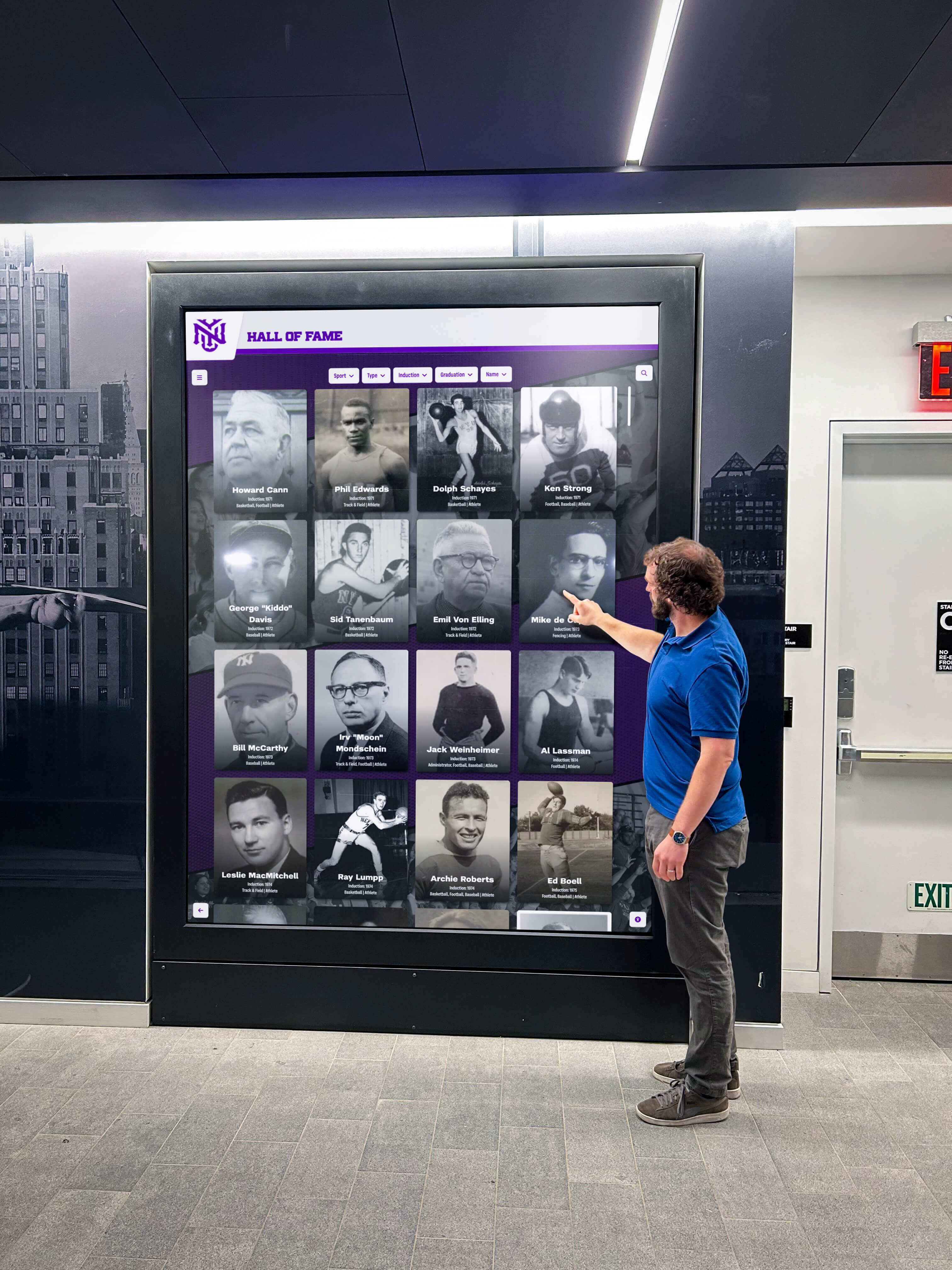
Families and visitors trust recognition displays to show accurate values — outlier detection is the final layer that catches implausible entries before they become visible to the public
Connecting Outlier Detection to the Broader Data Quality Program
Outlier detection is most effective when it operates as the final layer in a complete data quality stack, not as a standalone review practice. The layers that precede it determine how much work outlier detection must do.
Layer 1 — Field-level validation rules. Structural constraints at entry: character type, format, length, and approved value lists. Validation rules reject structurally invalid entries before they reach the database.
Layer 2 — Cross-field consistency checks. Logical constraints that compare related fields within the same record: temporal ordering, aggregation consistency, cross-reference resolution. These checks catch errors that are internally inconsistent but structurally valid.
Layer 3 — Outlier detection. Statistical and contextual checks against historical distributions and physical limits. Flags values that are internally consistent but contextually implausible.
Layer 4 — Pre-publication human review. A named reviewer examines flagged records against governing source documents and documents a disposition before publication is authorized.
Programs that begin implementation at Layer 3 without Layers 1 and 2 in place will find outlier detection noisy: the flag queue contains both genuine statistical outliers and structural errors that a validation rule would have caught at entry. Building the stack in order — validation first, consistency checks second, outlier detection third — produces a cleaner signal and a more actionable review queue.
For programs that have completed a full data quality audit of existing records and are now focused on preventing new errors from entering the system — the transition from remediation to prevention — the outlier detection framework in this guide fits naturally as the final pre-publication checkpoint in a comprehensive data governance program.
See How a Digital Platform Flags Outliers Before Publication
Rocket Alumni Solutions gives athletic directors a cloud-based recognition platform with approval workflows, audit trails, and publication controls that support pre-publication review — so unusual values are caught before they appear on any display channel.
Request a DemoFrequently Asked Questions
What is athletic award outlier detection?
Athletic award outlier detection is a pre-publication review process that flags award record values that are structurally valid but statistically or contextually unusual — performance scores outside historical distribution ranges, dates that violate calendar constraints, or aggregate totals that do not match their component records. Unlike field-level validation rules, which reject structurally invalid inputs at entry, outlier detection runs after records have been entered and approved, as a final check before values appear on recognition displays. The goal is to surface implausible values for human review before they are published, not to reject records automatically.
How is outlier detection different from data validation?
Data validation rules reject values that are structurally wrong: names containing numerals, dates in unsupported formats, award titles not found in the approved catalog. Outlier detection flags values that are structurally correct but contextually implausible: a correctly formatted performance time that is physically impossible for the event, a valid calendar date that falls outside the sport's competitive season, an aggregate total that does not match the sum of its component records. The two practices operate at different layers and catch different classes of error. Validation catches format errors at entry; outlier detection catches plausibility errors before publication. Both are necessary because each misses what the other catches.
What types of scores or values should trigger an outlier flag?
Three categories of values warrant outlier flags in school athletic award records. Performance scores should be flagged when they fall more than three standard deviations from the program's historical mean for that sport and event type, or outside sport-specific physical limit tables for programs with fewer than 30 historical records. Any score that would set or break a school record should be flagged for secondary governing-source verification regardless of statistical position. Date and season fields should be flagged when they violate calendar constraints — ceremony dates outside the expected seasonal window, graduation years outside a plausible range for active athletes, or cross-field temporal inconsistencies. Aggregate totals should be flagged when they differ from the calculated sum of their component records or exceed the prior program record by more than 30 percent.
Does an outlier flag mean the record is wrong?
No. An outlier flag means the value is unusual enough to require human review before publication — not that it is necessarily incorrect. Genuine record-breaking performances, unusual scheduling decisions, and legitimate edge cases will trigger outlier flags and be confirmed as correct after review. The distinction is that the reviewer confirms correctness against the governing source document and documents that confirmation in the record's audit trail. A flagged record that is reviewed, confirmed, and published with documentation is more trustworthy than an unchecked record that happened to fall within the expected range, because the confirmation step creates an explicit evidence trail for the value's accuracy.
How should programs handle outlier detection for historical records being digitized?
Historical records being digitized from paper sources should pass through the same outlier detection checks as new entries, with one adjustment: the resolution deadline for flagged historical records should be longer — typically five to ten business days — because the governing source documents may require archival research to locate. Programs should not bypass outlier detection for historical records on the assumption that older records have already been verified; paper archive digitization projects consistently surface date transpositions, unit mismatches, and aggregate calculation errors that were never caught in the original paper system. Flagging and resolving these errors during digitization is far less costly than correcting them after they have been published on permanent displays.
Conclusion: Catch the Implausible Before It Becomes Permanent
Athletic award outlier detection is the layer of data quality review that catches what format validation cannot: the correctly formatted value that is almost certainly wrong. A point total three standard deviations above the program’s historical average. A ceremony date scheduled before the season started. A career record that doubles the previous high. These values pass every structural check and reach the approval queue without a single error message — and without outlier detection, they reach the display the same way.
The programs that implement outlier detection before publication build recognition archives that families and athletes can trust, because every unusual value on the display was explicitly confirmed by a named reviewer who examined the governing source and documented their finding. That confirmation process takes minutes. Correcting a published error — notifying families, updating physical displays, issuing corrections to ceremony programs — takes far longer, and the credibility cost cannot be fully recovered.
Build Award Records That Stay Accurate from Entry to Display
Rocket Alumni Solutions gives athletic programs a cloud-based recognition platform with approval workflows, publication controls, and audit trails that support a complete pre-publication quality stack — from field validation through outlier review to display publication. Request a demo to see it in action.
Request a Demo