



Intent: research — an athletic awards canonical record policy defines which data source is authoritative when the same recognition arrives from multiple origins — a coach’s selection form, a conference results email, a booster club spreadsheet, or a direct CMS entry on a digital recognition platform. Without a canonical-record rule, multiple entries for the same athlete and the same honor accumulate across systems, and staff who encounter conflicting data have no documented basis for choosing which version to publish, display, or correct.
This guide is written for athletic directors, school administrators, IT and records staff, and facilities teams responsible for managing athletic recognition data. It provides a source-of-truth table that maps each record type to its designated canonical source, a conflict resolution workflow, guidance on preserving source notes without creating duplicate public profiles, and practical advice on connecting canonical-record governance to the digital display systems where award records become visible to students, families, and the broader community.
Award data arrives from many directions in a school athletic department. Coaches submit names at season’s end. Conference offices send results spreadsheets. Booster clubs enter inductions into shared drives. Staff members key nominations into a digital platform. Each source may provide slightly different spellings, different season labels, or different award titles for what is functionally the same recognition event. Without a canonical-record policy, the recognition program inherits all of those variations as competing truths — and every question about a specific record requires someone to compare multiple sources by hand to arrive at the answer that should have been documented from the start.

Every award record displayed in a recognition system carries a provenance question: which source document authorized this entry? A canonical-record policy answers that question before the first record is created
What Is an Athletic Awards Canonical Record Policy?
An athletic awards canonical record policy is a written document that designates one authoritative source for each category of athletic recognition data and specifies the rules that govern how conflicts between sources are detected, documented, and resolved. The policy does not prohibit information from arriving through multiple channels — in practice, that is unavoidable. It specifies, for each record type, which source’s version becomes the canonical record when the versions differ.
The policy covers three distinct governance needs:
- Source designation — for each type of award data (award winner name, season label, award title, governing date, athlete identification), which specific source document or system holds the canonical value
- Conflict resolution — what process staff follow when two sources disagree, and which source prevails under which circumstances
- Source note preservation — how non-canonical source data is retained alongside the canonical record without creating duplicate or conflicting public entries
A canonical-record policy is not the same as a data entry policy (which governs how data is keyed into a system) or a correction policy (which governs how published records are changed after errors are found). It specifically addresses the moment before a record is created — determining which incoming source data becomes the authoritative version that enters the recognition system as the single published truth.
Why Multiple Sources Create Recognition Data Problems
Athletic recognition data flows from more sources than most administrators realize. Consider a single season-end award: the coach selects a winner and submits a form; the athletic office logs the award for the school’s internal records; a conference office publishes results to all member schools; the booster club mentions the award in a newsletter; a family member asks for the athlete’s name to be added to the lobby display; and a staff member enters the record directly into the digital recognition platform using the name from memory. Each of these touches represents a potential variation — in spelling, in award title phrasing, in season format, or in the level of detail attached to the recognition.
The specific problems that emerge without a canonical-record policy include:
- Duplicate public profiles — the same award appears twice on a display or in an archive, each under a slightly different athlete name or season label, with no documented process for resolving which is correct
- Conflicting display values — a digital platform surfaces one version of an athlete’s name while a printed program or physical plaque carries another, and neither staff member responsible for each channel has authority to make the other conform
- Unresolvable correction requests — an athlete or family member requests a name correction, but the athletic office cannot determine which of three different source versions is the one the institution holds as authoritative
- Search and query failures — a query for all award recipients in a given sport or season returns incomplete results because equivalent records carry different season labels or award title formats across subsystems
These problems are compounded by staff turnover. A policy that exists only as institutional memory — “we always use the conference results email as the master” — dissolves when the staff member who held that knowledge leaves. A written canonical-record policy converts that knowledge into a documented standard that survives turnover.

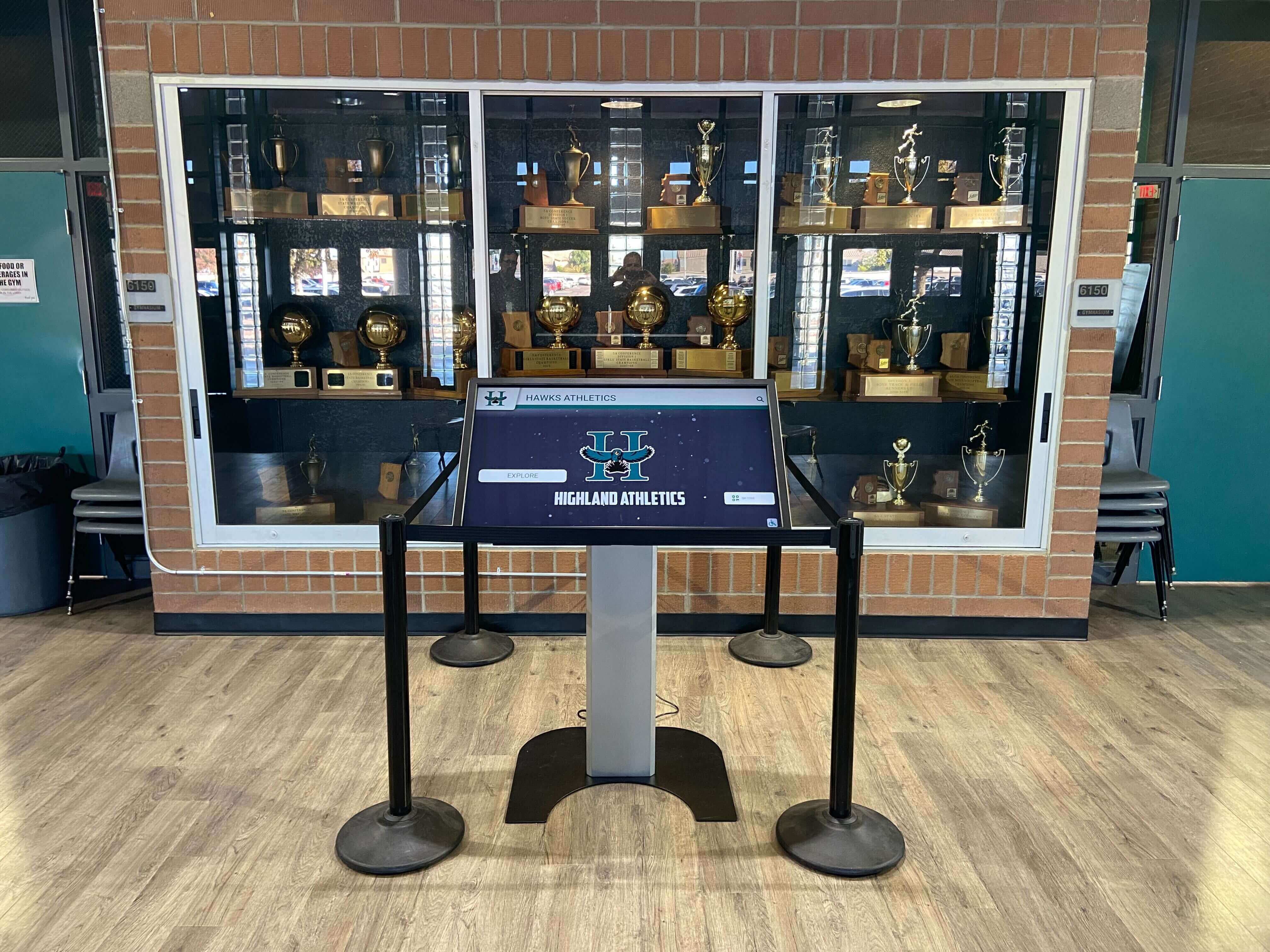
When physical and digital display channels carry the same canonical record, a visitor comparing the lobby plaque to the touchscreen display finds consistent information — the canonical-record policy is what makes that consistency reliable
The Source-of-Truth Table
The source-of-truth table is the operational core of an athletic awards canonical record policy. It maps each category of recognition data to its designated canonical source, names the secondary sources that may be retained as source notes, identifies the staff role responsible for resolving conflicts in that category, and states the conflict rule that applies when sources disagree.
| Record Type | Canonical Source | Secondary Sources (Note Only) | Owner Role | Conflict Rule |
|---|---|---|---|---|
| Award winner name | Coach’s official selection form (signed, dated) | Roster, booster submission, family request | Athletic director | Coach form prevails; secondary spelling noted in source log |
| Athlete identification (legal name, SIS match) | Student information system (SIS/SRS) record | Media guide, nomination form, display request | Registrar / athletic office | SIS record prevails for legal name and ID; display name preference captured as a separate field |
| Award title | School-approved award taxonomy | Conference award name, booster label, informal coach title | Athletic director | Taxonomy value prevails; external title retained as source alias in record notes |
| Season label | Athletic department season calendar | Conference schedule, school academic calendar | Athletic director | Department calendar format prevails; external format noted if it differs |
| Award governing date | Conference or governing body results communication | Coach announcement date, program event date, induction ceremony date | Athletic director | Governing body communication date prevails; ceremony date retained as display date if different |
| Hall of fame induction | Induction committee signed vote record | Nomination form, booster recommendation, public announcement | Principal or AD | Signed vote record prevails; nomination materials retained as supporting documentation |
| Record board performance metric | Official game/meet results from governing body | Coach-submitted stat, scorebook entry, media report | Athletic director / records keeper | Governing body result prevails; disputed values held in pending status until governing body confirms |
| Award category classification | School award taxonomy (same source as award title) | Conference category grouping, sport-specific category | Athletic director | School taxonomy prevails; cross-system category noted for display configuration |
Using the Table in Practice
The source-of-truth table is not a flowchart — it does not require staff to trace through decision trees for routine entries. For the large majority of records, the canonical source arrives first and alone: a coach submits a selection form, the athletic office logs it, and the entry is created from that single authoritative document. The table becomes operational when a secondary source arrives with a different value.
When a booster club submission lists an athlete’s name spelled differently than the signed coach’s form, staff do not need to evaluate which version is “probably right.” The policy designates the coach’s form as canonical; the booster submission’s spelling is logged as a source note. When a conference results email arrives with an award title that uses different phrasing than the school’s taxonomy, the taxonomy value is entered as the canonical award title and the conference phrasing is preserved in the source notes field.
The source notes field is not a correction queue — it is a provenance record. It documents that multiple sources were received and indicates which values they carried, without elevating any non-canonical value to display-eligible status.

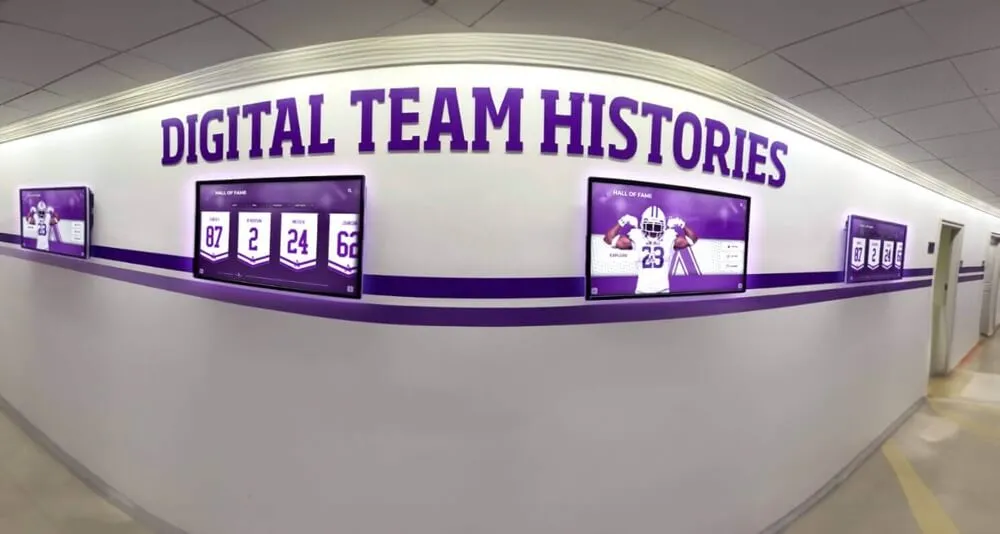
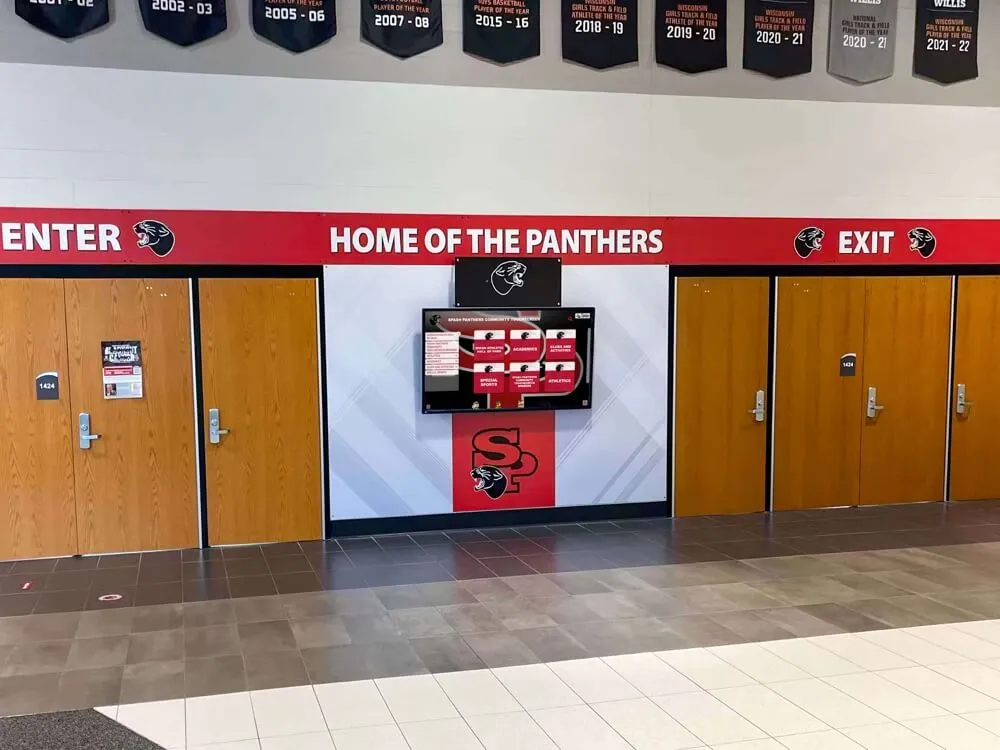
Consistent season labels and team names on a hallway display depend on a source-of-truth table that designates which system's format is canonical — without it, every staff member makes a formatting judgment independently
Designating Canonical Sources: Four Principles
Choosing the right canonical source for each record type requires applying consistent principles. Schools that designate canonical sources arbitrarily — or that switch designations informally over time — replicate the inconsistency the policy was meant to solve. The following four principles provide a framework for source designation decisions.
1. Prefer the Source Closest to the Governing Authority
For awards where a governing body — a conference office, a state athletics association, or a district organization — publishes official results, that communication is the strongest canonical candidate. Governing body results are documented, versioned, and typically final within a defined appeals window. Coach-submitted data, while valuable, reflects a single program’s perspective and may contain transcription errors or informal values that the governing body’s record corrects.
2. Prefer the Source with the Highest Verification Trail
A signed, dated form carries more verifiable weight than a phone call, an email without an attachment, or a remembered conversation. When designating canonical sources, prefer documents that have a clear chain of custody: submitted on a specific date, by a specific person with named authority, in a format that can be retrieved and compared if a dispute arises.
3. Separate Display Preferences from Canonical Data
Athlete identification is one of the most common tension points in canonical-record policy because athletes may prefer a name different from their legal name in the student information system. The policy should address this explicitly: the SIS record is the canonical source for legal name and record matching, but the recognition system may carry a separate display name field where a preferred or shortened name is stored. The display name does not replace the canonical legal name — it supplements it. Both values are preserved; only one is used for identity matching.
For programs building out comprehensive recognition systems, interactive hall of fame tools for athletics, donors, and arts covers the platform capabilities that support separate canonical and display name fields within a unified recognition record.
4. Assign Explicit Role Ownership for Each Domain
A source-of-truth table with no named owner produces a policy that everyone defers to and no one enforces. Each row in the source-of-truth table should name a specific staff role — not an individual by name, but a role title — as the resolver for conflicts in that record domain. When a conflict is escalated, it goes to the role owner. That role owner applies the conflict rule from the table and documents the resolution. Ownership by role, rather than by name, survives staff turnover.
Conflict Resolution Workflow
When two sources provide different values for the same record field, the canonical-record policy triggers a four-step conflict resolution workflow.
Step 1 — Flag the conflict. When a secondary source arrives with a value that differs from the canonical source on a record already created or in the creation queue, the staff member who receives the secondary source flags the conflict in writing. The flag includes: which record is affected, which field is in conflict, what value the canonical source carries, what value the secondary source carries, and the date the conflict was identified.
Step 2 — Route to the role owner. The conflict is routed to the staff role designated as owner for that record type in the source-of-truth table. Routing should follow a documented channel — an email to a designated address, a queue in the recognition system, or a shared tracking log — not an informal verbal discussion.
Step 3 — Apply the conflict rule. The role owner applies the conflict rule from the source-of-truth table. In the large majority of cases, the rule names the canonical source as prevailing and the secondary source as a note. In cases where the conflict rule requires judgment — for example, a performance metric where both the governing body and the coach’s scorebook may contain errors — the role owner documents the basis for the determination before any record value is changed or confirmed.
Step 4 — Document and close. The resolution is documented in the record’s source log: which conflict rule was applied, what the prevailing value is, what the non-canonical value was and where it came from, and the name and date of the role owner who resolved it. The conflict is marked closed. If the resolution resulted in a change to an already-published record, the correction workflow is triggered for that record separately from the conflict resolution.

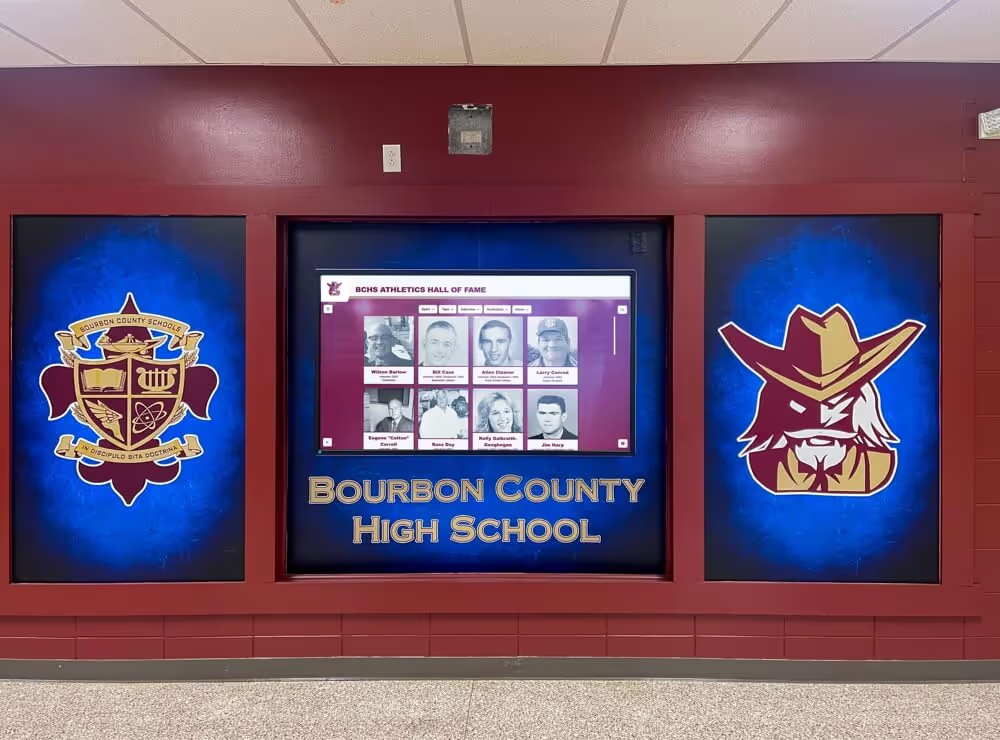
Visitors browsing a recognition display have no visibility into the source data behind each profile — they see the result of the canonical-record process as a clean, consistent, trustworthy presentation of the institution's recognition history
Preserving Source Notes Without Creating Duplicates
One of the most practical challenges in canonical-record governance is ensuring that non-canonical source data is retained for accountability purposes without becoming a second public-facing record. Source notes that are stored in a field visible to the recognition system’s display layer can surface as conflicting information if the platform treats every field as displayable content.
The policy should specify:
- Source notes are stored in a non-display field. The recognition system should have a designated notes or provenance field that is accessible to administrators but excluded from public display outputs. If the current platform does not support non-display administrative fields, source notes should be maintained in a separate log linked to the record by its unique identifier.
- Source notes do not trigger new record creation. A secondary source that arrives for an existing record updates the source notes field of that record — it does not create a new, parallel record. Staff who receive secondary sources should be trained that their role is to route the information to the existing record’s provenance log, not to create a new entry.
- Source notes are retained permanently. Because a dispute about an award record may arise years after the original entry, source notes should be treated as permanent components of the record rather than temporary staging data. Clearing source notes after a conflict is resolved removes the evidence trail that proves how the conflict was handled.
For programs that use touchscreen display systems and need to configure which data fields appear in public-facing views, hall of fame tools and display platform overviews describe how modern platforms separate administrative data fields from the content that appears on visitor-facing screens.
Connecting Canonical Records to Digital Displays
The canonical-record policy governs data before it reaches the display layer — but the display layer is where its effects become visible. A digital recognition platform that surfaces records from a well-governed canonical system presents visitors with clean, consistent profiles: athlete names spelled correctly and consistently, season labels formatted uniformly, award titles that match the school’s approved taxonomy, and no duplicate entries for the same recognition event.
When the canonical-record process is not working, the display layer reveals it. Duplicate profiles for the same athlete — one from a coach’s form entry and one from a booster club submission — appear as separate cards on a touchscreen display without any explanation of which is authoritative. Award titles that reflect informal coach labels rather than approved taxonomy values appear alongside formally named awards in a way that creates an uneven presentation of the institution’s recognition history.
Digital recognition platforms that support remote content management allow athletic administrators to apply canonical-record updates from any location. When a conflict resolution results in a field value change, the corrected canonical value can be published across all connected display channels simultaneously — the lobby touchscreen, the school website’s recognition page, and any remote access point — without requiring on-site IT involvement. Auto-ranking record boards that pull from the canonical dataset automatically reflect corrected values as soon as the authoritative record is updated.
For programs comparing display platforms for recognition governance capability, digital awards display platform reviews and comparisons provide feature-level assessments of how different systems handle record management, field-level access controls, and multi-channel publishing.
The connection between canonical-record governance and accessibility is also worth noting. Recognition platforms that are ADA WCAG 2.1 AA compliant ensure that the canonical record data — once governed and published — is accessible to all visitors, including those using screen readers, alternative navigation devices, or high-contrast display modes. Accessibility compliance at the display layer depends on accurate, well-structured data at the record layer; a canonical-record policy is part of the upstream infrastructure that makes accessible public display possible.

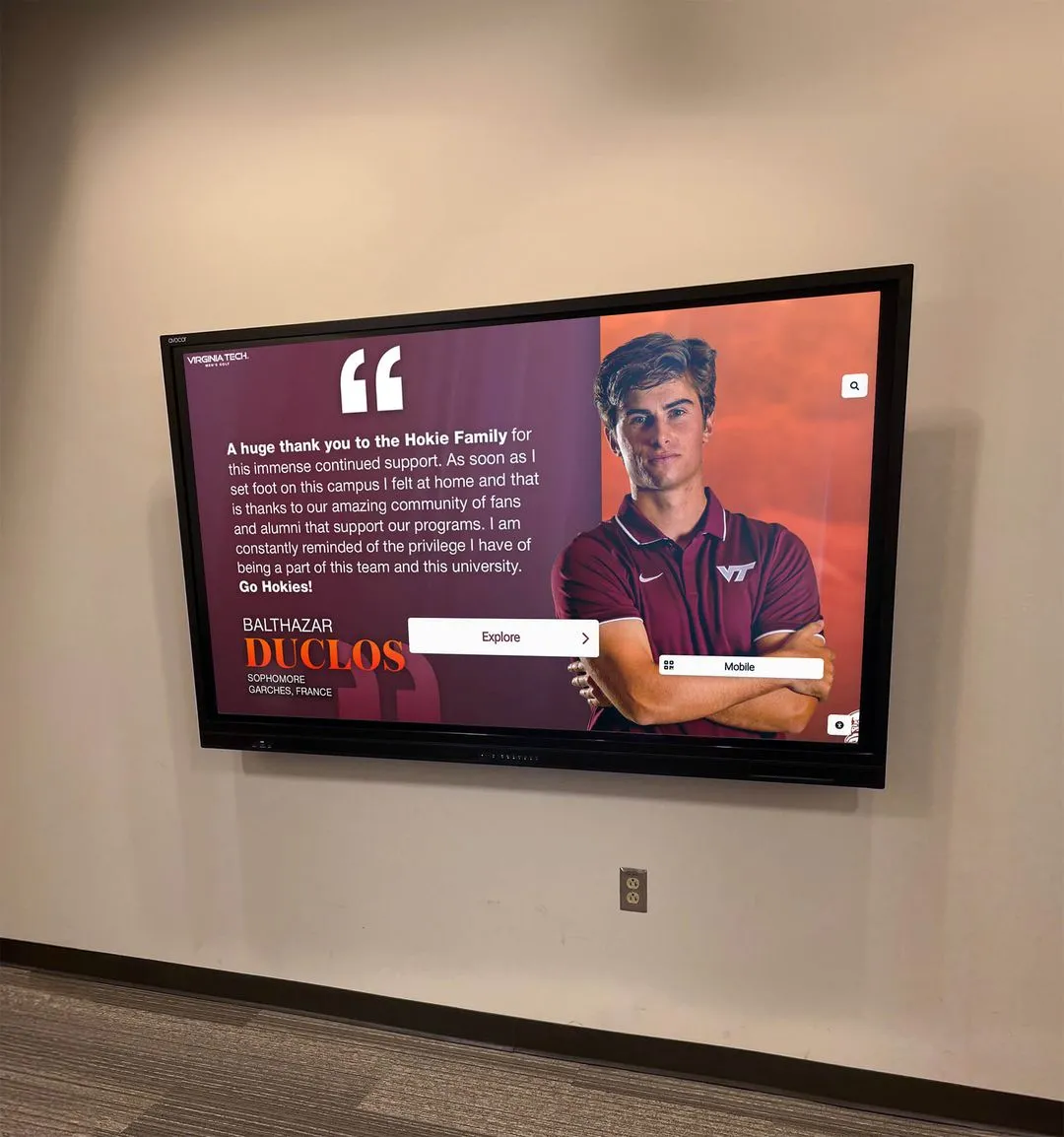
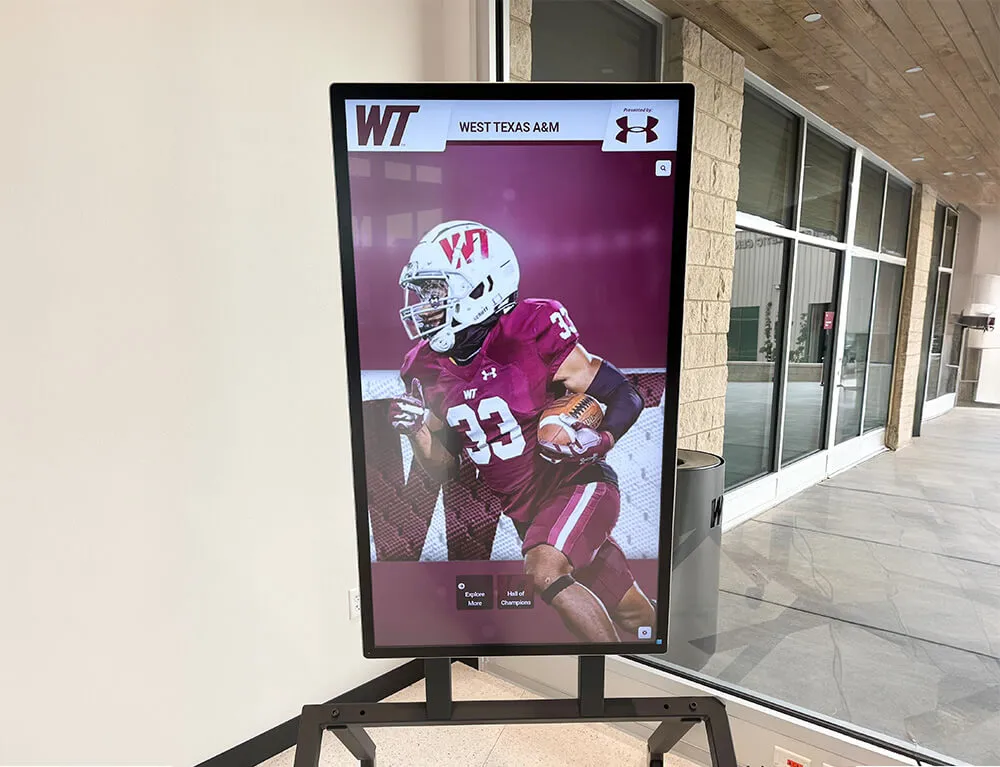
Each athlete card on a touchscreen display represents a single canonical record — the source-of-truth table behind the system determines which data source authorized the name, award, and season information shown to every visitor
Cited Reference Points
The governance literature on canonical-record management comes primarily from information management and library science, where the distinction between authoritative records and source variants has been formalized under terms such as authority control and bibliographic record standards. Schools applying these principles to athletic recognition data are extending a well-established framework into a domain where formal documentation has historically been thin.
According to the Society of American Archivists’ Describing Archives: A Content Standard (DACS), authoritative records require clear provenance documentation — identification of the source from which the record was derived and the chain of custody through which it was received. Applying this standard to athletic awards means that every canonical record should carry, at minimum, a source identifier, a receipt date, and the name of the role that authorized the canonical designation.
The data quality framework published by DMARC (Data Management Association International) defines canonical records as records that represent the single agreed-upon, authoritative version of a business entity — in this case, a recognition event — and specifies that canonical records should be maintained in a system of record distinct from operational data streams that may carry variant versions. For school athletic departments, this framework supports the practice of designating the athletic office’s recognition system (or a specific module within a digital platform) as the system of record, with all other sources treated as input streams subject to the canonical-record policy.
Implementing the Policy: A Starting Checklist
Before a canonical-record policy is operational, the following foundational elements should be in place:
- Source-of-truth table drafted and reviewed by athletic director, registrar, and IT or records staff
- Each record type in the table has a named role owner and a documented conflict rule
- Non-display source notes field identified or created in the recognition system
- Staff who receive award data from external sources have been trained on the routing workflow
- Conflict flagging process documented (which channel, which tracking format, which escalation path)
- Source note retention policy documented (permanent, non-clearable after conflict resolution)
- Policy review cycle established (annual review recommended, or following any platform migration)
- Policy stored in the athletic office’s governance document repository with effective date and version number
For schools building the broader data governance infrastructure within which a canonical-record policy sits, hall of fame display systems for academic and athletic recognition provide context on how recognition platforms manage layered data governance across individual records, categories, and seasons.
Programs that have already established reference data standards for team names, season labels, and award titles — the controlled vocabulary layer — will find canonical-record policy implementation faster, because the source-of-truth table can reference approved taxonomy values directly rather than needing to define acceptable formats at the same time. Programs without reference data standards may want to establish those first, since the canonical-record policy depends on knowing what the correct values look like before it can designate which source produces them.
For programs working through digital display platforms that surface recognition data publicly, hall of fame display and recognition wall platform comparisons outline the administrative and content management features that support policy-governed record publication across multiple display channels.

Long-standing recognition programs accumulate award records across decades and staff generations — a canonical-record policy is the governance layer that keeps that history internally consistent without requiring institutional memory to hold it together
Frequently Asked Questions
What makes an athletic award record “canonical”?
A record is canonical when it has been created from the designated authoritative source for its record type, as defined in the source-of-truth table, and when any conflicts with secondary sources have been resolved and documented. Canonical status is not automatic — it requires that the creating staff member identified and used the correct source and that no unresolved conflicts are flagged against that record. A record that was created from a secondary source by mistake, or that has an open conflict flag, is not yet canonical even if it appears in the recognition system.
What happens when the canonical source contains an error?
When the designated canonical source itself contains an error — for example, a coach’s selection form with a misspelled athlete name — the record should be created from the canonical source as received and then a correction request should be initiated following the program’s separate correction policy. The correction workflow documents the error, obtains a corrected value with authorization from the role owner, and updates the published record. The source notes field should record both the original canonical value and the corrected value with the basis for the correction. This keeps the canonical-record policy and the correction policy separate: canonical designation is about which source to trust; corrections are about what to do when even the trusted source is wrong.
How should the policy handle award records that predate the policy?
Records that were created before the canonical-record policy was established should be flagged for a retrospective audit rather than left in their current state. The audit applies the source-of-truth table retroactively: for each legacy record, which canonical source documents exist, do they agree with the recorded values, and are there unresolved conflicts between sources? Records that pass the audit are marked as retrospectively canonicalized. Records with unresolved discrepancies are flagged for role-owner review before being accepted as canonical. The audit scope can be phased — starting with the most actively displayed records (hall of fame inductions, all-time records) before moving to seasonal award records from prior years.
Can a canonical source be changed after the policy is adopted?
Yes, but only through a formal policy amendment process that documents the reason for the change and applies the new designation prospectively to new records. Legacy records created under the prior designation should be marked in the source notes field to indicate which canonical source governed them at the time of creation. Changing a canonical source designation without documentation creates exactly the ambiguity the policy was designed to prevent — staff working with older records would have no way to know which source was authoritative at the time each record was created.
Does a canonical-record policy conflict with an athlete’s right to request name corrections?
No. The canonical-record policy governs which source determines the initial record value — it does not prevent corrections. An athlete’s request for a name correction follows the program’s correction policy, which specifies the authorization and documentation requirements for changing a published value. The canonical-record policy and the correction policy work in sequence: the canonical-record policy governs creation, and the correction policy governs changes after publication. Both policies should acknowledge the display name distinction — an athlete may have a preferred name different from the SIS legal name, and that preference should be documented in a designated display name field rather than overwriting the canonical legal name field.
An athletic awards canonical record policy resolves the governance gap between data that arrives from multiple sources and the single authoritative recognition profile that should represent each award in public display. With a source-of-truth table, a documented conflict resolution workflow, and a staff training process for routing non-canonical data into source notes rather than parallel records, athletic departments can maintain recognition systems where every displayed record carries clear provenance and every staff member working with award data shares the same documented standard.
If your program is building or updating its recognition governance infrastructure and evaluating digital display platforms that support canonical-record management through remote CMS access, role-based field controls, and multi-channel publishing, schedule a custom demo with Rocket Alumni Solutions to see how governed recognition data translates into a consistent, accessible display experience across every channel where your athletes’ achievements are shared.