



Intent: research — an athletic awards database exclusion constraint policy defines the rules for preventing overlapping season boundaries, duplicate honor assignments, and conflicting award records from entering a recognition database in the first place. An exclusion constraint is a database-layer rule that compares a new or updated record against existing records and blocks the write if specified field combinations would overlap or collide — catching integrity violations at the point of entry, before corrupted data reaches a recognition display, a championship banner, or a hall of fame archive.
This guide is written for athletic directors, school administrators, IT and database teams, archivists, and recognition-program owners who maintain structured award records over multiple seasons. It covers what exclusion constraints are, the four most common overlap failures in athletic award databases, the six components of a complete exclusion constraint policy, a six-step implementation sequence, a readiness checklist, and a focused Q&A section on the most common policy questions.
Season boundaries matter in athletic recognition. A player wins Most Valuable Player in the 2023 fall season. The award record is entered. Months later, a data-entry correction opens the same sport-season-award combination and inadvertently creates a second MVP entry for 2023 — or extends the 2023 season boundary so it now overlaps with the 2024 season’s records. Neither error is obvious at the field level. Both errors corrupt the historical archive that feeds every downstream display, from the trophy case kiosk to the championship banner to the digital hall of fame. An athletic awards database exclusion constraint policy is the governance framework that prevents those overlaps from entering the system at all.

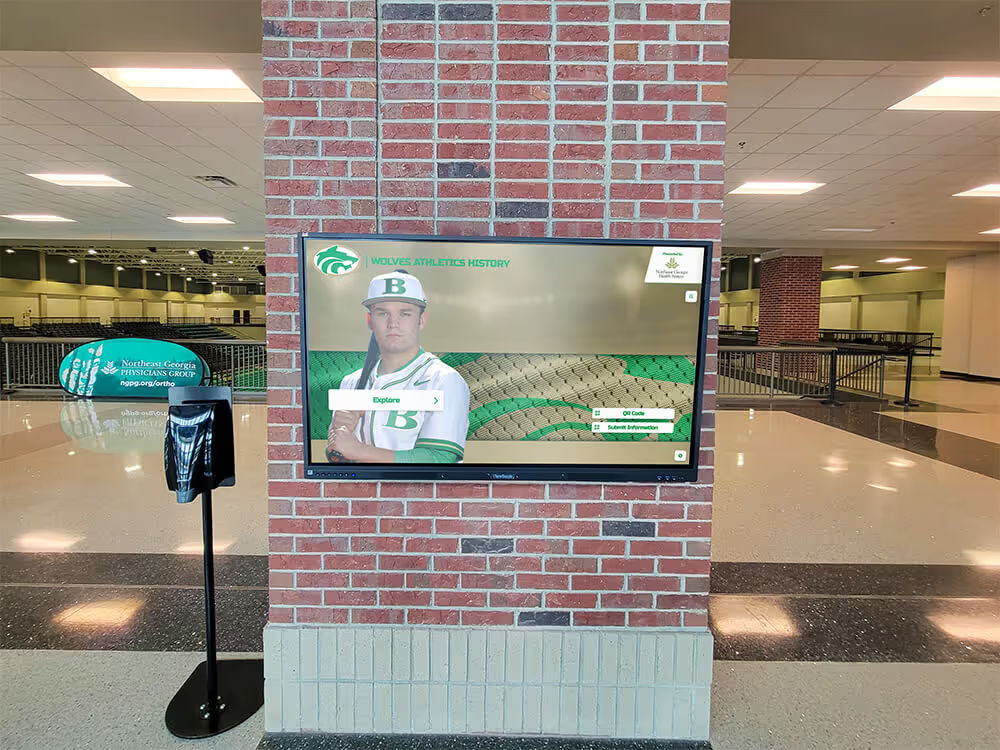
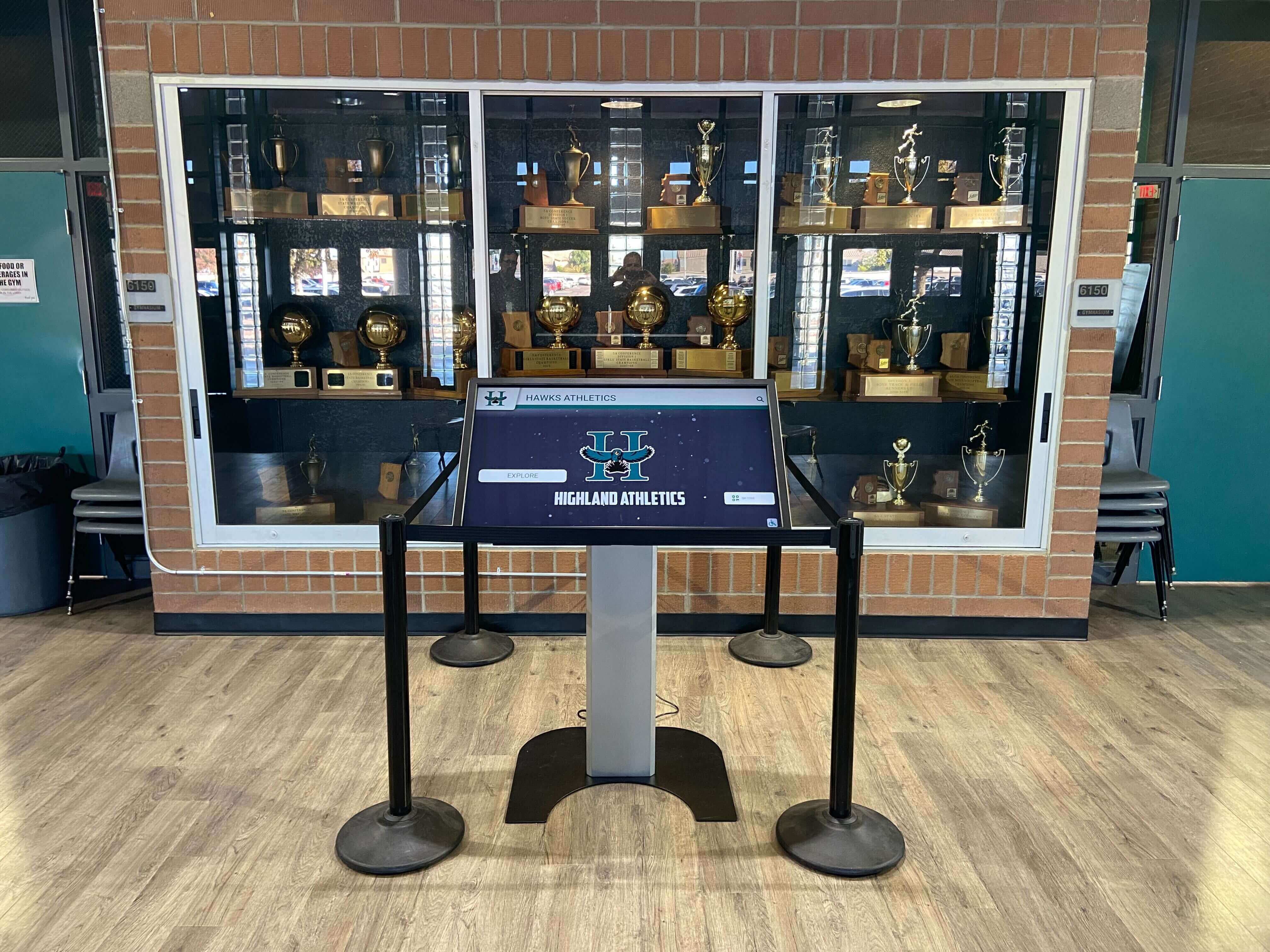
Trophy case kiosks display recognition records built from database records — exclusion constraints are the layer that prevents overlapping seasons and duplicate honors from reaching those displays in corrupted form
What Is an Exclusion Constraint in an Athletic Awards Database?
An exclusion constraint is a database integrity rule that prevents two records from sharing the same value, or overlapping range, for a specified combination of fields. Unlike a uniqueness constraint — which simply prevents two records from having identical values in a single field — an exclusion constraint evaluates whether two records’ field values conflict according to a defined operator, typically an overlap or equality check across multiple fields simultaneously.
In an athletic awards context, the most common exclusion constraint checks whether a new award record’s season range overlaps with an existing record’s season range for the same sport and award category. If the constraint finds an overlap, the database blocks the write and returns an error before any data is committed. The check happens automatically, at the database layer, regardless of which interface or application submitted the record.
A practical example: if the varsity basketball Most Valuable Player award for the 2023-2024 season is already recorded, an exclusion constraint on (sport, award_title, season_range) prevents anyone from entering a second MVP record whose season range touches 2023-2024 — whether the second entry is an honest duplicate, a data-migration artifact, or an erroneous boundary extension from a correction workflow that went too far.
The distinction between standards-based and practical matters here. SQL databases that support range types (such as PostgreSQL’s daterange and tsrange types with GiST indexing) can enforce exclusion constraints natively using the EXCLUDE USING syntax. Many school records systems and purpose-built athletic recognition platforms do not expose this native capability directly — making a written policy that defines equivalent application-layer validation rules equally important for programs that cannot implement exclusion constraints at the SQL layer.
Why Overlapping Seasons Corrupt Recognition Records
Recognition archives are sequential by design. Each season has a defined start and end. Each award within a season has a single rightful recipient (or a defined set, in the case of team awards). When season boundaries overlap in the database, the sequential structure breaks — and so does every downstream process that depends on it.
The display layer cannot resolve ambiguous seasons. When two records claim the same sport-season-award combination, a recognition display must choose one to show. Most platforms display whichever record was entered most recently or has the highest system-assigned ID — not whichever is historically correct. The result is that the wrong record appears on a lobby touchscreen, a championship banner archive, or a hall of fame screen, with no visible indication that a conflict exists in the underlying data.
The records board cannot determine the authoritative season. Athletic programs that maintain all-time records boards — tracking top performances by season and category — depend on clean season boundaries to rank entries correctly. An overlapping season creates ambiguity in which season a performance belongs to, and with it, ambiguity in whether the performance should appear on the current season’s records or a prior one.
Championship recognition depends on non-overlapping season claims. Championship banners, trophies, and plaques represent seasons as bounded, non-overlapping units of competition. When the database records that anchor those displays have overlapping boundaries, the display layer is working from a foundation that does not match the competitive record it is meant to commemorate. For programs that display high school championship banners alongside interactive digital recognition, the database must accurately reflect which season each championship belongs to — an accuracy that exclusion constraints protect at the point of entry.
Four Common Overlap Failures in Athletic Award Records
Understanding where overlaps originate helps programs design exclusion constraint policies that address the actual failure modes they encounter, not a theoretical set. Four patterns recur across school athletic programs of every size.
1. Season Boundary Drift During Corrections
The most common source of overlapping season records is a correction workflow that adjusts a season’s end date without checking whether the new boundary encroaches on an adjacent season’s records. An athletic director extends the 2023-2024 season end date from June 2024 to September 2024 to capture a late-posted result. September 2024 is also within the 2024-2025 season boundary. The database now contains records for two different seasons that overlap at September 2024 — with no alert raised because the correction was applied to a single field in a single record.
2. Data-Migration Duplicates
When programs migrate records from a legacy system — a spreadsheet, a prior platform, a manual archive — duplicate records frequently enter the destination system with slightly different field values. Two entries for the same sport, season, and award may have different capitalization, slightly different season-year formats (“2023-24” versus “2023-2024”), or a one-day boundary difference that places them in technically non-overlapping but practically identical date ranges. An exclusion constraint with appropriate operator definitions catches all of these as conflicts; a uniqueness constraint on a single formatted string field catches only the exact-match case.
3. Retroactive Honor Insertions
Programs that add historical awards retroactively — recognizing athletes from decades-old seasons whose records were never formally entered into a digital system — create insertion conflicts when the retroactive season boundaries are not precisely defined. A retroactive record for a 1998-1999 season that is entered with a boundary of January 1, 1999 to December 31, 1999 overlaps any record for a 1999-2000 season that was entered with a start date before January 1, 2000. For programs that maintain interactive museum-style displays covering multi-decade histories, retroactive insertion accuracy is especially critical — the archive may span 40 or 50 seasons, each of which must be cleanly bounded.
4. Multi-Sport Athlete Record Conflicts
Athletes who compete in multiple sports during the same academic year can have records that appear to overlap when sport-specific season fields are not properly scoped. A cross-country runner whose fall season ends in November and a basketball player whose winter season begins in November may be the same person — with two records that share the same athlete identifier and an apparent season-boundary overlap if the constraint is defined without a sport qualifier. A well-designed exclusion constraint policy specifies which field combinations constitute the overlap check — typically (athlete_id, sport, award_category, season_range) — so that legitimate multi-sport participation is not blocked as a false-positive conflict.
Six Components of an Exclusion Constraint Policy
A complete athletic awards database exclusion constraint policy addresses six areas. Each component should be documented in the written policy so that platform configuration and manual validation procedures can be aligned consistently across staff changes and system migrations.
1. Constraint Scope Definition
The policy specifies which record types are subject to exclusion constraint checks. In most programs, the relevant record types include: seasonal athletic awards (MVP, all-conference, captain designations, statistical leaders), championship season records (team titles, conference championships, tournament wins), and hall of fame induction cohorts (which must not overlap year-of-induction boundaries).
The policy should list the applicable record types explicitly, not leave them to inference, so that new record categories added in future seasons are evaluated against the scope definition before they go live — not after a conflict is discovered in production.
2. Overlap Field Specification
The policy defines which field combinations are evaluated by the exclusion check. For seasonal awards, the standard combination is (sport, award_category, season_range). For athlete-specific honors, the combination extends to (athlete_id, sport, award_category, season_range). For team awards, (team_identifier, award_category, season_range) is the appropriate scope.
The field specification also defines how “season_range” is represented — whether as a structured date range, a (start_year, end_year) integer pair, or a formatted string — and what operator governs the overlap test. Date ranges evaluated with the “overlaps” operator are the most precise. Integer-pair comparisons require explicit policy language for how boundary-year equality is treated (does a season ending in 2024 overlap one starting in 2024?).
3. Conflict Detection Point
The policy specifies at which stage of the record workflow the exclusion check occurs: at data entry (before the record is created), at correction submission (before an edit is committed), at migration import (before each batch record is written), or at all three. The recommended standard is to enforce the check at all three stages — because migration imports and correction workflows are the highest-risk entry points for overlap failures, and checking only at initial data entry leaves those workflows unprotected.
4. Conflict Notification Requirements
When an exclusion constraint blocks a write, the system must surface a notification that gives the submitting staff member enough information to understand what conflict was detected and what to do next. The policy defines the minimum notification content: the field combination that triggered the conflict, the existing record that the new or updated record conflicts with, the season boundaries in both records, and the name or role of the staff member who should review the conflict.
A notification that says only “Record rejected — constraint violation” without identifying the conflicting record is insufficient. Staff who cannot identify the source of the conflict will either abandon the correction workflow or submit the record through a bypass mechanism — both outcomes that defeat the purpose of the constraint.
5. Resolution Authority
When an exclusion constraint flags a conflict, someone must decide which record is authoritative — and that decision must be documented before either record is modified. The policy defines who holds resolution authority for each conflict type: the athletic director for seasonal awards, the registrar for athlete-identification conflicts, the IT administrator for migration-origin duplicates.
The resolution authority is not the same as the person who submits the correction. A staff member who enters a record that triggers a conflict should not have the authority to override the constraint unilaterally. Resolution authority requires a deliberate review of both the conflicting record and the new submission, a documented decision, and a logged resolution action. For programs that also track swim team records and multi-season competition histories, where season boundaries are particularly tight and records accumulate across many consecutive years, defining resolution authority clearly prevents ad-hoc overrides from bypassing the constraint without documentation.
6. Bypass and Override Logging
No exclusion constraint policy is complete without a bypass protocol — because legitimate edge cases exist where a constraint must be overridden by an authorized administrator. The policy defines the conditions under which a bypass is permitted, who can authorize it, and what documentation is required before the override is logged.
Bypass logging must capture: the record that triggered the constraint, the conflict that was detected, the name and role of the staff member who authorized the bypass, the stated reason for the override, and the date and time of the authorization. Without this log, the database contains records that exist outside the normal constraint rules with no audit trail explaining why — a gap that can complicate future governance reviews and make it impossible to distinguish intentional exceptions from undetected errors.

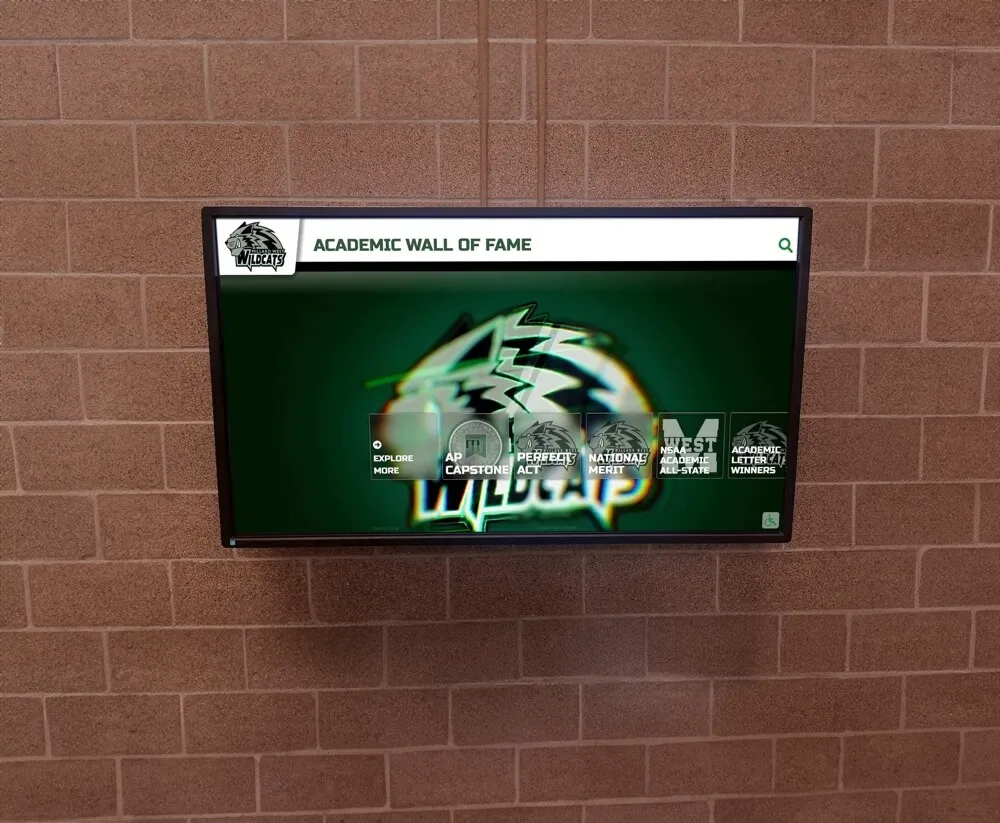
Each profile displayed on a touchscreen hall of fame represents a record whose season boundaries must be cleanly non-overlapping — exclusion constraints enforce that boundary integrity at the data layer before any profile reaches a public-facing screen
Implementing an Exclusion Constraint Policy: Six Steps
The following sequence is designed for programs establishing exclusion constraint governance for the first time. Programs already using uniqueness constraints on individual fields can enter at Step 2.
Step 1 — Audit existing records for boundary overlaps. Before implementing forward-looking constraints, identify existing overlap failures in the current database. A targeted query that groups records by (sport, award_category) and checks for season-range overlaps within each group reveals existing conflicts that the new policy must address before it can be enforced. Programs that have migrated records from legacy systems typically find the highest concentration of overlaps in the migrated dataset rather than in records entered natively into the current platform.
Step 2 — Define season boundaries as structured ranges, not formatted strings. Overlap detection is most reliable when season boundaries are stored as structured date ranges — a start date and an end date — rather than as formatted strings like “2023-2024.” Formatted strings require exact-match parsing to detect overlaps and will miss boundary conflicts caused by format inconsistency. If the current system stores seasons as formatted strings, the policy should specify a migration to structured date-range storage as a prerequisite for automated constraint enforcement.
Step 3 — Configure constraint checks at all three write stages. Implement exclusion constraint checks at data entry, correction submission, and migration import. If the platform does not support native exclusion constraint enforcement, configure application-layer validation rules that run the equivalent check before each write is committed. Document the validation rules in the policy alongside the platform configuration that implements them, so that future platform migrations include the constraint requirements as a specification, not an afterthought.
Step 4 — Define conflict notification templates. Write the notification text that staff will see when an exclusion constraint blocks a write. The template should include the conflicting record’s ID, the season range of each conflicting record, the award category and sport, and the name of the resolution authority to contact. Test the notification against three simulated conflict scenarios — a duplicate entry, a boundary-drift correction, and a migration import — before going live.
Step 5 — Assign resolution authority by conflict type. Document the resolution authority matrix in the written policy. For each record type covered by the constraint scope, name the role that holds resolution authority — not a specific person, but a role, so the policy remains valid through staff changes. Establish a resolution timeline: conflicts should be reviewed and resolved within a defined window (commonly three to five business days) to prevent a blocked correction from stalling a display update that is already overdue.
Step 6 — Establish the bypass log and review cycle. Create the bypass log format before any bypass is needed. Review all bypass log entries at a defined interval — quarterly is a reasonable starting point for programs with moderate record volumes — to identify whether any constraint is being routinely bypassed due to a policy gap (a legitimate record type the constraint was not designed to accommodate) or a data quality problem (a systematic boundary error in one category that requires a bulk correction before the constraint can apply cleanly).
For programs managing recognition records across multiple formats — digital kiosk archives, printed yearbook histories, and trophy-case plaques — consistent season definitions across all formats are a prerequisite for exclusion constraint enforcement to be meaningful. Digital yearbook archives and their relationship to athletic recognition records illustrates how records that appear in multiple formats must share a common season definition to remain consistent across all display channels.
See Award Records With Built-In Data Integrity Protection
Rocket Alumni Solutions provides cloud-based recognition platforms with built-in data integrity controls — including application-layer conflict detection, multi-channel publication logging, and correction workflows that prevent overlapping records from reaching your displays. Request a demo to see the platform's governance capabilities in action.
Request a DemoExclusion Constraint Policy Readiness Checklist
Use the following checklist to assess the current state of exclusion constraint enforcement before formalizing a written policy. Each item represents a specific practice that should be verified in the current records system and platform configuration.
Season Boundary Configuration
- Season records include a structured start date and end date, not only a formatted string label
- Season boundaries are consistently defined across all sport categories
- Season-boundary format is documented in the data dictionary used by all staff entering records
Constraint Enforcement
- Exclusion or overlap check runs at data entry before a new award record is created
- Exclusion or overlap check runs at correction submission before an edit is committed
- Exclusion or overlap check runs at migration import before each batch record is written
- Conflict notification includes the conflicting record ID, field values, and resolution authority
Resolution Workflow
- Resolution authority is defined by role for each applicable record type
- Resolution timeline is documented (number of business days from conflict detection to resolution)
- Resolution decisions are logged with date, authorizing party, reason, and outcome
Bypass Protocol
- Bypass conditions are defined explicitly in the written policy
- Bypass authorization requires a named senior role, not any staff member
- Bypass log captures all required fields before the override is committed
- Bypass log is reviewed at a defined interval (quarterly recommended)
How Digital Recognition Platforms Support Exclusion Constraint Enforcement
Purpose-built digital recognition platforms implement conflict detection as a platform-layer capability, though the terminology varies. The relevant capabilities to verify when evaluating a platform’s support for exclusion constraint policy compliance are:
Duplicate detection on record creation. The platform checks whether a new award record conflicts with an existing record on the same sport-season-award combination before saving. Platforms with this capability surface the conflict before the record is committed rather than after — preventing the corrupted record from reaching the display pipeline entirely.
Season boundary validation. The platform validates that a season’s defined boundaries do not overlap with any other season’s boundaries for the same sport category. This check is particularly valuable for programs that define seasons through an administrative interface rather than through direct database access, because it enforces boundary integrity at the point of configuration — before any award records are attached to the season.
Status flags for records under review. When a conflict is detected and the record is pending resolution, the platform should be able to mark it as “Pending Review” and suppress it from public-facing display channels until it is resolved. This prevents a conflicting record from appearing on a lobby touchscreen or a touchscreen digital signage display during the resolution window.
Correction workflow isolation. When a correction is applied to an existing record, the platform should process the correction in an isolated state — checking constraint compliance on the modified record before publishing the change to display channels. This isolation prevents boundary-drift corrections from propagating to live displays before the overlap check has confirmed that the corrected boundary does not conflict with adjacent records.
For programs evaluating whether existing digital signage software supports exclusion-style validation rules, the configuration options in the platform’s content management system are the most direct indicator. Administrative interfaces that allow season-boundary edits without any overlap validation are the highest-risk configurations for boundary-drift failures.
Connecting Exclusion Constraints to Hall of Fame and Trophy Case Displays
Exclusion constraint enforcement at the database layer is the upstream requirement that makes downstream display integrity possible. Every touchscreen kiosk profile, every championship banner entry, every trophy case placard, and every hall of fame inductee card shown to visitors is rendered from records in the database. When those records contain overlapping season boundaries or duplicate honor assignments, the display layer cannot correct the error — it can only surface it, in the form of duplicate profiles, conflicting award attributions, or records that appear under the wrong season.
Hall of fame displays. Hall of fame archives that span multiple decades accumulate records across many consecutive induction cohorts. Each cohort’s year must be non-overlapping with every other cohort’s year — a requirement that exclusion constraint enforcement makes automatic rather than dependent on administrator review. For programs that also memorialize athletes or community members with multi-decade recognition histories, such as fallen heroes touchscreen tribute displays, clean boundary enforcement at the record layer ensures that each person’s recognition period is accurately and exclusively attributed to the correct season or year.
Records boards and all-time rankings. Auto-ranking records boards — which rank athletic performances by season, category, and statistic — depend on non-overlapping season definitions to assign each performance to exactly one season. When two records claim the same season range, the ranking logic cannot determine which season’s leaderboard a performance belongs to. Exclusion constraints eliminate that ambiguity by ensuring that each performance record exists within exactly one cleanly-bounded season.
Championship banner archives. Digital championship banner archives require one championship record per season per award category. An exclusion constraint on (sport, championship_type, season_range) ensures that no two championship records can claim the same combination — preventing a duplicate entry from creating two banner entries for the same title. For programs that also manage championship banner production and design assets alongside their digital archives, the database record and the physical asset must represent the same non-overlapping season claim — a consistency that exclusion constraints protect at the source.
Basketball and sport-specific records. Sports with high record volumes — where statistical leaders, award recipients, and championship entries accumulate across many seasons — have the highest exposure to overlap failures from data entry volume alone. High school basketball scoring records illustrate the type of multi-season statistical archive where season boundary integrity is a prerequisite for meaningful ranking and display — because a single overlapping season boundary can corrupt the ranking order for every season that follows it.

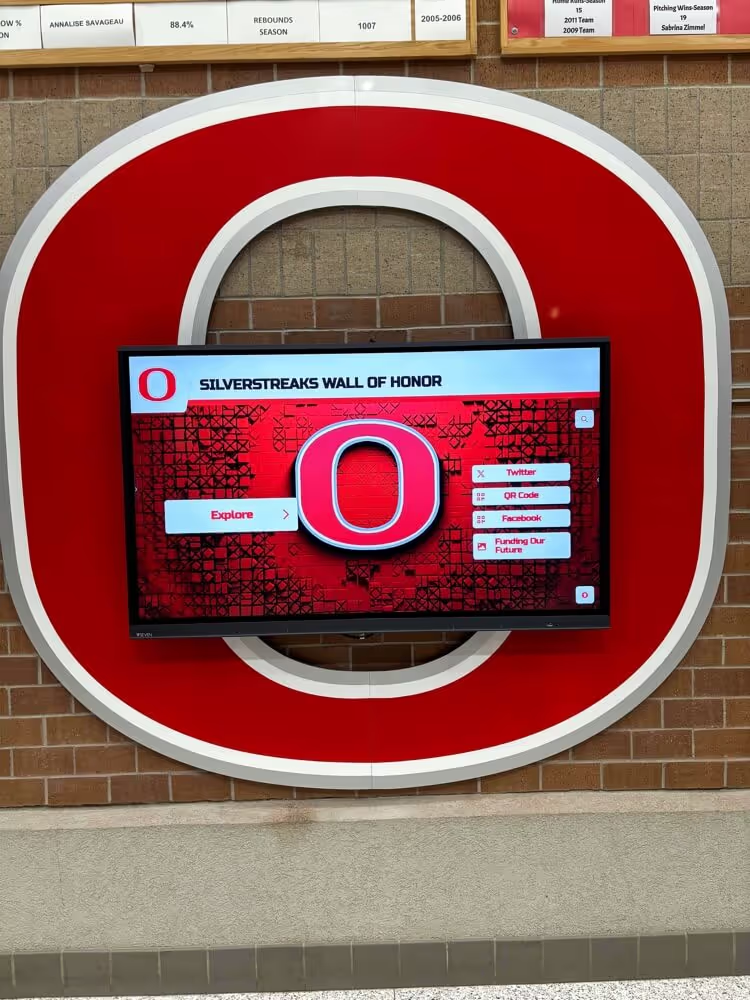
Hall of fame displays that span multiple induction cohorts depend on clean, non-overlapping season and year boundaries in the underlying database — exclusion constraint enforcement is what makes that boundary integrity automatic rather than dependent on manual review for each new entry
Connecting Exclusion Constraint Policy to Broader Data Governance
An exclusion constraint policy does not operate in isolation. It is the overlap-prevention layer within a broader data governance framework — the component that ensures each record occupies exactly one position in the historical record structure before any other governance rule is applied. A versioning policy can only track corrections cleanly if the records being versioned do not already overlap. A surrogate key policy can only guarantee stable record identity if the records identified are not duplicates of each other.
Programs that build exclusion constraint enforcement as part of a broader governance framework should sequence the implementation in governance priority order:
- Exclusion constraint enforcement (prevents invalid records from entering)
- Surrogate key policy (assigns stable identity to each valid record)
- Versioning policy (tracks corrections to each identifiable record)
- Lineage and timeliness monitoring (ensures the pipeline remains current and traceable)
Each layer depends on the one before it. Governance programs that implement versioning before exclusion constraint enforcement end up versioning records that include duplicates — creating a version history full of corrections that are actually resolving conflicts that should never have existed.
The investment in exclusion constraint enforcement pays forward across the entire governance stack. Programs that define season boundaries precisely, enforce overlap checks at every write stage, and log every bypass and resolution decision build a record foundation that every downstream display, archive, and report can rely on — without requiring manual review of the underlying data every time a new season’s records are entered.
Frequently Asked Questions
What is an exclusion constraint in an athletic awards database?
An exclusion constraint is a database integrity rule that prevents two records from sharing overlapping values in a specified combination of fields — most commonly (sport, award category, season range) for athletic award records. Unlike a uniqueness constraint, which checks for identical values in a single field, an exclusion constraint evaluates whether a new or updated record's field values overlap with any existing record's values according to a defined operator, such as date range overlap. When an overlap is detected, the database blocks the write before any data is committed, preventing the conflict from reaching recognition displays, records boards, or hall of fame archives.
Why do overlapping seasons in an athletic awards database cause display problems?
When two records claim overlapping season boundaries for the same sport and award category, recognition displays cannot determine which record is authoritative. Most platforms display whichever record has the most recent entry timestamp or the highest system-assigned ID — not the historically correct one. This means a duplicate record created by a data-migration error or a correction-boundary drift can silently displace the correct award from display without any alert to administrators. Exclusion constraint enforcement prevents overlapping records from entering the database, eliminating the source of the display conflict before it can propagate to any channel.
What should an athletic awards database exclusion constraint policy include?
A complete exclusion constraint policy should address six components: constraint scope definition (which record types are subject to the check), overlap field specification (which field combinations are evaluated and with what operator), conflict detection point (at data entry, correction submission, and migration import), conflict notification requirements (what information the alert must include), resolution authority (who decides which record is authoritative, by record type), and bypass and override logging (when overrides are permitted and what must be documented before an override is committed). Each component should be specific enough that a new administrator can implement identical practices without ambiguity.
How does an exclusion constraint differ from a uniqueness constraint for athletic awards?
A uniqueness constraint prevents two records from having identical values in a specified field or field combination — it checks for exact matches. An exclusion constraint is broader: it checks for any overlap or conflict between records' values according to a defined operator, which may be equality (like uniqueness) but is more commonly a range-overlap test. For seasonal award records, a uniqueness constraint on a formatted season string (such as "2023-2024") would miss boundary conflicts caused by format inconsistency ("2023-24" versus "2023-2024") and would not catch date-range overlaps where two seasons share boundary dates. An exclusion constraint with a date-range overlap operator catches all of these cases.
Can digital recognition platforms enforce exclusion constraints automatically?
Purpose-built digital recognition platforms implement conflict detection as a platform-layer capability, including duplicate detection at record creation, season boundary validation, and status flags that suppress conflicting records from public display during the resolution window. The specific implementation varies by platform — some enforce checks natively at the database layer, others through application-layer validation rules. When evaluating a platform, verify that conflict detection runs at all three write stages (data entry, correction submission, and migration import), that conflict notifications include the conflicting record's identity and field values, and that conflicting records can be suppressed from display channels until resolution is complete.
Conclusion: Clean Season Boundaries for Recognition Archives That Last
An athletic awards database exclusion constraint policy is the integrity layer that ensures each award record occupies exactly one position in the historical record structure — bounded by a cleanly-defined season that does not overlap with any other season’s records for the same sport and award category. Without this layer, every other governance investment is built on a foundation that may contain conflicts that corrupt displays, ranking boards, and hall of fame archives without triggering any alert.
Programs that define season boundaries as structured date ranges, enforce overlap checks at every write stage, define resolution authority for each record type, and log every bypass decision build a recognition archive that any administrator, archivist, or recognition platform can work with confidently — because the data it contains is structurally sound, not just descriptively accurate.
See Award Records With Conflict-Free Season Boundaries
Rocket Alumni Solutions provides athletic directors and school administrators with a cloud-based recognition platform that includes built-in conflict detection, application-layer boundary validation, and multi-channel publication controls — so overlapping seasons and duplicate honors never reach your trophy case kiosks, records boards, or digital hall of fame displays. ADA WCAG 2.1 AA compliant, with remote content management and auto-ranking record boards. Request a demo to see the platform's data integrity capabilities in practice.
Request a Demo