




Intent: research — Athletic awards database fillfactor tuning is the practice of configuring PostgreSQL’s per-table and per-index fillfactor storage parameter to reserve free space on data pages so that in-place row updates — Heap Only Tuple (HOT) updates — remain possible after a record’s initial write. For an athletic award archive where records are routinely corrected across multiple seasons (misspelled athlete names, adjusted award dates, reclassified sport categories), a mismatched fillfactor eliminates the free space those corrections require for HOT updates, forcing PostgreSQL into slower update-plus-dead-tuple cycles that bloat tables and degrade display query performance.
This guide is written for school IT administrators, database administrators, athletic directors, and recognition-program data stewards who manage PostgreSQL-backed award archives powering digital halls of fame, lobby touchscreen displays, and championship records boards. It covers what fillfactor is, how HOT updates connect to page-level free space, a direct answer for which fillfactor values fit which athletic award table profiles, a decision table by update frequency and access pattern, step-by-step tuning commands, monitoring queries, and seasonal adjustment guidance.
Award records in school athletic databases look append-only from the outside — a coach submits season results, an administrator enters induction choices, and the data lands in the table. The reality inside the database is more iterative. Athlete names are corrected after the first entry. Award categories are reassigned when a sport is reclassified. Induction years are updated when a historical ceremony’s date is confirmed. Season records are adjusted when a championship ruling is appealed. These corrections accumulate silently and, without deliberate athletic awards database fillfactor tuning, they convert what appears to be a clean append-heavy archive into a table littered with dead tuples, bloated indexes, and fragmented data pages that slow the display queries coaches and families rely on during recognition events.

Digital athletic records displays in school hallways reflect data from tables that are corrected dozens of times per season — fillfactor tuning reserves the free page space that makes each correction faster and prevents the table bloat that degrades display query performance over time
What Is Fillfactor in a PostgreSQL Athletic Awards Database?
Fillfactor is a PostgreSQL storage parameter that controls what percentage of each data page (an 8 KB disk block) PostgreSQL fills with row data during initial INSERT operations. The remainder of the page is reserved as free space available for future UPDATE operations on existing rows.
The default fillfactor is 100 for heap tables, meaning PostgreSQL fills every page completely during inserts with no reserved free space. For an append-only table — one where rows are inserted once and never updated — a fillfactor of 100 is optimal: it minimizes the number of pages used and maximizes read efficiency by packing data tightly.
For a table where existing rows are updated after their initial write — which describes most athletic award tables that are corrected repeatedly across seasons — a fillfactor of 100 is a liability. When an update arrives for a row on a page that has no free space, PostgreSQL cannot update the row in place. Instead, it writes a new version of the row to a different page, leaves a dead tuple pointer at the original location, and adds the new row to an index entry. The result is table bloat (dead tuples consuming space until VACUUM reclaims it), index bloat (the index now containing pointers to both the original dead tuple and the new live tuple), and more heap pages to scan for every subsequent query on that table.
Index fillfactor is a parallel parameter that controls how full each B-tree index page is filled during index creation. The default for indexes is 90 — PostgreSQL already reserves 10% of each index page by default, specifically to allow space for new index entries near existing keys without requiring immediate page splits. For athletic award indexes on frequently corrected columns, lowering index fillfactor further reduces the frequency of page splits during update cycles.
Why Frequently Updated Athletic Award Records Require Fillfactor Attention
The update patterns in athletic recognition databases differ from transactional systems in one critical way: the corrections are concentrated, not evenly distributed. Updates arrive in bursts tied to recognizable events in the athletic calendar:
- Post-ceremony data review — After award ceremonies, staff correct entries identified during event check-in: a middle name added, a graduation year adjusted, a sport spelling standardized.
- Appeals and reclassifications — When a program reclassifies records after an eligibility ruling or records board restatement, dozens of rows receive updated sport-category or award-tier values simultaneously.
- Annual historical corrections — Many programs maintain open correction windows for historical record imports, accepting retroactive updates to past-season data year-round.
- Induction record finalization — Hall of fame induction records pass through multiple draft states (nominated, confirmed, inducted, published) before reaching their final values, with each state transition triggering an update.
For programs managing these correction cycles through a digital hall of fame or lobby touchscreen kiosk, every uncorrected dead tuple on an awards table is a small performance tax on the display queries that serve that data. The tax is negligible for a single correction on a small table, but cumulative across thousands of corrections on a multi-year athletic archive, it creates the slow-loading displays and stale data reports that administrators notice first and diagnose last.
Planning the criteria and selection workflow for a school hall of fame involves defining the review and correction process that determines how many update cycles each inductee record goes through before publication — that workflow’s correction frequency is the key input for fillfactor tuning decisions on the induction table.
Athletic Awards Database Fillfactor Tuning: Direct Answer by Table Profile
For athletic award tables with frequent corrections, the right fillfactor is typically 70–80. For append-only tables or tables corrected only once per season, the default of 90–100 is appropriate. Index fillfactor should trail the table fillfactor by 5–10 percentage points for corrected columns.
The single most important variable in the fillfactor decision is how many updates a typical row receives between the first VACUUM cycle after its insertion and its final stable state. A row updated zero times after insertion needs no reserved space. A row updated five to ten times — as is common for a hall of fame inductee record moving through nomination, confirmation, and editorial review cycles — benefits materially from reserved space that keeps each update in the same page as the original row.
Decision Table: Fillfactor by Athletic Award Table Profile
| Table Profile | Update Frequency | Recommended Table Fillfactor | Recommended Index Fillfactor | Rationale |
|---|---|---|---|---|
| Append-only seasonal results (scores, stats) | Zero after entry | 100 | 90 (default) | No reserved space needed; maximize page density |
| Award assignments corrected once at season close | 1–2 updates per row | 90 | 85 | Minimal reservation; single-pass correction cycle |
| Induction records with multi-state review workflow | 3–8 updates per row | 75–80 | 70–75 | Moderate reservation supports draft-to-published cycle |
| Historical import tables with open correction windows | 5–15 updates per row | 70 | 65–70 | Significant reservation needed; corrections span years |
| Active records boards with season-by-season restatements | 10+ updates per row | 60–70 | 60–65 | High reservation; frequent seasonal restatements |
| Audit/log tables (append-only by policy) | Zero | 100 | 90 (default) | Insert-only; fillfactor tuning adds no value |
The ranges in this table reflect that fillfactor should be calibrated to the specific correction rate observed in each program’s database, not set to a single universal value. A program running three sports with two correction cycles per year per record has a different optimal fillfactor than a program running fifteen sports where records are reclassified after every conference championship ruling.
How HOT Updates Depend on Page-Level Free Space
Heap Only Tuple (HOT) updates are PostgreSQL’s mechanism for updating a row without adding a new index entry when the updated columns are not covered by any index. For a HOT update to succeed, two conditions must both be true:
- The updated columns must not be part of any index. If the update changes an indexed column (such as
award_dateorsport_id), PostgreSQL must write a new index entry pointing to the updated row — which disqualifies the update from HOT treatment regardless of page space. - The original row’s page must have enough free space to hold the new row version. If the page is full (as it always is when fillfactor = 100 and the page was filled during the initial insert batch), PostgreSQL writes the new row version to a different page and adds an index pointer to both the dead tuple on the old page and the live tuple on the new page.
For athletic award tables where the most commonly corrected fields are non-indexed — athlete display name, biographical notes, award description text, media attachment URLs — HOT updates are structurally possible on every correction. Whether they actually occur depends entirely on whether the original page has free space, which is controlled by the table’s fillfactor setting.
The practical consequence of HOT-eligible corrections: a fillfactor of 75 on a 5-million-row award archive with 10% of rows updated per season can eliminate tens of thousands of dead tuples per year compared to a fillfactor of 100, reduce AUTOVACUUM pressure significantly during the post-ceremony correction window, and keep index sizes stable across multiple seasons without manual REINDEX operations.
For programs managing an MLB-style digital hall of fame archive with deep historical record sets, digital hall of fame database and display management guides address the multi-decade archive patterns where HOT-eligible updates on non-indexed biographical fields represent the majority of the ongoing correction workload.

Trophy case touchscreen displays serve finalized records that often went through several correction cycles during induction review — the fillfactor on the underlying table controls whether those corrections generated table bloat or remained in-place HOT updates that left the page compact
Step-by-Step: Setting Fillfactor for Existing Athletic Award Tables
These steps modify fillfactor on a live PostgreSQL database without requiring downtime. The fillfactor change takes effect for newly written pages only — existing pages retain their current fill level until a VACUUM FULL or CLUSTER operation rewrites them. A phased approach is appropriate for production databases serving active recognition displays.
Step 1: Identify Update-Heavy Tables
SELECT
  schemaname,
  relname AS table_name,
  n_tup_upd      AS total_updates,
  n_tup_ins      AS total_inserts,
  n_tup_hot_upd  AS hot_updates,
  ROUND(n_tup_hot_upd::numeric / NULLIF(n_tup_upd, 0) * 100, 1) AS hot_update_pct,
  n_dead_tup     AS dead_tuples
FROM pg_stat_user_tables
WHERE schemaname = 'public'
ORDER BY n_tup_upd DESC
LIMIT 20;
Tables with a hot_update_pct below 50% and a high dead_tuples count are the priority fillfactor tuning candidates. Low HOT percentages with many dead tuples are the exact signature of a frequently corrected table with no reserved page space.
Step 2: Set the New Fillfactor
ALTER TABLE athletic_awards SET (fillfactor = 75);
ALTER TABLE hall_of_fame_inductees SET (fillfactor = 70);
ALTER TABLE season_records SET (fillfactor = 80);
The ALTER TABLE ... SET command is a metadata-only change — it completes instantly without a table rewrite or lock on the table data. New pages written after this command (from subsequent inserts or update-triggered row moves) will respect the new fillfactor. Existing fully packed pages are unaffected until rewritten.
Step 3: Set Index Fillfactor on Corrected-Column Indexes
-- Rebuild the index on award_date with reduced index fillfactor
-- Use CONCURRENTLY to avoid blocking reads during index creation
CREATE INDEX CONCURRENTLY idx_awards_award_date_new
ON athletic_awards (award_date)
WITH (fillfactor = 70);

-- After verifying the new index is used by the planner:
DROP INDEX CONCURRENTLY idx_awards_award_date;
ALTER INDEX idx_awards_award_date_new RENAME TO idx_awards_award_date;
Index fillfactor changes always require an index rebuild — ALTER INDEX does not support changing fillfactor for existing index pages. Use CONCURRENTLY to build the replacement index without blocking concurrent display queries.
Step 4: Rewrite Existing Pages to Apply the New Fillfactor
-- Schedule during a low-traffic maintenance window
-- CLUSTER rewrites all rows in the specified index order and applies the new fillfactor
CLUSTER athletic_awards USING idx_awards_award_date;

-- Re-analyze after cluster to update planner statistics
ANALYZE athletic_awards;
CLUSTER acquires an exclusive lock on the table and rewrites all pages — it should only run during a scheduled maintenance window, not during active import or display traffic. For tables too large or too traffic-sensitive for CLUSTER, allow AUTOVACUUM to gradually reclaim and rewrite pages over time; full fillfactor benefits will arrive incrementally across several AUTOVACUUM cycles rather than immediately.
Step 5: Verify HOT Update Rate Improvement
-- Run this 24-48 hours after the fillfactor change and one import cycle
SELECT
  relname,
  n_tup_upd,
  n_tup_hot_upd,
  ROUND(n_tup_hot_upd::numeric / NULLIF(n_tup_upd, 0) * 100, 1) AS hot_update_pct,
  n_dead_tup
FROM pg_stat_user_tables
WHERE relname IN ('athletic_awards', 'hall_of_fame_inductees', 'season_records');
A successful fillfactor tuning shows a measurably higher hot_update_pct and a lower steady-state n_dead_tup count compared to the baseline recorded in Step 1. HOT update percentages above 70% for the target tables indicate that most corrections are finding the free space they need on the original page.
See How a Managed Platform Handles Award Record Corrections Without Database Bloat
Rocket Alumni Solutions provides school athletic directors and IT teams with a cloud-based recognition platform where storage management, table maintenance, and fillfactor optimization are handled at the infrastructure level — so correction cycles for induction records, season restatements, and historical data reviews never produce the table bloat that degrades display query performance. Request a demo to see how the platform keeps recognition data accurate and display queries fast across the full correction lifecycle.
Request a Platform DemoMonitoring Fillfactor Effectiveness Over Time
Fillfactor tuning is not a one-time setting — it requires ongoing monitoring to confirm that the chosen value continues to match the table’s actual update rate as recognition programs expand, correction workflows change, and historical import cycles add new update patterns to tables that were once relatively stable.
Monitoring Query: Dead Tuple Accumulation Rate
SELECT
  relname,
  n_dead_tup,
  n_live_tup,
  ROUND(n_dead_tup::numeric / NULLIF(n_live_tup, 0) * 100, 2) AS dead_pct,
  last_autovacuum,
  last_vacuum
FROM pg_stat_user_tables
WHERE n_dead_tup > 1000
ORDER BY dead_pct DESC;
A dead_pct above 10% on an award table suggests that the current fillfactor is insufficient — too many updates are generating dead tuples because page free space runs out before the next AUTOVACUUM cycle. Tables consistently above 20% dead tuples despite frequent AUTOVACUUM cycles need a lower fillfactor.
Monitoring Query: Page Bloat by Table
SELECT
  tablename,
  pg_size_pretty(pg_total_relation_size(schemaname||'.'||tablename)) AS total_size,
  pg_size_pretty(pg_relation_size(schemaname||'.'||tablename)) AS table_size,
  pg_size_pretty(pg_indexes_size(schemaname||'.'||tablename)) AS indexes_size
FROM pg_tables
WHERE schemaname = 'public'
  AND tablename IN ('athletic_awards', 'hall_of_fame_inductees', 'season_records')
ORDER BY pg_total_relation_size(schemaname||'.'||tablename) DESC;
Compare these sizes quarter over quarter. Table size growing faster than the rate of new award records is evidence of dead tuple accumulation that exceeds what AUTOVACUUM is reclaiming — a signal that fillfactor should be reduced further to enable more HOT updates before dead tuples need to be reclaimed.
For recognition programs that also run search queries against award records — filtering inductees by name, sport, or year for lobby kiosk browsing — hall of fame search relevance testing describes the query latency patterns that drift upward when index bloat from high dead-tuple accumulation increases the number of index pages a search must scan.

Every portrait card and seasonal award visible on this touchscreen display comes from tables where dead tuple accumulation rate is a direct function of the table fillfactor — monitoring that rate after each correction cycle confirms whether the tuned fillfactor is keeping HOT update percentages above the operational target
Seasonal Fillfactor Adjustment Patterns for Athletic Recognition Databases
Athletic award databases have a correction calendar that is more predictable than most other database workloads. The concentrated correction windows that follow end-of-year ceremonies, conference championship rulings, and historical import projects create known periods of elevated update activity — and those periods are where fillfactor tuning delivers the most measurable benefit.
Pre-ceremony adjustment window (1–2 weeks before major award events):
Before an end-of-year recognition ceremony or hall of fame induction night, administrators typically review all pending records and apply a final round of corrections. For tables that will receive this correction burst, a one-time VACUUM followed by CLUSTER during the week before the event resets page density to exactly the fillfactor setting — ensuring maximum free space is available for the correction burst just before display traffic peaks.
Post-import ANALYZE after seasonal bulk imports:
After a bulk import of seasonal award records, run ANALYZE immediately to update the planner’s statistics. Without fresh statistics, the query planner may choose a sequential scan over an index on a newly grown table, even when the index would be more selective. Pairing this with a VACUUM (not VACUUM FULL) reclaims dead tuples from correction updates applied during the import workflow without rewriting the entire table.
Annual maintenance window: review and reset:
Schools that operate on an academic calendar can tie the annual fillfactor review to the start of each academic year — after the previous year’s records are finalized and before the next season’s import window opens. Review the hot_update_pct from the Step 5 monitoring query, compare it to the value at the previous year’s review, and adjust fillfactor if the HOT percentage has drifted below 60% over the year.
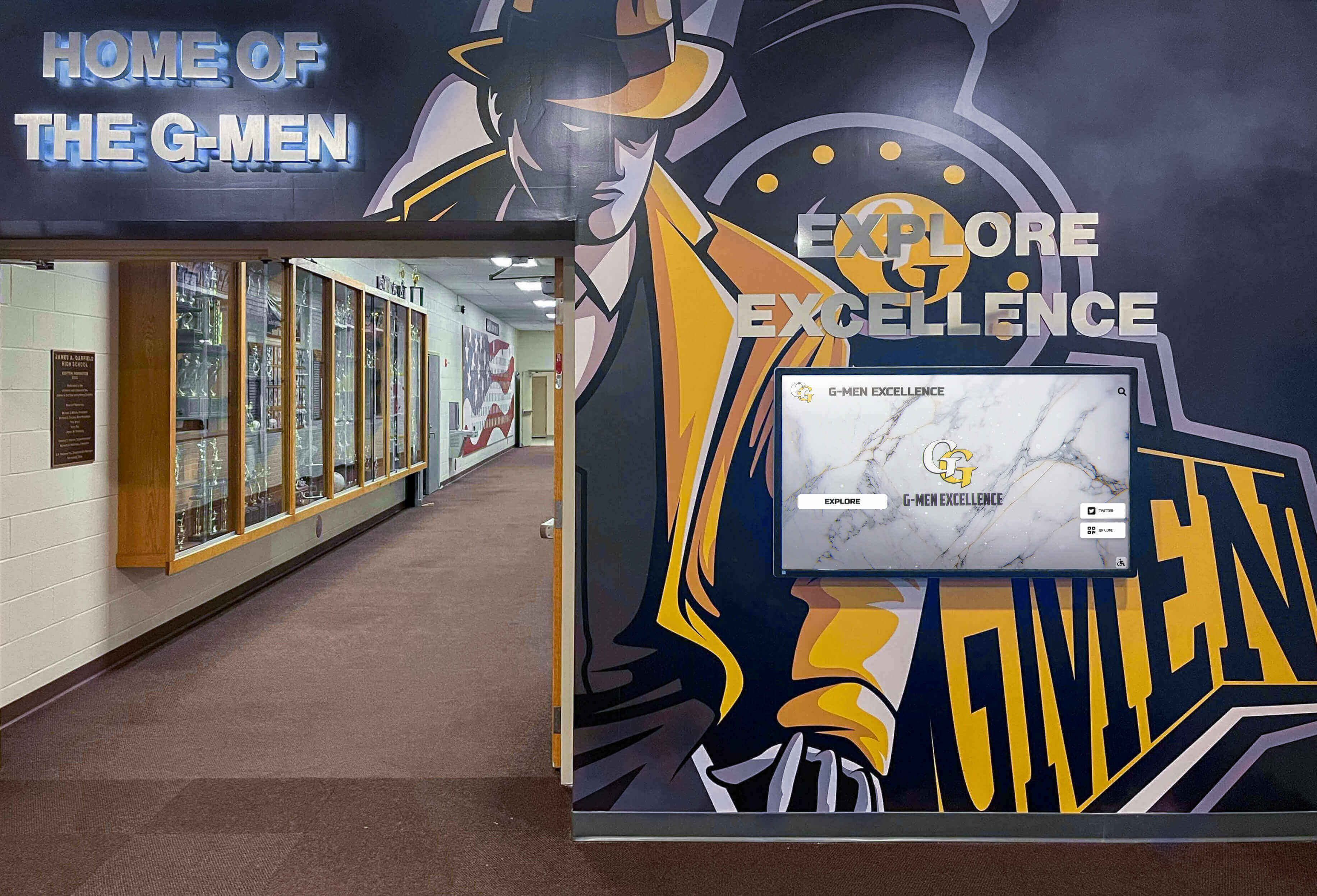
School hallways that combine physical trophy cases with digital displays reflect two timescales of recognition data: the static archive in the cases and the live database powering the screen — fillfactor tuning ensures the live records can absorb seasonal correction cycles without the page bloat that slows the display
For athletic programs with a seasonal structure that drives concentrated correction bursts — such as cross-country programs that finalize all season statistics and award assignments during a single post-championship week — cross-country season planning and scheduling guides illustrate the concentrated end-of-season reporting cycle that creates the highest update density on athletic award tables.
For school programs coordinating classroom-integrated recognition projects alongside athletic awards — where student-created recognition displays draw from the same database infrastructure as the athletic archive — classroom recognition project display guides describes the dual-use database patterns that may require separate fillfactor policies for academic and athletic record tables sharing the same system.
What Fillfactor Tuning Cannot Fix
A thorough athletic awards database fillfactor tuning guide must be explicit about what fillfactor cannot address. Fillfactor is a page-space reservation mechanism — it solves the specific problem of HOT update eligibility and dead-tuple accumulation from standard updates. It does not address:
Index bloat on frequently indexed columns. When corrections update indexed columns — award_date, sport_id, season_year — HOT updates are disqualified regardless of page free space, and index entries accumulate as updates generate new index pointers. Fillfactor tuning on those indexes reduces page splits, but it does not eliminate index bloat from high-frequency updates to indexed columns. Index bloat on correction-heavy indexed columns requires periodic REINDEX CONCURRENTLY as part of a scheduled maintenance cycle.
Query performance degraded by missing statistics. If AUTOVACUUM’s ANALYZE frequency is insufficient for the table’s update rate, the query planner operates on stale statistics and may choose suboptimal plans. Fillfactor addresses dead tuple accumulation, not statistics freshness. Increase autovacuum_analyze_scale_factor or schedule explicit ANALYZE runs after high-volume correction cycles to maintain planner accuracy independently of fillfactor settings.
Table growth from genuinely new records. Fillfactor reserves space for in-place updates, but new rows added to the table still consume pages. A recognition archive that adds 10,000 new award records per season will grow by those records regardless of fillfactor setting. Fillfactor tuning only affects the dead-tuple overhead on rows that are updated after insertion — it does not compress or shrink the storage required for genuinely new data.
Display query latency from missing or bloated indexes. If the primary display query patterns require index support that the current index set does not provide, fillfactor tuning improves the health of existing indexes but does not create new ones or fix incorrect index coverage. Index design and fillfactor tuning are complementary, not interchangeable, components of a complete performance strategy for recognition databases.
For programs coordinating award ceremony displays with the broader school recognition infrastructure — where the visual elements of ceremony programs must align with the database’s published record state — school award ceremony decoration and presentation planning covers the ceremony-day workflows where real-time database accuracy is the critical dependency for display content.

Administrators checking athlete profile accuracy during recognition events experience the downstream effect of every fillfactor decision made during database configuration — HOT update rates and dead tuple counts determine whether correction cycles keep the display fast or slow it measurably over a multi-year archive
For school programs that also manage recognition content for student-athletes who have received recognition for both athletics and academic achievement — where award records include high school recognition categories beyond sports — high school student award categories and eligibility describes the cross-category recognition record types that may share an awards table with athletic records, affecting the fillfactor decision for that table.
For programs deploying recognition displays with authenticated access controls — where the display infrastructure uses certificate-based authentication before serving recognition content — recognition display authentication and connectivity testing covers the display layer dependencies that depend on database query latency remaining within acceptable bounds even during peak correction and import cycles.
Frequently Asked Questions
What is fillfactor in PostgreSQL and why does it matter for athletic award databases?
Fillfactor is a PostgreSQL storage parameter that controls what percentage of each data page is filled with row data during initial inserts, leaving the remainder as reserved free space for future in-place updates. For athletic award databases where records are corrected repeatedly — during post-ceremony reviews, appeals processes, and historical imports — a fillfactor below 100 reserves page space that allows Heap Only Tuple (HOT) updates. HOT updates are faster than standard updates because they do not require new index entries, and they do not generate dead tuples that must be reclaimed by VACUUM. Without reserved page space (fillfactor = 100), every correction generates a dead tuple on the original page and a new row on a different page, bloating the table and slowing display queries over time.
What fillfactor should I use for an athletic awards table with frequent corrections?
For athletic award tables with frequent corrections — induction records moving through nomination and review cycles, seasonal records reclassified after appeals, historical records with open correction windows — a fillfactor of 70–80 is a practical starting point. Run the pg_stat_user_tables query to check your current hot_update_pct: if it is below 50%, the current fillfactor is too high and should be reduced. For index fillfactor on columns covered by indexes, set it 5–10 percentage points below the table fillfactor. Append-only tables that receive no updates after initial insert should remain at the default fillfactor of 100, since reserved space that is never used just wastes storage.
How do I know if my athletic awards database needs fillfactor tuning?
Run SELECT relname, n_tup_upd, n_tup_hot_upd, ROUND(n_tup_hot_upd::numeric / NULLIF(n_tup_upd, 0) * 100, 1) AS hot_update_pct, n_dead_tup FROM pg_stat_user_tables WHERE schemaname = 'public' ORDER BY n_tup_upd DESC. Tables showing a hot_update_pct below 50% and a high n_dead_tup count need fillfactor tuning — those are the tables where corrections are generating dead tuples because they cannot find free space on the original page. A dead_pct above 10% relative to live tuples on an award table is the operational threshold for reducing fillfactor and scheduling a CLUSTER operation to rewrite existing pages at the new fill density.
Does changing fillfactor immediately apply to existing pages in a table?
No. An ALTER TABLE ... SET (fillfactor = 75) command is a metadata-only change that completes instantly without locking the table or rewriting existing data. It applies only to newly written pages — pages that receive rows from future inserts or row moves triggered by updates. Existing fully-packed pages remain at their current density until rewritten. To apply the new fillfactor to existing pages, schedule a CLUSTER operation on the table during a low-traffic maintenance window: CLUSTER athletic_awards USING idx_awards_award_date rewrites all rows in index order with pages filled to the new fillfactor level, then follow with ANALYZE to refresh planner statistics. CLUSTER requires an exclusive lock, so schedule it outside active import or display traffic windows.
How does fillfactor tuning interact with AUTOVACUUM in a recognition database?
Fillfactor tuning and AUTOVACUUM are complementary: fillfactor reduces how many dead tuples are generated in the first place (by enabling HOT updates), while AUTOVACUUM reclaims the dead tuples that are generated when HOT is not possible. A well-tuned fillfactor lowers AUTOVACUUM's workload by reducing the rate of dead tuple accumulation — fewer dead tuples mean less frequent AUTOVACUUM cycles on heavily corrected tables, which in turn means AUTOVACUUM's shared infrastructure is available for other tables during peak import windows. Run ANALYZE explicitly after large seasonal imports to ensure the query planner's statistics reflect newly appended rows even if AUTOVACUUM's scheduled analysis has not yet fired.
Conclusion: A Practical Fillfactor Policy for Athletic Award Correction Workflows
Athletic awards database fillfactor tuning addresses a problem that is invisible until its accumulated effect becomes undeniable — a recognition archive that once loaded quickly now stalls on display queries, index maintenance that once completed in minutes now takes hours, and AUTOVACUUM cycles that once ran infrequently now compete with import processes for database resources. The root cause is almost always the same: an insert-optimized fillfactor of 100 applied to a table that has always received steady corrections, silently generating dead tuples with every update until the bloat crosses the threshold where it affects the displays, ceremonies, and recognition events that depend on the database.
A fillfactor tuned to 70–80 for correction-heavy award tables, verified with the HOT update percentage query, and maintained with annual review and post-ceremony VACUUM cycles delivers a measurably healthier archive: fewer dead tuples, more compact indexes, faster display queries, and AUTOVACUUM cycles that run on a predictable schedule rather than under emergency pressure during peak recognition events.
Programs that document fillfactor settings alongside other index governance decisions — including connection pool configuration, BRIN index policy, and query plan regression baselines — build a recognition database infrastructure that scales across multi-season archives and multi-display deployments without accumulating the silent performance debt that correction-heavy tables produce when storage parameters are left at their defaults.
Keep Award Corrections Fast and Recognition Displays Responsive
Rocket Alumni Solutions provides school athletic directors and IT administrators with a cloud-based recognition platform where database storage optimization, table maintenance, and display query performance are managed at the platform level. Season-by-season corrections to induction records, award restatements, and historical imports stay fast and bloat-free without requiring your team to tune fillfactor settings or schedule CLUSTER operations manually. Request a demo to see how the platform handles athletic award data at scale.
Request a Platform Demo