



Intent: research — an athletic awards database optimistic locking policy defines the rules for detecting and resolving edit conflicts when two or more staff members open and modify the same award record at the same time. Rather than blocking concurrent access entirely, optimistic locking allows all users to read and begin editing a record simultaneously, then checks for conflicts only at the moment a save is attempted. If the record was changed by another user after the current session opened it, the system blocks the overwrite and surfaces both versions for deliberate review. A written policy governs which records are subject to locking checks, what the conflict notification must include, who has resolution authority, and how resolved edits are logged.
This guide is written for athletic directors, school administrators, IT and database teams, and recognition-program owners responsible for maintaining accurate athletic honor records. It covers what optimistic locking means for school athletic programs, how it differs from pessimistic locking, the five components of a complete policy, a six-step implementation sequence, a readiness checklist, and a Q&A section on the most common concurrency governance questions.
When two staff members access the same award record at the same time — the athletic director updating a season year while the registrar corrects an athlete’s name — one of them will finish first. The second save should not silently erase the first. Without concurrency protection, it can. An athletic awards database optimistic locking policy closes that gap by defining the mechanism that detects simultaneous edits, prevents silent overwrites, and ensures that when two changes collide, both sets of intent are preserved for deliberate resolution rather than discarded without notice.

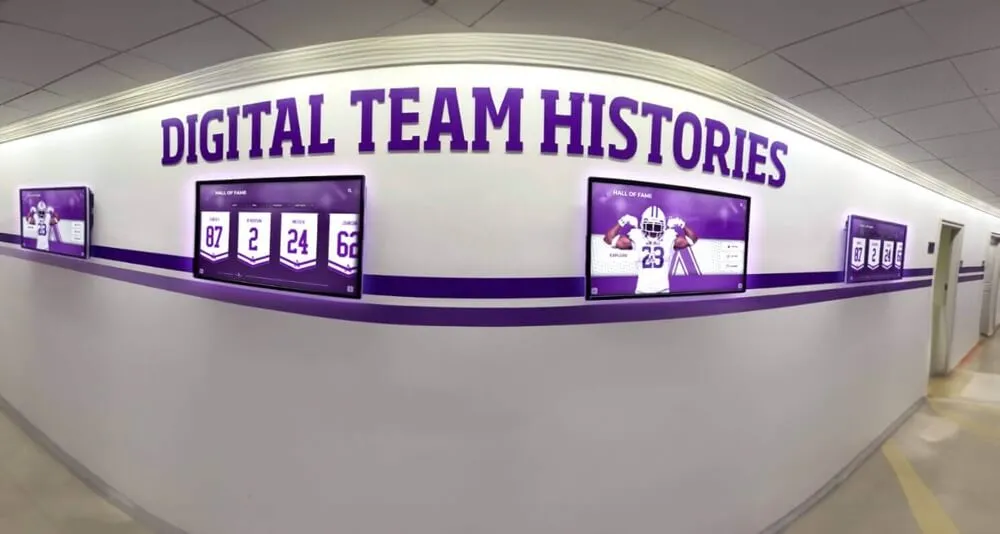
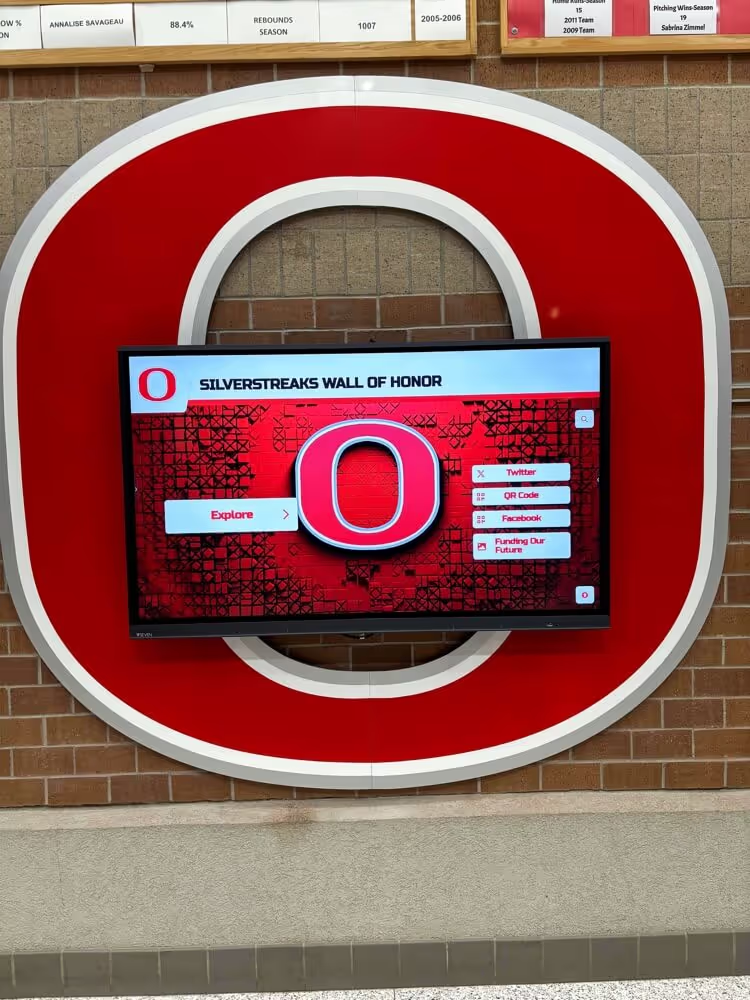
Concurrent access to recognition records is routine in schools with multiple administrators — an optimistic locking policy ensures that when two staff members edit the same record at the same time, neither change silently overwrites the other
What Is Optimistic Locking in an Athletic Awards Database?
Optimistic locking is a concurrency control strategy that allows multiple users to read and begin editing a record at the same time, then detects conflicts at the moment of save rather than at the moment of open. The name reflects its core assumption: most of the time, two users will not happen to modify the same record in the same short window, so there is no reason to lock the record preemptively. When a conflict does occur — because two sessions opened the same record before either had saved — the system raises an alert rather than silently accepting the later save.
The technical mechanism is straightforward. When a user opens a record for editing, the system records the record’s current version token — typically a timestamp, an incrementing integer, or a hash of the record state. When the user saves, the system compares the token they held when they opened the record against the token currently in the database. If the tokens match, the record has not been changed by anyone else since the session began, and the save proceeds. If the tokens differ, someone else saved a change in the intervening window. The system blocks the second save and surfaces a conflict notification.
For school athletic programs, the practical result is that administrators can work with recognition records simultaneously without artificial wait queues, and the system prevents any two concurrent edits from creating an undetected split — where one person’s correction silently disappears under another person’s update.
Why Concurrent Edits Create Silent Overwrite Risk
Athletic recognition programs frequently involve multiple staff working with shared records. An athletic director managing hall of fame inductees, a registrar correcting athlete rosters, a facilities coordinator updating display-channel publication status, and a front-office assistant resolving data entry errors may all access the same records database during the same afternoon. Most of the time, they work on different records. Occasionally, they work on the same one.
Without concurrency protection, the second save wins — completely and silently. If the athletic director corrects an athlete’s misspelled name and saves, and then the assistant principal opens the same record, updates the award year, and saves, the award-year correction reaches the database. So does the silent restoration of the misspelled name — because the assistant principal opened the record before the athletic director’s correction was made, and the save carries the pre-correction name field value along with the updated year. Neither person receives an alert. The recognition display shows the overwritten name the next time it refreshes.
This pattern is not visible in a basic change log. Both corrections appear in the log: the athletic director changed the name field, the assistant changed the year field. The log does not show that the assistant’s save also silently reverted the name to its pre-correction value. Optimistic locking catches the conflict before it reaches the database — so the log never needs to reconstruct what went wrong.
For programs that manage award records retroactively — adding historical recognitions that preceded the current recognition system — the overwrite risk is elevated because retroactive records often require edits by multiple staff across multiple sessions before they are complete. For context on how retroactive recognition policies interact with the record entry process, athletic award retroactive recognition policies covers the approval and documentation requirements that typically accompany retroactive edits, making concurrency protection at the data layer especially relevant during those workflows.
Optimistic Locking vs. Pessimistic Locking: Comparison
Two concurrency control approaches are commonly discussed for database systems. Understanding the tradeoff helps programs select the method appropriate for their access patterns and staffing structure.
| Characteristic | Optimistic Locking | Pessimistic Locking |
|---|---|---|
| When conflict is checked | At save time | At open time |
| Concurrent read access | Always allowed | Blocked if record is locked |
| Effect on non-conflicting concurrent edits | None — both saves succeed | Second user waits until lock is released |
| What happens on conflict | Second save blocked; conflict surfaced | Second open blocked; user waits |
| Risk of deadlock | None | Possible if sessions hold locks indefinitely |
| Best for | Low-conflict environments; many readers, few simultaneous editors | High-conflict environments; tight simultaneous edit windows |
| Risk in school programs | Infrequent conflicts missed if no policy exists | Abandoned sessions leave records locked for other users |
| Staff experience | Normal editing with occasional conflict alerts | Waiting or “record locked” messages when another edits |
For school athletic recognition programs, optimistic locking is the appropriate default. Records databases in this context have many simultaneous readers and relatively few simultaneous editors. Conflicts are infrequent. Pessimistic locking would force staff to wait while a colleague finishes editing — and if that colleague abandons the session without saving, the lock may persist until an administrator intervenes. Optimistic locking avoids that risk while still catching the conflicts that do occur.
Five Components of a Complete Optimistic Locking Policy
A written athletic awards database optimistic locking policy addresses five components explicitly. Documenting each component in the written policy — rather than relying solely on platform configuration — ensures that a future administrator can verify that system behavior matches the institutional standard without needing technical access to the underlying database.
1. Version Token Format and Assignment
The policy specifies what version token the system uses to detect conflicts: a timestamp, an incrementing integer version number, or a hash of the record state. It also specifies that the token is assigned automatically by the system at each save and is never set by staff action.
Policy language example: “Each award record carries an integer version counter incremented automatically by the system at each successful save. No staff member may manually set or modify the version counter.”
2. Conflict Detection Rule
The policy defines when the system checks for a conflict and what constitutes one. A conflict exists when the version token held by the current editing session does not match the token currently stored in the database.
Policy language example: “Before accepting a save, the system compares the version counter held at the time the record was opened against the counter currently stored in the database. If they differ, the save is blocked and a conflict notification is raised. The record is not modified until the conflict is resolved.”
3. Conflict Notification Content
The policy specifies what information the conflict notification must include: the record identifier, the field or fields changed by the intervening save, the values held by both the blocking save and the current session’s pending save, and the timestamp and identity of the user whose save caused the conflict.
Policy language example: “The conflict notification must display the record identifier, the fields modified by the prior save with their previous and current values, the fields pending in the blocked save, and the identity and save timestamp of the user whose save blocked the current session.”
4. Resolution Authority
The policy defines who has authority to resolve a conflict — to choose which version of a disputed field value takes effect, or to approve a merged resolution incorporating changes from both sessions. In most programs, this authority belongs to the athletic director or a named designee.
Policy language example: “The athletic director or an authorized designee holds resolution authority for all award record edit conflicts. Conflict resolutions must be logged with the identity of the resolving party, the field-level resolution choices made, and the date and time of resolution.”
5. Conflict Log Requirements
The policy requires that every detected conflict and every resolution be logged, separate from the normal field-level correction log. The conflict log captures data the normal log does not: the competing values, who held each version, how the conflict was resolved, and who authorized the resolution.
Policy language example: “All detected edit conflicts are entered automatically into a conflict log at the time of detection. All resolutions are entered at the time of resolution. The conflict log is retained for the same period as the records it covers — permanently for hall of fame and major championship records, a minimum of seven years for seasonal honors.”
Implementing an Optimistic Locking Policy: Six Steps
The following sequence is designed for programs establishing concurrency governance for the first time. Programs that already have version token support in their platform can enter the sequence at Step 3.
Step 1 — Identify which records carry the highest concurrent-edit risk. Not all award records carry the same risk. Hall of fame entries receive the most sustained attention and are most likely to be opened by multiple staff during active entry periods and before recognition events. End-of-season award records are frequently edited in clusters as athletic directors and coaches finalize team honors close to banquet dates. Identify which categories have the highest concurrent access frequency and prioritize them in the policy.
Step 2 — Verify whether the current platform supports version tokens. Most purpose-built digital recognition platforms and database management systems include some form of version tracking per record, though it may not be exposed as a user-facing conflict detection feature. Contact the platform vendor to confirm whether version tokens are maintained per record and whether conflict detection is enforced on save. If the platform does not support version token comparison, document this gap in the policy and establish a manual conflict prevention procedure — typically a record reservation log or a scheduled editing window by staff role — until a platform upgrade can close the gap.
Step 3 — Define the conflict notification format. Work with the platform administrator to confirm what information the system surfaces when a conflict is detected. The minimum requirement is that the conflict notification identifies which record triggered the alert, which fields conflict, and who last saved the record before the current session attempted to. If the current platform does not surface this information, document what it does surface and note the gap in the policy so that future platform evaluation criteria can include full conflict notification as a requirement.
Step 4 — Assign a conflict resolution owner. Designate the athletic director or a named designee as the conflict resolution owner for award records. Document this assignment in the policy. Establish a response time standard — for example, a detected conflict is resolved within one business day — so that the blocked save does not leave a record in an indeterminate state. For programs with a large staff accessing shared records, designate a primary and backup resolution owner to ensure continuity during absences.
Step 5 — Create the conflict log. Establish the conflict log as a required document — either within the platform’s administrative interface, in a shared folder with restricted access, or as a tab in the program’s governance spreadsheet. The log should include: conflict date and time, record identifier, fields in conflict, competing values, identity of both users, resolution choice, and date of resolution. Treat the conflict log as a governance document with the same retention requirements as the underlying award records.
Step 6 — Train staff on the conflict notification workflow. A conflict notification is only useful if the staff member who receives it knows what it means and what to do next. Document the conflict response procedure in a brief staff reference: what the notification says, who to contact to initiate resolution, and what happens to the blocked save while resolution is pending — specifically, that the pending save is held without loss and can be applied after the conflict is resolved. Include this procedure in onboarding documentation for any new staff with award record editing access.
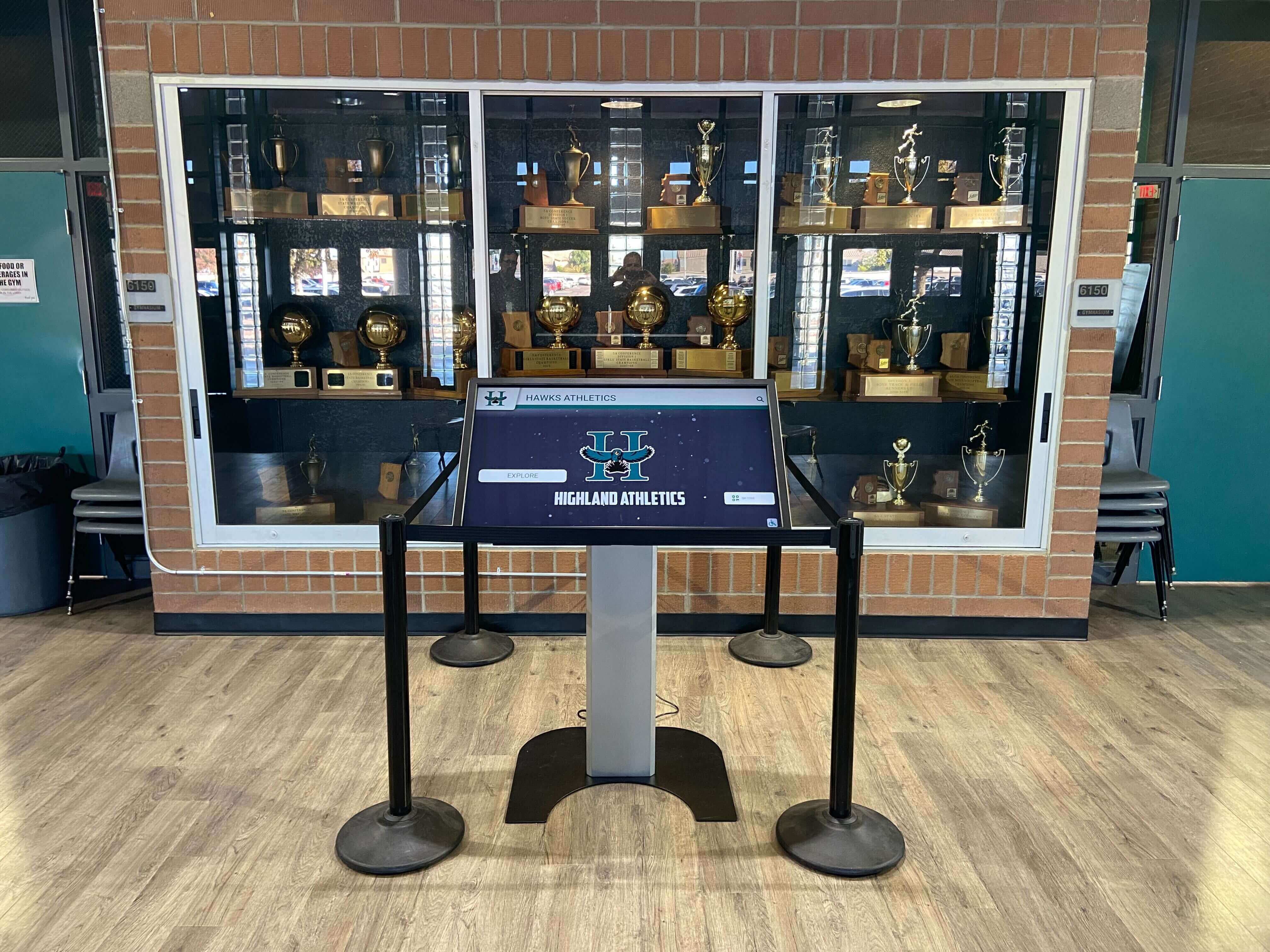
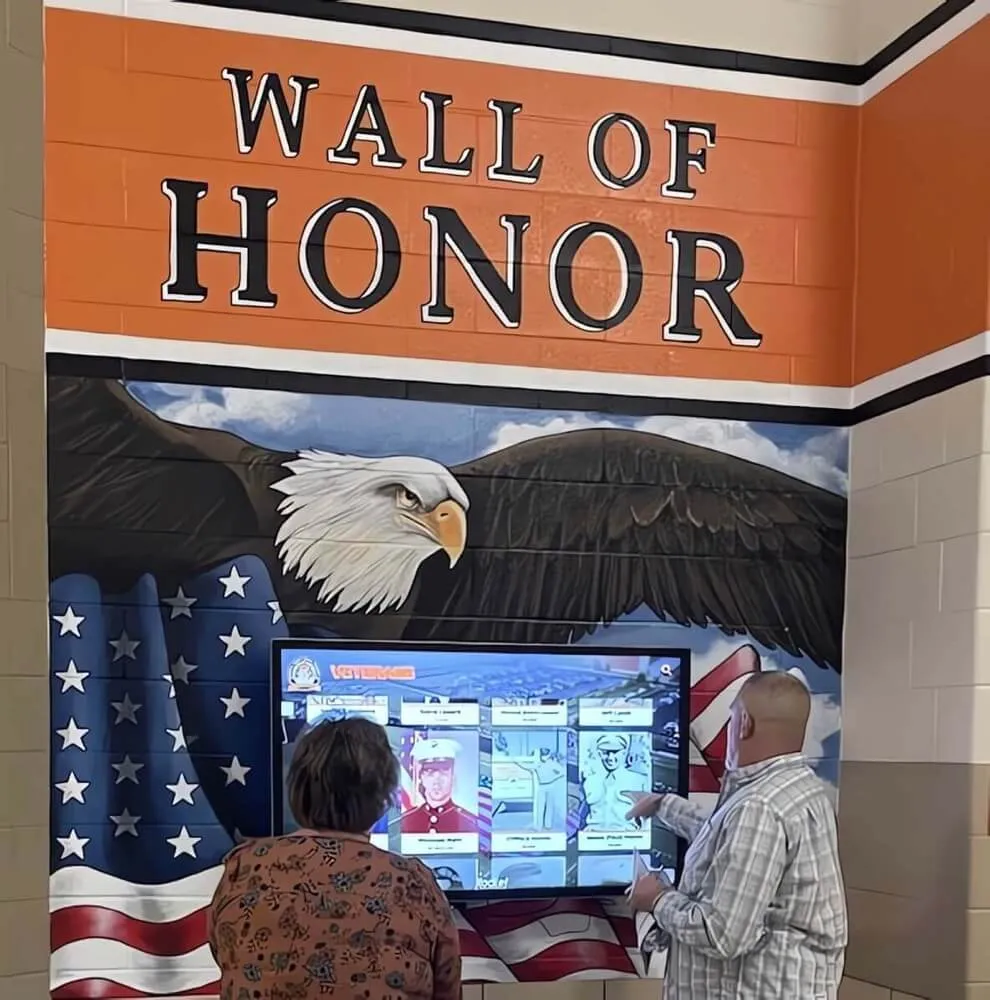
Records behind a recognition display are edited by multiple staff members across multiple sessions — optimistic locking ensures that when two sessions modify the same record, the conflict is surfaced and resolved deliberately rather than silently overwritten
Optimistic Locking Policy Readiness Checklist
Use the following checklist to assess whether the program’s current platform and procedures meet the minimum requirements for a written optimistic locking policy.
Platform Configuration
- Platform maintains a version token (timestamp, integer counter, or state hash) per award record
- Version token is updated automatically at each successful save
- Platform compares tokens on save and blocks overwrites when tokens differ
- Conflict notification identifies the record, the conflicting fields, and the user whose save caused the conflict
- Blocked save is preserved — not discarded — pending conflict resolution
Policy Documentation
- Policy specifies the version token format in use
- Policy defines the conflict detection rule in writing
- Policy specifies the required content of conflict notifications
- Resolution authority is assigned by name and role in the policy
- Conflict log format and retention period are documented
Staff Readiness
- All staff with award record edit access have reviewed the conflict notification procedure
- Conflict resolution owner and backup are identified and have confirmed the role
- Response time standard for conflict resolution is documented
Conflict Log
- Conflict log exists and is accessible to the resolution authority
- Log captures: conflict date/time, record ID, conflicting fields, competing values, both user identities, resolution choice, and resolution date
- Log retention period matches the retention period for the underlying award category
For programs evaluating display platform capabilities as part of a broader platform review, digital hall of fame high-contrast mode testing and platform validation covers a related dimension of platform evaluation — verifying that platform features function as specified across access scenarios. Platform concurrency behavior and conflict detection should be on the same evaluation checklist. Similarly, hall of fame website browser compatibility testing addresses how recognition platform administrators can systematically verify that the platform behaves consistently across the range of devices and sessions staff use to access record-editing interfaces — a direct precondition for concurrency protection to work as designed.
How Digital Recognition Platforms Support Concurrency Protection
Purpose-built digital recognition platforms handle optimistic locking as a built-in infrastructure behavior, though it is rarely described using that term in platform documentation. Every save operation in a well-designed cloud-based recognition system includes a version check. The platform maintains a version counter per record that increments automatically with each successful save and compares that counter at each subsequent save attempt.
Platform capabilities that directly support optimistic locking policy compliance:
- Automatic version token management. The platform assigns and increments version tokens without requiring staff action. No administrator needs to manually manage version state — the system handles it as part of the save workflow.
- Conflict detection at save time. The platform compares version tokens before committing any save to the database. If the tokens differ, the save is rejected and the conflict is surfaced before any data is modified. The record retains the state of the most recent successful save while the conflict is pending.
- Conflict notification in the editing interface. Well-designed platforms surface conflict notifications directly in the editing interface — not only in a backend log — so the user whose save was blocked can immediately see what happened, what fields are in conflict, and what the competing values are.
- Pending save preservation. After a conflict is detected, the pending changes from the blocked session are held accessible so that the resolution authority can review and apply them without requiring the affected user to re-enter their changes from scratch.
- Conflict audit trail. The platform logs each conflict detection event and each resolution, creating an audit record that supports the conflict log requirements of the written policy without requiring a separate manual logging step.
For programs evaluating which platform capabilities to prioritize when selecting or upgrading a recognition system, touchscreen software options for managing recognition content provides context on how platform selection decisions affect the content management workflows that govern staff editing access and concurrent record updates. A platform that does not enforce version-level conflict detection cannot support a meaningful optimistic locking policy regardless of the written policy’s completeness.
For recognition programs that also use digital scoreboard integrations or broader athletic display systems where live record updates may occur alongside staff editing sessions, basketball scoreboard features and buying considerations for schools covers the display infrastructure context where record accuracy at the database layer translates directly to what is visible to athletes, families, and visiting teams.
For programs that manage employee or staff recognition alongside athletic honor records — sharing the same platform and administrative access — creative employee recognition programs and their governance considerations illustrates how concurrent-edit protection applies across all recognition categories managed on a shared system, not only athletic award records.

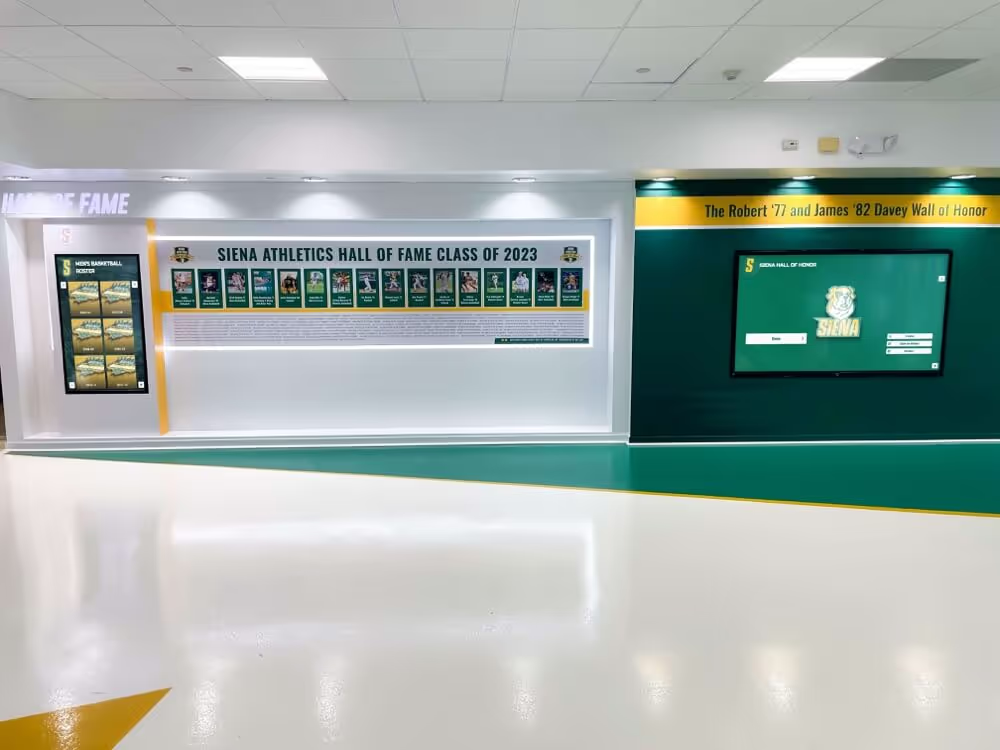
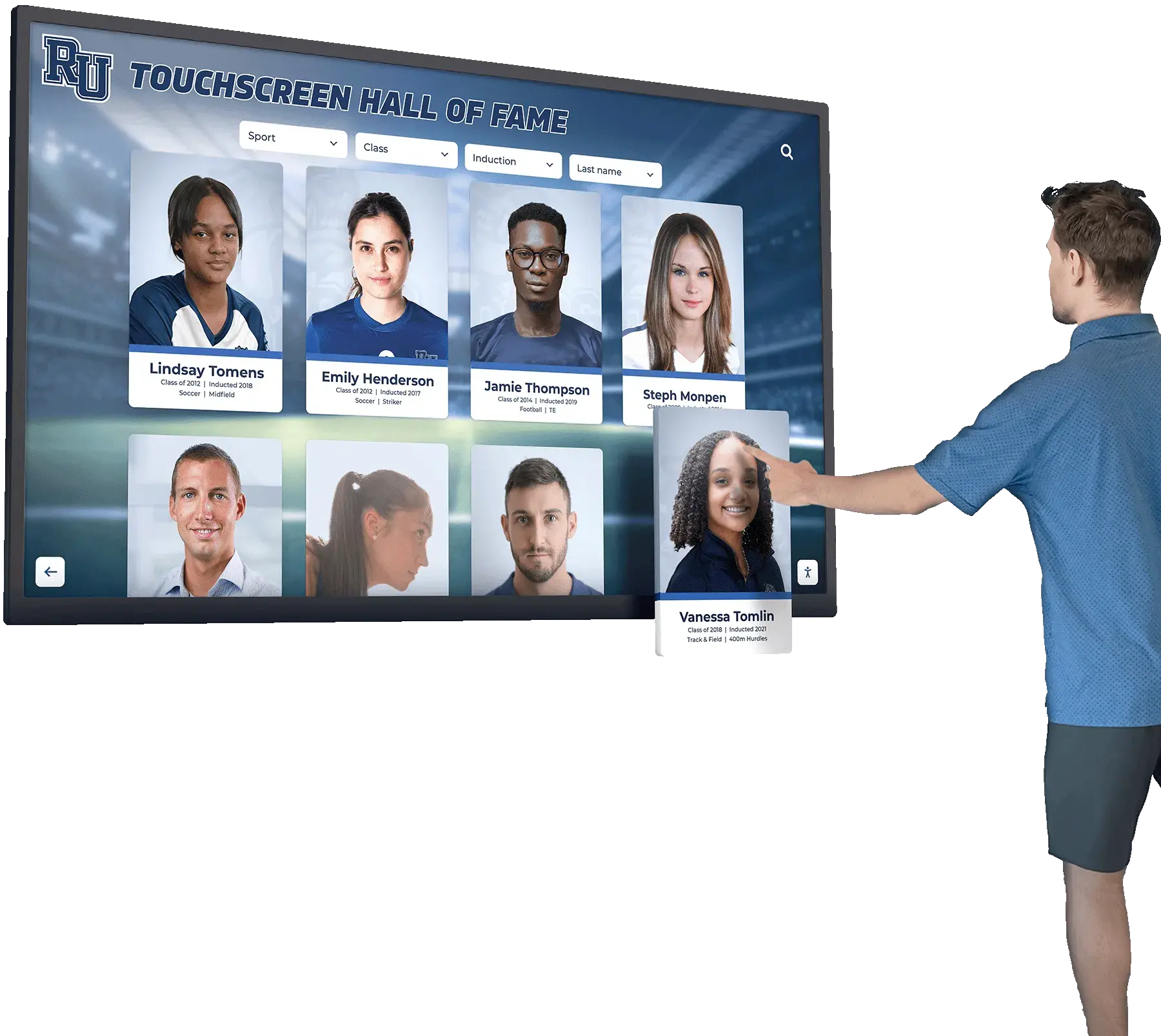
Every profile visible on a touchscreen recognition display depends on accurate, un-overwritten data in the underlying database — optimistic locking ensures that concurrent staff edits produce deliberate, resolved outcomes rather than silent data loss
Connecting Optimistic Locking to Broader Data Governance
An optimistic locking policy does not operate in isolation. It is one layer within a broader data governance framework for athletic award records — the concurrency layer that protects the accuracy of the data all other governance policies depend on. A correction log documents changes, but only accurately if the data reaching the log was not silently overwritten before the log recorded it. A data versioning policy creates retrievable record states, but only if each version captures the genuine intended state rather than an artifact of a silent overwrite.
Programs that have already established correction logging or data versioning governance will find that optimistic locking closes the gap those policies cannot reach: the window between when an edit is opened and when it is saved. Correction logs and version histories document what happened after the save. Optimistic locking is the governance layer that ensures what was saved accurately reflects what was intended — by one deliberate author, not by a collision between two concurrent sessions that neither staff member was aware of.
For recognition events such as alumni reunions, induction ceremonies, and awards banquets — where recognition records are often reviewed and corrected in the days before a public event by multiple staff simultaneously — the concurrent-edit window is at its widest. For context on how recognition program governance applies in the context of alumni-facing events where records carry heightened visibility, class reunion planning and the recognition record considerations that accompany alumni events covers how recognition accuracy standards apply precisely when records are under the most concentrated simultaneous review.
Who Should Own Conflict Resolution Authority?
Conflict resolution authority is the right to decide, when two competing edits exist, which version takes effect — or whether a merged resolution incorporating elements of both should be applied. This authority should belong to the athletic director in most programs. It should be documented by name and role in the written policy, with a named backup to ensure continuity when the primary resolution authority is unavailable.
Three situations that commonly trigger conflict resolution in school programs:
Pre-banquet record finalization. In the days before an athletic banquet or induction ceremony, multiple staff members review and correct award records to ensure display accuracy for the event. Concurrent edits during this period are the most common source of conflicts in programs that track them.
Post-migration cleanup. When a program migrates from one recognition platform to another, imported records frequently require corrections from multiple staff across multiple sessions. Conflicts during post-migration cleanup are common and often involve records that have not been touched since original entry.
Season-close award entry. When coaches and athletic directors finalize end-of-season team honors simultaneously — often within a short window before awards are announced — the same records may be opened by different staff members who each have partial information to enter.
In each scenario, the conflict itself is not a failure — it is evidence that the concurrency protection mechanism is working as intended. The governance failure would be if the conflict were silently resolved by discarding one user’s changes without notification. A written policy that assigns resolution authority and requires a conflict log converts detected conflicts from evidence of a problem into evidence of governance functioning correctly.
Frequently Asked Questions
What is an athletic awards database optimistic locking policy?
An athletic awards database optimistic locking policy is a written governance document that defines the rules for detecting and resolving edit conflicts when two or more staff members modify the same award record at the same time. Optimistic locking allows multiple users to read and begin editing a record simultaneously, then checks for conflicts only at the moment of save. If the record was changed by another user after the current session opened it, the save is blocked and a conflict notification is raised. The policy specifies the version token format, the conflict detection rule, the required content of conflict notifications, who has resolution authority, and how conflicts are logged.
How does optimistic locking prevent silent overwrites of athletic award records?
Optimistic locking attaches a version token — a timestamp, an incrementing integer, or a state hash — to each award record. When a user opens a record for editing, the system records the current token. When the user saves, the system compares the saved token against the current database value. If they match, no one else changed the record since the session began, and the save proceeds normally. If they differ, someone else saved a change in the intervening window. The system blocks the second save and surfaces a conflict notification that identifies the competing changes. Neither change is lost — the conflict is held for deliberate resolution by the designated resolution authority.
How does optimistic locking differ from pessimistic locking for school athletic programs?
Pessimistic locking prevents concurrent access by locking a record when the first user opens it for editing, forcing all other users to wait until the lock is released. Optimistic locking allows all users to access the record simultaneously and checks for conflicts at save time only. For school athletic programs — where records have many readers, relatively few simultaneous editors, and a risk that abandoned edit sessions will leave records locked indefinitely under pessimistic locking — optimistic locking is the appropriate default. It allows normal concurrent access while still protecting against silent overwrites when two users happen to modify the same record in the same window.
What should an optimistic locking policy include for athletic award records?
A complete optimistic locking policy for athletic award records should document five components: the version token format and how it is assigned (automatically by the system, never by staff); the conflict detection rule (save is blocked when tokens differ); the required content of conflict notifications (record identifier, conflicting fields and values, identity of the user whose save caused the conflict); resolution authority (the athletic director or a named designee holds the right to decide which version takes effect); and conflict log requirements (all detected conflicts and resolutions are logged with field-level detail and retained for the same period as the underlying records).
Can digital recognition platforms enforce optimistic locking automatically?
Yes. Cloud-based digital recognition platforms designed for athletic and school recognition programs maintain version tokens at the record level as part of their standard save workflow. The platform increments the token automatically at each successful save and compares tokens before accepting any subsequent save — without requiring staff to take any action related to version management. The conflict notification, pending-save preservation, and conflict audit trail are all handled at the platform layer. The written policy governs what the program does when a conflict occurs — the resolution authority, the response time, the log format — while the platform handles the technical detection and notification automatically.
See Concurrency-Protected Award Records in Action
Rocket Alumni Solutions provides athletic directors with a cloud-based recognition platform that protects award records from concurrent-edit overwrites — with automatic version tracking, conflict detection at save time, and a full audit trail for every record. ADA WCAG 2.1 AA compliant, with remote content management, auto-ranking record boards, and QR code mobile access. Request a demo to see how recognition records stay accurate when multiple staff are editing simultaneously.
Request a Demo