



An athletic awards database pg_stat_database baseline is a before-and-after snapshot of PostgreSQL’s pg_stat_database system view, scoped to your school’s specific recognition database, that gives IT administrators and athletic department data stewards a factual reference point for cumulative activity counters — connections, buffer cache hits, row operations, and transaction volume — against which they can measure the impact of award imports, seasonal data refreshes, and hall of fame display queries throughout the school year.
This guide is for athletic directors, school IT staff, and recognition archive coordinators who maintain a PostgreSQL-backed athletic awards collection that powers digital hall of fame displays, lobby kiosks, and championship records boards. It covers the scope of pg_stat_database in PostgreSQL 18, how to isolate your database row from shared-objects rows, how cumulative counters behave and why delta rates require elapsed time, what blks_hit actually measures, the distinction between tup_returned and tup_fetched, how I/O timing zeros should be interpreted, and a practical baseline checklist aligned to the recognition calendar.
Every school’s athletic awards collection carries decades of achievement — varsity letters earned, championships won, records set in gyms and on tracks and in pools — and that history deserves the same care in its digital home as it does in the trophy cases and halls of fame it supports. When that digital home runs on PostgreSQL, the pg_stat_database view is the most direct window into how the database as a whole is behaving: how many connections are active right now, how many blocks the award display queries have served from the buffer cache this season, how many rows the inductee profile lookups have returned since the last statistics reset. Capturing an athletic awards database pg_stat_database baseline before each major event or import window creates a factual record that makes the next round of questions — “Was the database busier than usual during the awards ceremony?” — answerable rather than speculative.

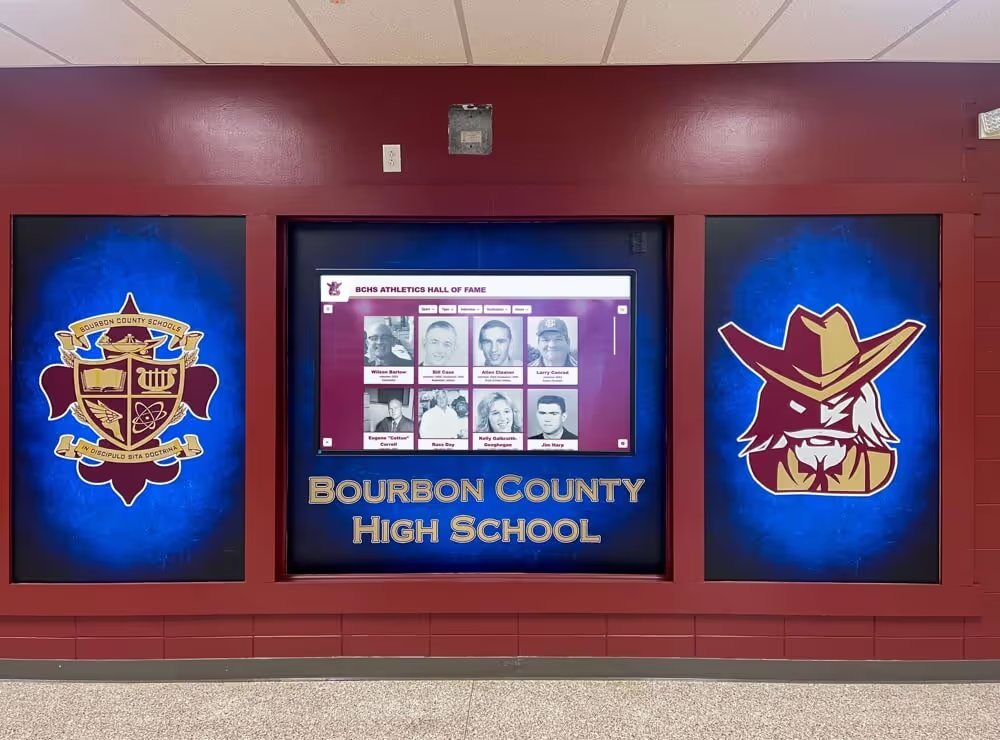
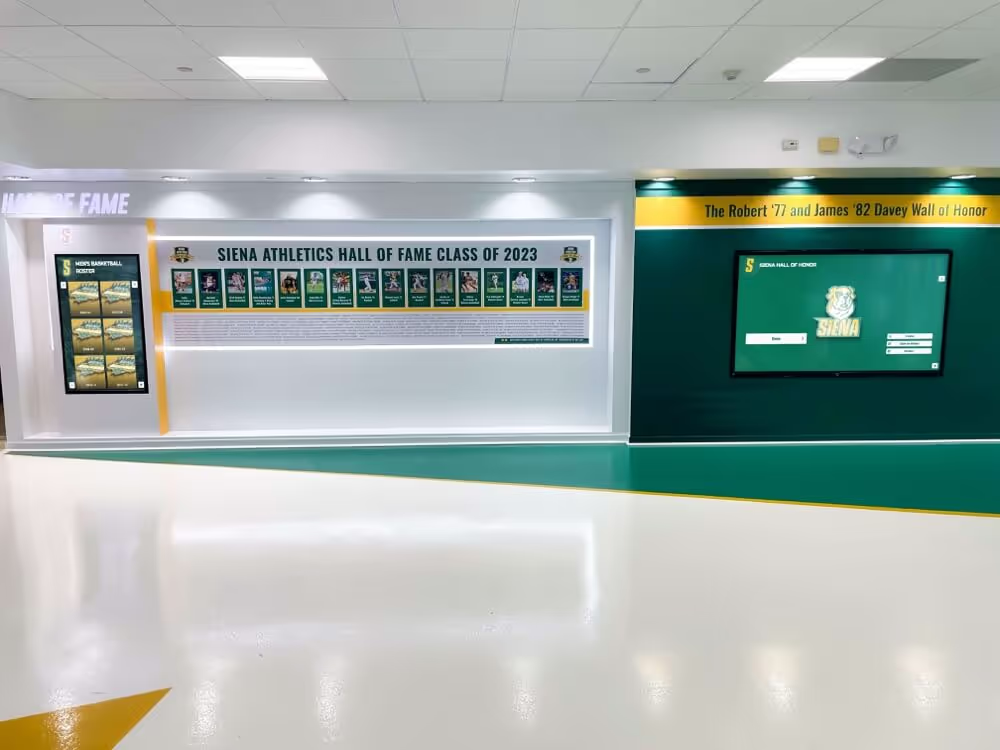
Illustrative school recognition display — a pg_stat_database baseline captures cumulative database-level statistics before high-traffic recognition periods so that the IT team can quantify what the event or import window added to the running totals
What pg_stat_database Provides for Athletic Award Collections
pg_stat_database returns one row per database in the PostgreSQL cluster, plus one additional row for shared catalog objects. According to the PostgreSQL 18 documentation on pg_stat_database, this view surfaces database-level cumulative activity statistics that accumulate from the moment the statistics were last reset — or from when the database was created if they have never been reset.
For a school managing an athletic awards collection, the view answers questions at the database level rather than the query level:
- How many connections are currently open against the recognition database? The
numbackendscolumn reports the current count of active backends — it reflects the live state at query time, not a cumulative total. Every other numeric column in the view is cumulative. - How often has the shared buffer cache served blocks to display queries without a disk read? The
blks_hitcolumn counts block requests answered from PostgreSQL’s shared buffer pool. Theblks_readcolumn counts those that required fetching from disk or the OS page cache. - How many rows have inductee search queries returned versus how many have index scans fetched?
tup_returnedandtup_fetchedcapture different sides of row access — a distinction that is easy to misread. - Has the statistics counter been reset since the last baseline? The
stats_resettimestamp tells you when the counters were last zeroed. A reset between two baseline snapshots invalidates the delta calculation.
The shared-objects row (where datid is 0 and datname is NULL) covers system catalog tables shared across all databases in the cluster. When targeting an athletic awards database specifically, filter by datname to exclude that row and any other databases on the same instance.
Before You Sample: Four Verification Steps
A pg_stat_database baseline has no value if the conditions under which it was taken are unclear. Four checks should precede every snapshot.
Verify you are querying the correct database row. Filter by both datid and datname to confirm you are reading the row for the awards database and not aggregating across the cluster. A query such as:
SELECT datid, datname, stats_reset
FROM pg_stat_database
WHERE datname = 'athletic_awards';
confirms the target before you capture any counters.
Record the stats_reset timestamp. If the statistics were reset between the before-snapshot and the after-snapshot — whether by a scheduled maintenance script, a DBA action, or a PostgreSQL version upgrade — the delta between the two snapshots is meaningless. Note the stats_reset value in both snapshots and confirm they match.
Sample outside a long-lived cached transaction. A session that has been open for an extended period may hold a cached snapshot of the statistics that does not reflect recent activity. Connect with a fresh session, run your query, and disconnect rather than leaving the connection open between the before-snapshot and the after-snapshot.
Record the wall-clock time at each snapshot. The view’s counters are cumulative, not per-unit-time. To calculate rates — blocks served per minute, transactions per hour, rows returned per second — you need the elapsed time between the two snapshots. Store the snapshot timestamp alongside the counter values, not just the counter values alone.

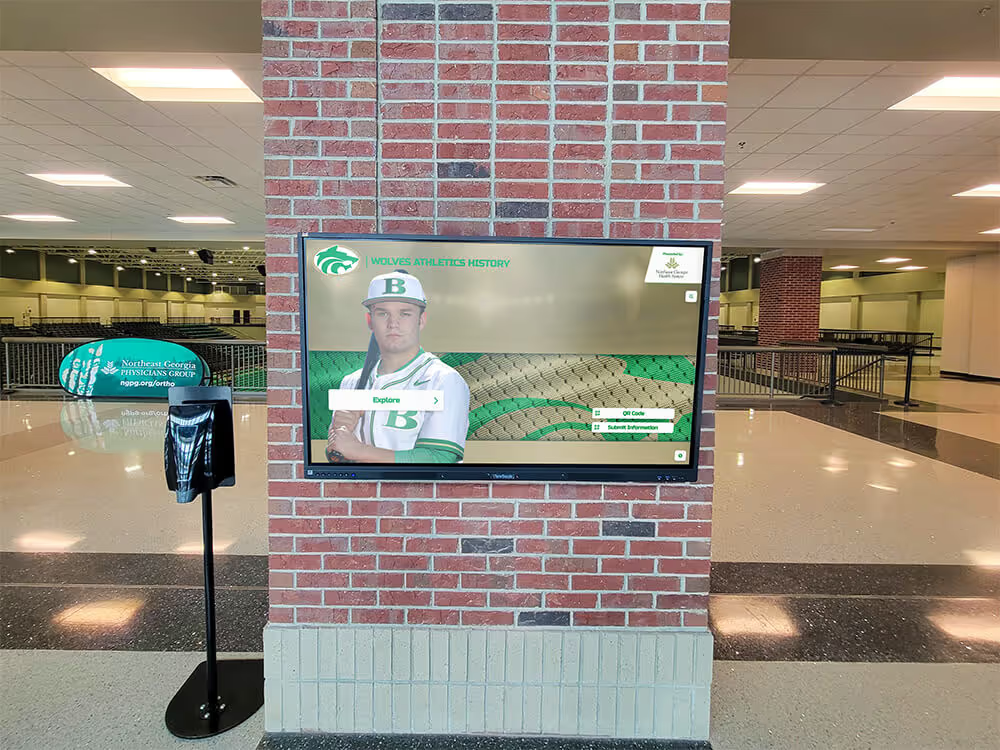
Illustrative school hall of champions display — each new inductee added to the athletic awards collection generates database write activity that a pg_stat_database baseline captures in its cumulative counters, giving the IT team a measurable record of what each import season contributes
Reading the Baseline: Key Columns and What They Mean for Award Collections
The table below covers the columns most relevant to athletic award database operations, with notes on scope, whether the value is current or cumulative, and the most common misread for each.
| Column | Type | Covers | Common Misread |
|---|---|---|---|
numbackends | Current | Active connections to this database right now | This is not cumulative. It reflects the live count, not a total over time. |
xact_commit | Cumulative | Committed transactions since stats_reset | Includes all commits — display queries, import operations, maintenance scripts |
xact_rollback | Cumulative | Rolled-back transactions since stats_reset | A non-zero value is not always a problem; expected for cancelled display queries |
blks_read | Cumulative | Blocks fetched from disk or OS page cache | Does not tell you how many were from disk vs. OS page cache — that distinction requires storage-layer tooling |
blks_hit | Cumulative | Blocks served from PostgreSQL’s shared buffer pool | Does not include OS page cache hits; the value reflects PostgreSQL’s buffer layer only |
tup_returned | Cumulative | Rows emitted by sequential scans and index scans | Not unique records, not unique athletes — counts every row sent out by a scan operation |
tup_fetched | Cumulative | Rows fetched via index scans that were then returned to the client | A subset of tup_returned; both are scan-level counts, not application-level page views |
tup_inserted | Cumulative | Rows inserted since stats_reset | Reflects import and data-entry volume over the period |
tup_updated | Cumulative | Rows updated since stats_reset | Includes record corrections, photo URL updates, and display configuration changes |
tup_deleted | Cumulative | Rows deleted since stats_reset | Includes deduplication and archive cleanup operations |
conflicts | Cumulative | Query conflicts on hot standby replicas | Relevant only if the awards database has a read replica serving display queries |
stats_reset | Timestamp | When counters were last reset to zero | Must match between before- and after-snapshots for the delta to be valid |
Capturing all these columns at both the start and end of a measurement window — along with the wall-clock timestamps — gives you a complete activity record for the period, whether that period is an award import, a hall of fame induction ceremony, or an end-of-season recognition banquet.
When school archive coordinators are formalizing what artifacts belong in the athletic awards collection before they enter the database, an Athletic Hall of Fame Accession Form provides a structured intake process that documents each artifact’s identity and condition before its records are entered — reducing the corrective updates and deletes that inflate tup_updated and tup_deleted over time.
Establishing Delta Rates: Elapsed Time and Cumulative Counters
The counters in pg_stat_database do not reset between samples — they accumulate continuously. A delta calculation requires subtracting the before-snapshot value from the after-snapshot value. A rate calculation then divides the delta by the elapsed seconds between the two snapshots.
For example, if blks_hit was 4,200,000 at the start of a 90-minute award import window and 4,380,000 at the end, the delta is 180,000 blocks served from the shared buffer pool during the window. Dividing by 5,400 seconds gives a rate of approximately 33 buffer hits per second across the entire window — a number you can compare against a baseline taken during a quiet overnight period to understand how much the import elevated buffer activity.
This calculation only holds if:
stats_resetis identical in both snapshots- Both snapshots were taken against the same database row (same
datid) - The elapsed seconds are measured at the moment of each query, not estimated afterward
If a statistics reset occurred between snapshots, the after-snapshot values will be lower than the before-snapshot values for counters that were non-zero before the reset, and the delta will be negative or nonsensically small. This is the most common reason a baseline review produces confusing numbers.
For award collections that also track SLRU cache activity during bulk imports — the local cache layers that handle transaction status lookups and sequence operations — the Athletic Awards Database pg_stat_slru Review | Interpreting Cache Counters During Seasonal Imports covers complementary counters that sit alongside pg_stat_database in PostgreSQL’s monitoring statistics framework.
blks_hit, tup_returned, and tup_fetched: What They Really Measure
Three columns in pg_stat_database are consistently misread in school IT reviews, and misreading them leads to incorrect conclusions about display performance and collection size.
blks_hit Is the PostgreSQL Buffer Cache Only
blks_hit counts blocks that PostgreSQL served from its own shared buffer pool — the memory area configured by the shared_buffers parameter. It does not count blocks served by the operating system’s page cache. When PostgreSQL cannot find a block in the shared buffer pool, it reads from storage — but if the OS has recently cached that block, the read is fast even though blks_hit does not count it. A session that reports a low blks_hit relative to blks_read is not necessarily causing physical disk I/O; it may be hitting the OS page cache. Distinguishing these two requires storage-layer instrumentation outside PostgreSQL, not pg_stat_database alone.
For an athletic awards database, this matters most when interpreting display query performance. A lower-than-expected blks_hit value during an induction ceremony is not automatic evidence of disk pressure — it is evidence that the PostgreSQL shared buffer pool was not the source, which leaves the OS page cache and actual disk reads as the remaining possibilities.
tup_returned and tup_fetched Are Not Row or Athlete Counts
tup_returned counts rows emitted during sequential and index scans — it is a scan-operation counter, not a count of unique rows, unique athletes, or page views. If an inductee search query scans 200 rows to return 5 matching profiles, tup_returned increments by 200, not by 5.
tup_fetched counts rows fetched via index scans that were then returned to the client. It is a subset of the access pattern, not a duplicate of tup_returned. The two values together reflect the balance between sequential and index scan activity in the database, but neither represents unique records in the collection or unique visitors to a display screen.
When schools are reconciling their digital recognition records against historical paper archives — a process where accurate name spellings, graduation years, and honor titles matter — the Hall of Fame Biography Fact-Check Checklist: Names, Dates, Teams, and Honors provides a verification process that reduces the corrective updates that add to tup_updated long after the initial import.

Illustrative interactive recognition display demonstration — the queries that serve screens like this contribute to pg_stat_database counters with every session, and a seasonal baseline documents how that activity accumulates across the school year
I/O Timing and the track_io_timing Prerequisite
pg_stat_database includes two timing columns: blk_read_time and blk_write_time. These columns record the total milliseconds spent reading blocks from and writing blocks to storage — but only when track_io_timing is enabled in the PostgreSQL configuration. When this setting is off, both columns return zero, and a zero value does not indicate that no I/O time was spent; it indicates only that timing was not recorded.
Before drawing any conclusions from timing columns, confirm the setting:
SHOW track_io_timing;
If the result is off, the zero values in blk_read_time and blk_write_time are inconclusive. Enabling track_io_timing requires a configuration change and a reload, and it adds a small overhead to every I/O operation because PostgreSQL must call the operating system’s time function on each read and write. For most athletic awards databases that are not under sustained heavy I/O load, the overhead is negligible — but the decision to enable it should be made deliberately rather than assumed.
When timing data is available, the ratio of blk_read_time to blks_read gives the average milliseconds per block read during the measurement window, which is a more direct signal of storage response time than block count alone.
Historical and Archival Records in the Athletic Awards Collection
Many schools’ athletic award collections include materials that predate digital systems — scanned photographs of championship teams, digitized newspaper clippings documenting record-breaking seasons, and archival images that carry historical significance alongside their recognition value. When these materials are ingested into a PostgreSQL-backed awards database, they generate the tup_inserted and tup_updated activity that a baseline captures.
For historical photograph collections that are being digitized for inclusion in a recognition database, the Historical Photos Archive for Schools: Complete Guide to Digitizing and Showcasing Your Institution’s Oldest Photos in 2025 addresses the digitization workflow that precedes database ingestion — from scanning standards to metadata conventions that determine how records are organized once they enter the system.
Schools that hold cyanotype or other early photographic formats among their athletic archives face additional handling requirements before digitization can begin. The Athletic Archive Cyanotype Photograph Intake: Protecting Blue Team Photographs Before Digitization covers the intake process for these materials, which typically represent the oldest and least-replaceable records in a school’s athletic history.

Illustrative school recognition display — award collections that span multiple decades accumulate a history of pg_stat_database activity across every import season, and a baseline established at the start of each year documents the incremental load each recognition cycle adds to the cumulative counters
Aligning Baselines with the Recognition Calendar
The most useful baselines are not taken at arbitrary intervals — they are aligned to the athletic program’s recognition calendar. The events that drive database activity in a school’s awards system are predictable: fall sports banquets, winter induction ceremonies, spring records-board updates, and the summer data hygiene window when IT staff correct spellings, add photographs, and merge duplicate records from different database entry points.
A recognition-calendar-aligned baseline schedule looks like this:
Before each award import window: Capture a snapshot before the import begins, record the stats_reset timestamp, and note the wall-clock time. Capture the after-snapshot immediately when the import completes. The delta documents the load the import added.
At the start of each recognition season: Capture a snapshot at the beginning of the high-traffic period — typically the week before a major banquet or induction ceremony — and another at the end. The delta documents what the season’s display traffic generated.
Before and after data hygiene operations: Corrective updates and deduplication deletes generate tup_updated and tup_deleted activity that is worth separating from import and display activity in the historical record.
At each statistics reset (if resets are scheduled): Record a final snapshot immediately before the reset and document the cumulative totals, so the reset does not erase the historical record for the period.
Baseline Acceptance Checklist
Before treating a baseline snapshot as a valid reference point, confirm each item:
- The query filtered by
datname(and optionallydatid) to target only the athletic awards database — shared-objects row excluded - The
stats_resettimestamp was recorded in the snapshot and matches the value in both before- and after-snapshots for any delta calculation - The snapshot was taken in a fresh session, not within a long-lived or idle transaction that might cache statistics
- The wall-clock timestamp was recorded at the moment of each snapshot query
-
track_io_timingstatus was checked and noted — timing columns were not interpreted as zero-meaning-no-I/O without this verification -
blks_hitwas understood as PostgreSQL shared buffer pool hits only — OS page cache contribution was not assumed to be captured here -
tup_returnedandtup_fetchedwere not treated as unique record counts or unique visitor counts -
numbackendswas understood as a current-state value, not a cumulative total for the measurement period - All counter columns noted as cumulative were confirmed to have been recorded with matching
stats_resettimestamps
Frequently Asked Questions
What is pg_stat_database and why does it matter for athletic awards collections?
pg_stat_database is a PostgreSQL system view that returns one row per database in the cluster plus a row for shared catalog objects. It exposes cumulative counters for transactions, buffer cache activity, row operations, and connection counts. For athletic awards collections, it provides a factual record of how much database activity a display season, an award import, or a data hygiene operation generated — supporting capacity planning and performance review conversations between IT staff and athletic administrators.
How often should an athletic awards database pg_stat_database baseline be captured?
Baselines should align to the recognition calendar rather than a fixed time interval. Capture a before-and-after snapshot around each award import window, at the start and end of each high-traffic recognition season, and before and after data hygiene operations. Consistency of timing matters more than frequency — a snapshot taken immediately before and after an import produces a clean delta; one taken hours earlier or later introduces noise from other activity.
Why does blks_hit sometimes seem lower than expected during a recognition event?
blks_hit counts only blocks served from PostgreSQL’s own shared buffer pool, not blocks served by the operating system’s page cache. If PostgreSQL cannot find a block in its shared buffer pool, it reads from storage — but if the OS has recently cached that block, the read is fast despite blks_hit not incrementing. A lower-than-expected blks_hit during a busy recognition event means the shared buffer pool was not the source, not necessarily that physical disk reads occurred.
What does a zero value in blk_read_time and blk_write_time indicate?
Zero values in blk_read_time and blk_write_time are inconclusive without first confirming that track_io_timing is enabled. When this PostgreSQL setting is off, the timing columns always return zero regardless of actual I/O duration. Run SHOW track_io_timing; to confirm the setting before drawing any conclusions from timing columns in a baseline review.
Can pg_stat_database tell us exactly how many award records were added during an import?
Not directly. The tup_inserted delta captures all rows inserted across all tables in the database during the measurement window — including rows from maintenance scripts, index activity, and any concurrent operations, not just the award import. For a precise count of records added by a specific import, query the target tables directly or use application-level logging that records the import’s row count at completion.

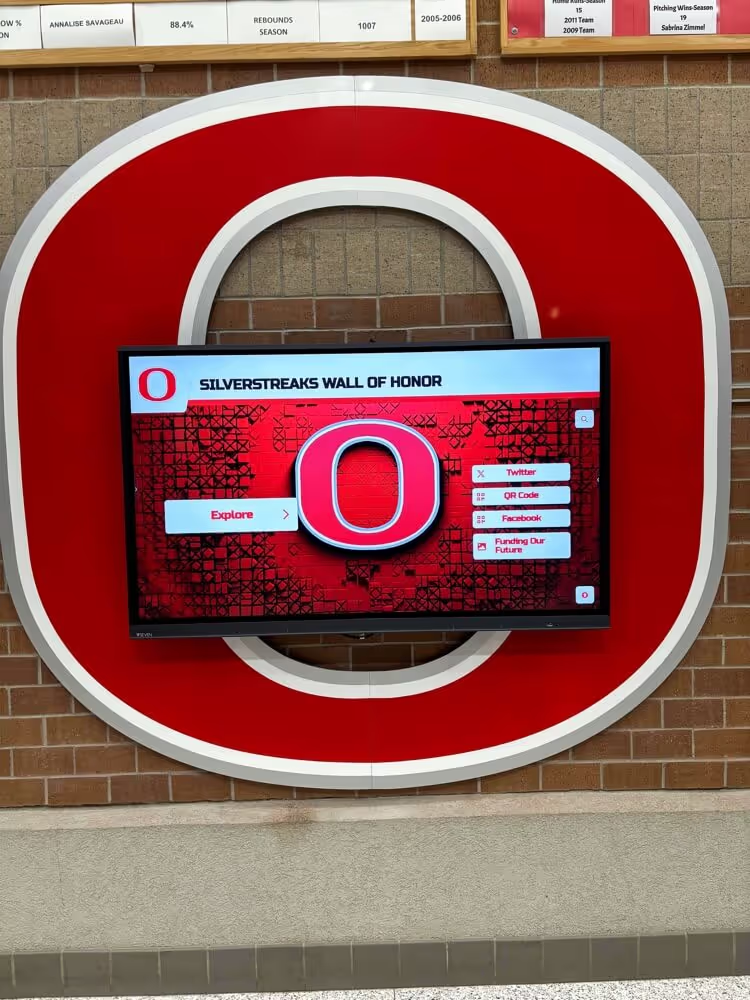
Illustrative school hall of fame lobby display — recognition collections serving installations like this benefit from a structured pg_stat_database baseline practice that documents the database activity each recognition season contributes to the cumulative record
See How Digital Awards Displays Serve School Recognition Programs
Rocket Alumni Solutions builds cloud-managed digital hall of fame and athletic recognition platforms for schools and universities. Request a demo to see how recognition data is organized, displayed, and updated — and to explore how a modern digital platform can serve your school's award collection.