



An athletic awards database prepared transaction audit is the step of checking PostgreSQL’s pg_prepared_xacts system view — and its equivalents in other databases — before running a new season import, to confirm that no in-doubt two-phase commit transactions are holding locks or blocking storage reclamation against the recognition tables. A prepared transaction is a transaction that has been written to disk and detached from its session, waiting for an external transaction coordinator to issue the final commit or rollback signal. Finding one in an awards database before a season import does not mean something has gone wrong, but it does mean the import team needs to understand who owns that transaction and whether it is safe to proceed.
This guide is for school athletic directors, recognition program owners, and the IT or database administrators who support season imports of award records, roster data, and hall-of-fame inductee batches. It explains what prepared transactions are, how they differ from SQL prepared statements, how to interpret pg_prepared_xacts, what to do when the audit surfaces an in-doubt transaction before import day, and when escalation is the right response.
Before running an end-of-season award import — loading conference honors, individual player awards, or a new hall-of-fame inductee batch — a brief check of the database’s prepared transaction state takes seconds and can prevent hours of recovery work. If a prior import session left a transaction in the PREPARE TRANSACTION state and that session disconnected without completing the commit or rollback, the transaction continues holding locks and blocking storage reclamation on the tables the next import will need. The audit finds that condition before new data arrives, not after.

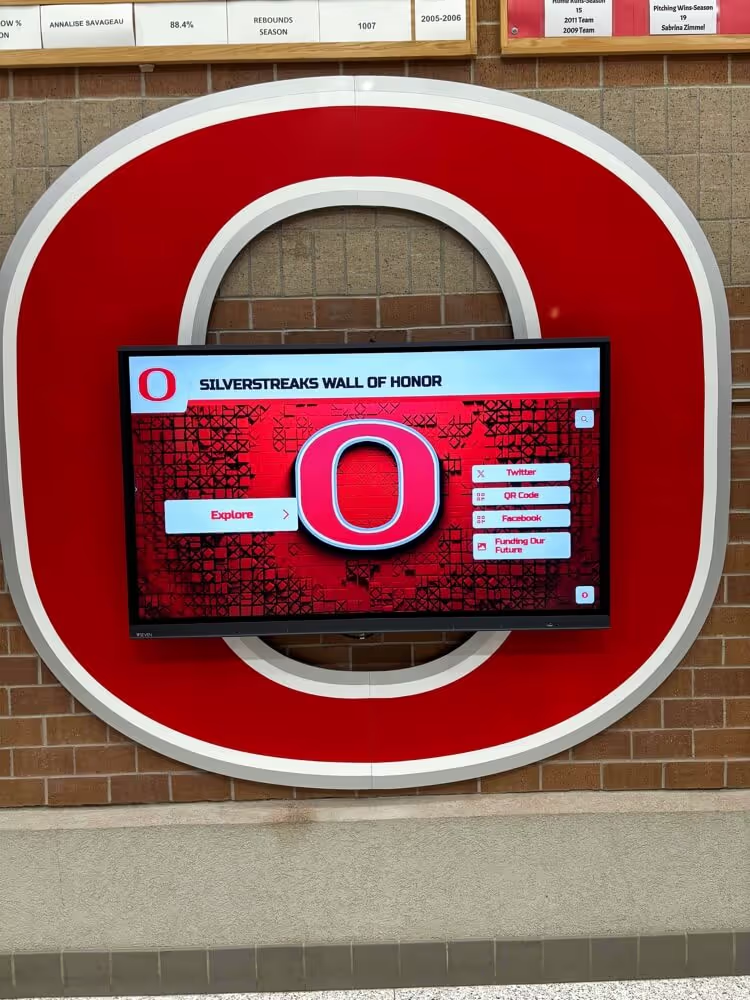
Hall of fame displays depend on award records that arrived complete and without transaction conflicts — a prepared transaction audit before each season import confirms there are no in-doubt commits holding locks on the tables the import will write to
What Is a Prepared Transaction — and What It Is Not
A prepared transaction is a specific database mechanism for two-phase commit. When an external transaction coordinator — a system responsible for synchronizing commits across two or more databases — reaches the first phase of the commit protocol, it issues PREPARE TRANSACTION 'transaction_id' to each participating database. This command writes the full transaction state to disk, detaches the transaction from the issuing session, and holds all acquired locks until the coordinator issues COMMIT PREPARED or ROLLBACK PREPARED. The PostgreSQL documentation on PREPARE TRANSACTION describes this as preparing the current transaction for two-phase commit so that it can be committed successfully even after a database crash.
A prepared transaction is not the same as a SQL prepared statement. This distinction matters for athletic directors and their IT partners because the two terms appear in the same conversations and are easily confused.
| Term | SQL Command | Purpose | Who Uses It |
|---|---|---|---|
| SQL prepared statement | PREPARE name AS ... | Caches a query plan for repeated execution with different parameter values | Application code, ORMs, import scripts — very common |
| Prepared transaction (two-phase commit) | PREPARE TRANSACTION 'id' | Suspends a transaction mid-commit for external coordinator finalization | External transaction managers — rare in most school recognition systems |
A school’s recognition database is almost certainly full of SQL prepared statements — every well-written import script uses them to avoid re-parsing the same insert or update query thousands of times per batch. Those are routine and have nothing to do with the prepared transaction audit. The audit is looking for the second row in the table above: transactions in the two-phase commit suspended state, visible in the pg_prepared_xacts view, that no active session is currently managing. For a deeper look at how prepared statements fit into policy for athletic recognition databases, the athletic awards database prepared statement policy on awardsdisplay.com covers that side of the distinction in detail.
What pg_prepared_xacts Shows
pg_prepared_xacts is a PostgreSQL system view that lists every transaction currently in the prepared-but-not-yet-committed-or-rolled-back state. Each row includes:
- transaction: the internal transaction ID, which determines what data the prepared transaction has modified and what it blocks
- gid: the global transaction identifier string — the value originally passed to
PREPARE TRANSACTION 'transaction_id', up to 200 bytes - prepared: the timestamp when the transaction entered the prepared state
- owner: the database role that executed
PREPARE TRANSACTION - database: the database in which the transaction was prepared
For a school awards database that does not use an external two-phase commit coordinator, this view should be empty. Any row found there represents a transaction that has been suspended, potentially for an extended period, while continuing to hold all locks it acquired before being prepared.
An IT administrator and an athletic director reviewing recognition records — the pre-import prepared transaction audit is a brief coordination step between these two roles before new season data enters the database
Why Prepared Transactions Matter for Season Imports
Three properties of prepared transactions make them directly relevant to a season award import:
Lock retention. A prepared transaction continues holding every lock it acquired during its execution. If the transaction touched athlete profiles, season records, or award assignment tables — all tables an incoming import needs to write to — those locks remain in place until COMMIT PREPARED or ROLLBACK PREPARED is issued. An import that encounters those locks will either wait (potentially indefinitely) or fail with a lock timeout error, leaving a partial import state that requires diagnosis.
VACUUM blocking. The PostgreSQL documentation notes that long-lived prepared transactions block VACUUM from reclaiming storage. In athletic databases with years of roster change history, accumulating blocked VACUUM operations degrade query performance precisely when import load is highest — end of season, when new award batches are largest and the most people are accessing the recognition system.
Transaction ID wraparound risk. In severe cases, a prepared transaction held for an extended period can prevent PostgreSQL from advancing its transaction ID counter, eventually forcing a database shutdown to prevent wraparound. The PostgreSQL documentation cites this as one reason to set max_prepared_transactions = 0 when two-phase commit is not intentionally in use. This is an edge case for a school recognition database, but it illustrates why an abandoned prepared transaction is not a trivially ignorable condition.
Understanding whether the school’s recognition database is configured for two-phase commit at all is the first question the audit checklist addresses.
Pre-Import Prepared Transaction Audit Checklist
Run this checklist before each major season import — any batch writing to athlete profiles, season award assignments, or hall-of-fame induction records. Minor corrections to individual records do not require a full audit but benefit from the pg_prepared_xacts spot check in step 5.
Confirm whether your recognition system uses an external transaction coordinator. Ask your platform provider or IT administrator: does the application use XA transactions, distributed commit protocols, or any middleware that spans multiple databases in a single commit operation? If the answer is no, a prepared transaction found in
pg_prepared_xactsis unexpected and warrants investigation before any import runs. If the answer is yes, proceed to step 2 to understand the expected state.Identify the coordinator and its expected GID format. If your system does use two-phase commit, the coordinator’s documentation should describe the global transaction identifier (GID) naming format it assigns — for example, a prefix indicating the coordinating system plus a timestamp or UUID. Knowing the expected format lets you distinguish coordinator-owned prepared transactions (which the coordinator will resolve) from abandoned or orphaned ones whose origin is unknown.
Check max_prepared_transactions in your database configuration. If this parameter is set to 0 — the PostgreSQL default unless explicitly changed — two-phase commit is disabled at the database level and
PREPARE TRANSACTIONcommands will fail. Your IT administrator can confirm the current value. If the value is 0 but you find rows inpg_prepared_xacts, the database may have been reconfigured since those rows were created. Escalate before importing.Query pg_prepared_xacts and record the result. Have your database administrator run a read-only query against the view and share the output. For each row found, note the GID string, the prepared timestamp, the owner role, and the database name. Do not issue any commands against the rows at this stage. This step is observation only.
Compare findings against the coordinator’s in-flight transaction list. If your system uses a coordinator, the coordinator should have a matching record for each GID found in
pg_prepared_xacts. A GID that appears in the database view but not in the coordinator’s log is an orphaned prepared transaction — the coordinator no longer knows about it. An orphan must not be committed or rolled back without understanding what data it modified and whether that data is still valid.Verify the prepared timestamp against your import schedule. A prepared transaction dated minutes before the current check may be legitimately in-flight from a coordinator still operating normally. A prepared transaction dated days or weeks before the check is almost certainly abandoned. Age alone does not authorize action on it, but it is important context for the escalation in step 7.
Escalate orphaned or unexplained prepared transactions to qualified IT staff before importing. Do not issue
COMMIT PREPAREDorROLLBACK PREPAREDwithout explicit authorization from the system or person who owns the originating coordinator. Committing an orphan can permanently write partial data to the recognition database. Rolling it back can permanently discard data the coordinator intended to commit. Either action without coordinator awareness breaks the two-phase commit contract. Escalation is the correct step — not a unilateral database command.Document the audit outcome. Record the date, auditor name, number of rows found in
pg_prepared_xacts, and the disposition: empty (clear to proceed); coordinator-owned (coordinator confirmed in-flight); or escalated (waiting for IT resolution). This log supports the import approval record and is useful if a future anomaly is traced to a specific import window.
Decision Table: What to Do When pg_prepared_xacts Is Not Empty
| Finding | Likely Explanation | Recommended Action |
|---|---|---|
| Zero rows | No prepared transactions in progress | Clear to proceed with import |
| Rows present; GIDs match coordinator’s in-flight list; timestamp is recent | Coordinator is mid-operation; normal when coordinator is actively running | Wait for coordinator to complete; confirm with coordinator operator before importing |
| Rows present; GIDs match coordinator’s list; timestamp is hours or days old | Coordinator operation stalled or coordinator crashed mid-commit | Escalate to IT; investigate coordinator health before importing |
| Rows present; GID format is unrecognized; recent timestamp | Unexpected source — possibly a test or misconfigured process | Escalate to IT; do not import until source is identified |
| Rows present; GID format is unrecognized; timestamp days or weeks old | Likely orphaned from a prior import, migration, or test operation | Escalate to IT for investigation; do not commit or rollback without IT authorization and confirmed ownership |
| max_prepared_transactions is 0 but rows exist | Database was reconfigured, or rows pre-date the current configuration | Escalate immediately; this state should not occur in normal operation |

Every athlete profile on a recognition touchscreen represents a completed, verified import — the prepared transaction audit confirms there are no suspended commits waiting to affect the next season's data before the import team proceeds
Escalation and Validation: Working With IT Before Acting
The prepared transaction audit is a check-and-escalation process, not a resolution script. The distinction matters because the two resolution commands — COMMIT PREPARED and ROLLBACK PREPARED — carry consequences the import team cannot evaluate without coordinator context:
COMMIT PREPARED 'gid' finalizes the transaction as if it committed normally. If the transaction wrote partial data that the coordinator intended to roll back — because another participant in the two-phase operation had failed — committing it creates a permanently inconsistent state between the recognition database and whatever other system the coordinator was synchronizing with.
ROLLBACK PREPARED 'gid' discards the transaction’s changes entirely. If the transaction modified records the coordinator intended to commit, rolling it back creates a permanent gap in the data — award records that should exist will not.
The coordinator is the only system with the full picture of the correct resolution for each prepared transaction it manages. When escalating, the IT administrator should provide the coordinator operator with the GID string, the prepared timestamp, the database name, the owner role, and any error logs from the period around that timestamp. The coordinator operator then determines whether a late commit, late rollback, or further investigation is appropriate.
For schools using recognition platforms that handle import coordination internally — platforms that manage the full import pipeline and do not expose two-phase commit mechanics to the athletic department’s workflow — this escalation path runs within the platform’s own support infrastructure. The pre-import audit step is still valuable as a confirmation that the underlying database state is clean before the platform’s import process begins. Athletic programs exploring how recognition programs come together around an import cycle can also benefit from a spring sports awards night planning guide for athletic directors on halloffame-online.com, which covers both ceremony planning and the record systems behind it.
max_prepared_transactions: The Default-Disabled Setting
One of the most practical facts about two-phase commit for school recognition programs is that PostgreSQL disables it by default. The max_prepared_transactions configuration parameter controls how many simultaneous prepared transactions the database allows. Its default value is 0, which means PREPARE TRANSACTION will fail with an error if called. This is an intentional safety default — the PostgreSQL documentation recommends setting it to 0 for any application that does not intentionally use an external transaction manager, specifically to prevent forgotten prepared transactions from accumulating and blocking VACUUM.
For school athletic databases:
- If
max_prepared_transactionsis 0, the recognition system does not use two-phase commit, andpg_prepared_xactswill be empty in normal operation. Rows found there indicate either a configuration change or a manual intervention that bypassed the default — both worth investigating before proceeding with an import. - If
max_prepared_transactionsis greater than 0, the value was set deliberately by an administrator. The IT contact should know why it was changed and which coordinator system is expected to use it.
This setting is verified at step 3 of the audit checklist — not because the value alone resolves every question, but because it establishes the baseline expectation for what pg_prepared_xacts should contain and frames every finding the audit surfaces.

Hall of fame inductee records like these depend on imports that completed cleanly — a prepared transaction audit is the pre-import checkpoint that confirms no suspended commit was waiting to interfere with the season's incoming data
Preserving School Athletic Legacy Through Import Governance
School athletic recognition records represent years of student achievement — individual honors, conference titles, record-breaking performances, and hall-of-fame inductees whose legacy belongs to the school community. A prepared transaction left in an in-doubt state before an import does not automatically corrupt those records. But it creates conditions where the import may lock up, fail silently, or partially succeed — any of which is harder to diagnose and recover from than a pre-import check would have been.
The audit practice described here is governance: a brief, documented confirmation that the database is in a known state before new data arrives. For programs interested in how digital recognition platforms present school athletic achievement to students and families, how schools recognize student athletes through athletic awards on touchscreenwebsite.com covers the display and recognition side of the program. For programs evaluating modern display formats for athletic achievement, best ways to showcase athletic achievement awards digitally on touchhalloffame.us and showcasing athletic achievement awards digitally on touchwall.tv offer complementary platform perspectives.
Award data quality efforts — checking data freshness, reconciling display records, validating referential integrity — all depend on the underlying database being in a predictable state before each write cycle begins. The prepared transaction audit is the earliest checkpoint in that cycle.
Frequently Asked Questions
What is an athletic awards database prepared transaction audit?
An athletic awards database prepared transaction audit is the process of querying pg_prepared_xacts — PostgreSQL's system view of in-doubt two-phase commit transactions — before running a season import, to confirm no suspended transactions are holding locks or blocking storage reclamation on the tables the import will write to. The audit identifies whether any transaction has been prepared (detached from its session after PREPARE TRANSACTION) but not yet committed or rolled back by its coordinating system. Finding such a transaction is not automatically a failure condition, but it requires investigation and, when ownership cannot be confirmed, escalation to qualified IT staff before new award data is written.
How does PREPARE TRANSACTION differ from a SQL prepared statement?
PREPARE TRANSACTION (the two-phase commit command) and PREPARE (the SQL prepared statement command) are entirely different mechanisms. PREPARE TRANSACTION suspends a full database transaction mid-commit, writes its state to disk, and waits for an external coordinator to issue the final commit or rollback. SQL prepared statements cache a query plan for repeated execution with different parameter values — a performance optimization used by application code and import scripts. Most school athletic databases use SQL prepared statements routinely and have nothing in pg_prepared_xacts at all. The prepared transaction audit targets only the two-phase commit mechanism, not the query caching mechanism.
Can a school IT administrator safely commit or rollback an in-doubt prepared transaction?
Not without confirming the correct action with the system that issued the PREPARE TRANSACTION. The external transaction coordinator is the authoritative source for whether COMMIT PREPARED or ROLLBACK PREPARED is correct for a given GID. Committing a transaction the coordinator intended to roll back writes partial data permanently to the recognition database. Rolling back a transaction the coordinator intended to commit permanently loses data. The correct step is to identify the GID in the coordinator's transaction log and let the coordinator operator determine the right resolution. IT staff who cannot identify the coordinator should treat the prepared transaction as an escalation requiring investigation, not a row to be resolved by database command alone.
What does max_prepared_transactions = 0 mean for a school's award database?
max_prepared_transactions = 0 means two-phase commit is disabled at the database level. PREPARE TRANSACTION commands will fail, and pg_prepared_xacts will remain empty under normal operation. PostgreSQL uses this as the default setting to prevent orphaned prepared transactions from accumulating in systems that do not intentionally use an external coordinator. For school athletic databases on platforms that do not use distributed commit protocols, this default is appropriate and expected. If the value has been changed to a non-zero setting, the change should be documented and the IT administrator should be able to name which coordinator is expected to use that capacity.
How often should a school run a prepared transaction audit before award imports?
Run the audit before every major season import — any batch writing to athlete profiles, season award assignments, or hall-of-fame induction records. For schools with high import frequency, such as multiple sports processing awards simultaneously at end of season, a brief daily check of pg_prepared_xacts during the import window adds minimal overhead and provides a clear record of database state at each import step. Individual record corrections do not require a full audit but benefit from the pg_prepared_xacts spot check as a verification step before the correction is applied and before the change appears on recognition displays.
See How a Managed Recognition Platform Handles Import Integrity
Rocket Alumni Solutions provides schools with a cloud-based athletic recognition platform that manages award data imports, display records, and hall-of-fame inductee batches at the infrastructure level — so your team focuses on the athletes, not the database state behind the scenes. ADA WCAG 2.1 AA compliant, with auto-ranking record boards, QR code mobile access, unlimited inductees and layouts, and remote content management from any device. Request a demo to see how a dedicated recognition platform keeps school award records accurate, complete, and display-ready across every season.
Request a Demo