



Intent: research — An athletic awards database REINDEX CONCURRENTLY policy defines the conditions under which a school’s recognition database administrators should rebuild degraded indexes using PostgreSQL’s concurrent reindex mode — rebuilding index structures without holding the access-exclusive lock that blocks reads and writes throughout the operation. Standard REINDEX acquires an exclusive lock on the indexed table for the full duration of the rebuild, halting every query against the recognition database while the operation runs. In a school environment where lobby kiosks, web archives, and digital hall of fame displays query the awards database continuously, that lock translates directly into visitor-facing outages during maintenance windows that are rarely long enough to be invisible. REINDEX CONCURRENTLY eliminates that outage by building a new index structure alongside the live table, swapping it in atomically, and dropping the old index — without blocking any ongoing reads or writes.
This guide is written for athletic directors, school IT administrators, facilities and database teams, and recognition-program data stewards responsible for PostgreSQL-backed award databases that power digital displays and touchscreen kiosks. It covers when concurrent reindexing is appropriate, the prerequisites that must be confirmed before any concurrent rebuild begins, the monitoring queries that track rebuild progress without guessing, the criteria for rolling back a rebuild that goes wrong, and a maintenance record template that provides the audit trail to justify future scheduling decisions.
An athletic season’s final weeks are the worst time for a recognition database to slow down. Coaches are submitting award nominations. Athletic directors are approving inductee lists. Families are searching lobby kiosks for their athlete’s records. And the indexes that make those queries fast — built up over seasons of inserts, corrections, and bulk imports — may have grown bloated enough to make every interaction noticeably slower than it was a year ago. The question is not whether to rebuild those indexes. It is how to do it without taking the display offline for the duration. An athletic awards database REINDEX CONCURRENTLY policy answers that question before the season, so the rebuild runs predictably, monitored, and reversible — not as an emergency measure at the worst possible moment.

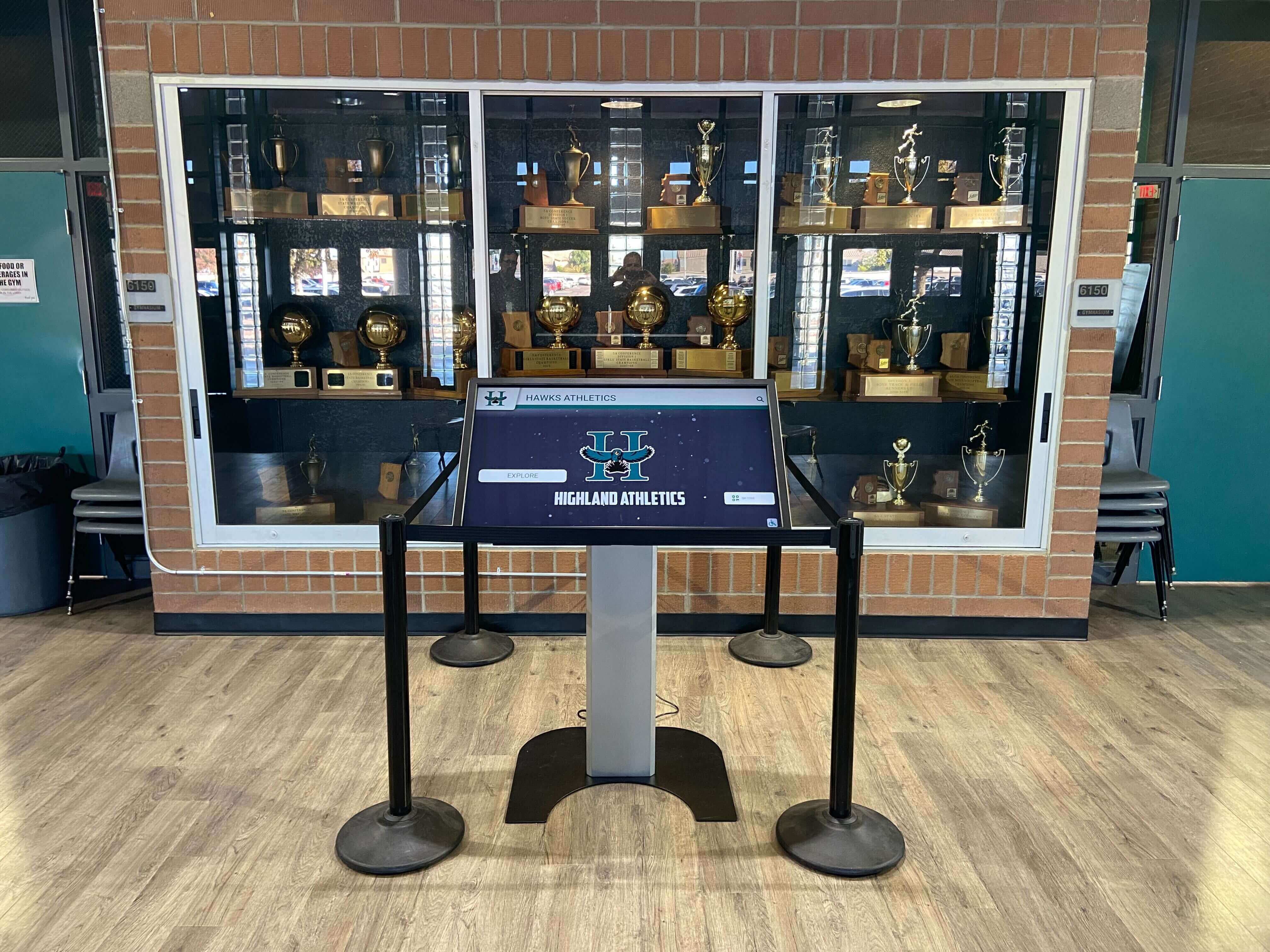
Recognition kiosks in trophy cases depend on index-backed queries to retrieve athlete records — a REINDEX CONCURRENTLY policy defines the conditions under which those indexes can be rebuilt without interrupting the queries that serve each visitor interaction
What Is REINDEX CONCURRENTLY and Why Does It Matter for Athletic Award Databases?
REINDEX CONCURRENTLY is a PostgreSQL operation that rebuilds an existing index without holding a lock that blocks concurrent reads or writes on the indexed table. Introduced in PostgreSQL 12 for individual indexes and extended in PostgreSQL 14 to support rebuilding all indexes on a table or database in a single command, it is the practical solution to one of the most common database maintenance problems in production systems that cannot tolerate downtime.
Standard REINDEX — without the CONCURRENTLY option — takes an ACCESS EXCLUSIVE lock on the indexed table for the full duration of the rebuild. No queries can read from the table. No imports can write to it. For most production systems, including award databases that serve lobby kiosks and web archives continuously, this lock creates an outage of unpredictable length: a heavily bloated index on a large multi-decade athletic archive can take minutes to hours to rebuild, and every minute of that window is visible to visitors as a failed or hung display.
REINDEX CONCURRENTLY works differently. It builds the new index incrementally alongside live table activity, using a lighter lock protocol that allows reads and writes to continue throughout. The tradeoff: the operation takes longer, consumes more I/O, and requires more temporary disk space than a standard rebuild. It can also fail partway through — leaving an invalid index that must be cleaned up — in ways that a standard REINDEX cannot. A policy governs precisely these tradeoffs: when to use concurrent reindexing, when standard reindexing during a true maintenance window is the better choice, and how to handle failure in each case.
For athletic award databases, the typical justification for a concurrent rebuild is index bloat — the gradual accumulation of empty or nearly-empty index pages caused by row updates, deletions, and bulk corrections over multiple seasons. Bloat increases the number of index pages the query planner must scan for every lookup, which slows down every query that touches the affected index. Regular autovacuum reclaims dead row space in the main table but cannot compact an index to recover empty pages from deleted entries. Only a rebuild — standard or concurrent — removes that bloat. For context on how autovacuum and index maintenance interact in an athletic recognition database, athletic awards database autovacuum policy and maintenance scheduling covers the relationship between routine vacuum tuning and the circumstances that make periodic index rebuilds necessary.
When Is REINDEX CONCURRENTLY Appropriate?
A complete athletic awards database REINDEX CONCURRENTLY policy specifies the conditions that make concurrent reindexing the correct choice — not a default maintenance action applied to every index on a fixed schedule.
Four conditions justify a concurrent rebuild:
1. Index Bloat Exceeds the Policy Threshold
The most direct indicator is measurable index bloat. PostgreSQL’s pg_stat_user_indexes and the pgstattuple extension (where available) provide the raw data; the policy should specify a threshold — commonly 30–40% bloat ratio for B-tree indexes on active recognition tables — above which a rebuild is scheduled. A well-maintained index with bloat under 20% does not need a rebuild; routine VACUUM and autovacuum handle dead-tuple cleanup adequately at that level.
-- Estimate index size and scan frequency for award database tables
SELECT
  schemaname,
  tablename,
  indexname,
  pg_size_pretty(pg_relation_size(indexrelid)) AS index_size,
  idx_scan,
  idx_tup_read,
  idx_tup_fetch
FROM pg_stat_user_indexes
WHERE schemaname = 'public'
  AND tablename IN ('athletic_awards', 'inductees', 'award_categories')
ORDER BY pg_relation_size(indexrelid) DESC;
When pgstattuple is available, the pgstatindex function provides a direct bloat measurement in the avg_leaf_density column — values below 50% on a B-tree index indicate significant bloat that degrades query performance.
2. Query Plan Regression Is Attributable to Index Degradation
A bloated index changes the query planner’s cost estimates because index pages now return fewer rows per page than they did when the index was compact. This can cause the planner to prefer a sequential scan over an index scan — or to choose a less selective index — for queries that should use the bloated index. When query plan monitoring shows a regression on a specific index-backed access pattern, and the regression coincides with a period of high write activity or bulk imports, index bloat is the likely cause.
3. A True Maintenance Window Is Not Available Before the Problem Affects Visitors
If bloat or corruption has been identified but no maintenance window is scheduled before the display must remain available, concurrent reindexing allows the rebuild to proceed without an outage. The policy should specify that concurrent reindexing is appropriate when the next scheduled maintenance window is more than a defined number of days away — commonly seven to fourteen — and the bloat or degradation is actively affecting query performance measured by display response times.
4. An Invalid Index Requires Rebuild After a Failed Concurrent Operation
Failed REINDEX CONCURRENTLY operations leave behind an invalid index — visible in pg_class with indisvalid = false. This invalid index does not assist queries but does carry write overhead for every DML operation on the table. The correct response is a new REINDEX CONCURRENTLY to replace it. A policy that specifies this response explicitly prevents teams from leaving invalid indexes in place or, worse, using a standard REINDEX without recognizing the availability impact.
Prerequisites Before Any Concurrent Rebuild
Concurrent reindexing requires confirmed prerequisites before the command runs. A policy that specifies prerequisites prevents the most common failure modes — a rebuild that consumes available disk space and aborts, or a rebuild run from a user session that lacks the necessary privileges.
Disk space verification. REINDEX CONCURRENTLY builds the new index to full size before dropping the old one. The database volume must have at least as much free disk space as the current index occupies, plus a margin for write-ahead log (WAL) growth during the rebuild. For a 200 MB index on a busy recognition table, the policy should require confirming at least 500 MB of free space before the rebuild begins.
-- Check current index sizes before concurrent rebuild
SELECT
  indexname,
  pg_size_pretty(pg_relation_size(indexrelid)) AS current_size,
  pg_size_pretty(pg_total_relation_size(indexrelid)) AS total_with_toast
FROM pg_stat_user_indexes
WHERE tablename = 'athletic_awards'
ORDER BY pg_relation_size(indexrelid) DESC;
Privilege confirmation. REINDEX CONCURRENTLY requires that the executing user owns the table or index, or holds superuser privileges. The policy should specify which database role runs scheduled concurrent rebuilds and confirm that role’s privileges before execution.
Replication lag baseline. Concurrent reindexing generates WAL records. On systems with read replicas — including those used for read-heavy display queries — these WAL records replicate to standby servers. The policy should record the replication lag baseline before the rebuild begins and specify the lag threshold above which the rebuild should be paused or canceled to prevent the standby from falling too far behind the primary.
Transaction ID wraparound headroom. Concurrent reindexing holds a snapshot open for the full duration of the rebuild. On databases approaching transaction ID wraparound — visible when age(datfrozenxid) approaches the autovacuum_freeze_max_age limit — holding a long-lived snapshot can interfere with autovacuum’s freeze operation. The policy should require confirming that the database has at least 500 million transactions of wraparound headroom before a concurrent rebuild is scheduled.
See how a purpose-built recognition platform manages database maintenance without impacting display availability — request a demo to explore how Rocket Alumni Solutions handles index health and query performance at the platform level.

Hall of fame displays serve inductee queries throughout the day — the concurrent reindex policy specifies the prerequisites that must be confirmed before any rebuild begins, ensuring the operation does not consume disk space or generate replication lag that would degrade display performance during the rebuild window
The REINDEX CONCURRENTLY Command for Athletic Award Tables
With prerequisites confirmed, the concurrent rebuild command follows a consistent pattern. The policy should specify the exact syntax to use for each scope and require that rebuilds run from a dedicated maintenance session rather than a shared application connection.
Single-index rebuild — most common for targeted bloat remediation:
REINDEX INDEX CONCURRENTLY idx_awards_award_date;
REINDEX INDEX CONCURRENTLY idx_inductees_name_covering;
REINDEX INDEX CONCURRENTLY idx_awards_athlete_id;
Full-table rebuild — all indexes on one recognition table:
REINDEX TABLE CONCURRENTLY athletic_awards;
REINDEX TABLE CONCURRENTLY inductees;
Full-schema rebuild — all tables in the recognition schema, use only during planned low-traffic windows:
REINDEX SCHEMA CONCURRENTLY public;
The policy should discourage schema-level concurrent rebuilds during active display hours, even though they do not block queries. A schema-level rebuild consumes significant I/O for an extended period, which degrades query response times across all tables without blocking any individual query. The correct scope for a concurrent rebuild during active hours is the single index or single table whose bloat has been measured and confirmed.
Session configuration for concurrent rebuilds:
-- Set in the maintenance session before executing REINDEX CONCURRENTLY
SET maintenance_work_mem = '512MB';  -- Allows faster index sort pass
SET statement_timeout = '0';         -- Disable timeout; rebuild may take hours
SET lock_timeout = '30s';            -- Fail fast if lock cannot be acquired
The maintenance_work_mem setting controls how much memory PostgreSQL allocates for the index build. Higher values reduce the number of on-disk sort passes and shorten the rebuild time. The policy should specify the maximum value appropriate for the school’s database server — typically 25–50% of available RAM for a dedicated database server.
Monitoring a Concurrent Rebuild in Progress
One of the most common errors in managing concurrent index rebuilds is running the operation without monitoring it. A REINDEX CONCURRENTLY that runs for hours may be making normal progress — or it may be blocked on a long-running transaction that holds a conflicting lock. Without monitoring, neither is visible until the rebuild finishes, fails, or is canceled.
Query 1: Track rebuild progress via pg_stat_progress_create_index
SELECT
  pid,
  phase,
  blocks_done,
  blocks_total,
  ROUND(blocks_done::numeric / NULLIF(blocks_total, 0) * 100, 1) AS pct_complete,
  tuples_done,
  tuples_total,
  current_locker_pid
FROM pg_stat_progress_create_index
WHERE command ILIKE '%concurrent%';
The phase column cycles through the stages of concurrent index creation: initializing, waiting for writers before build, building index, waiting for writers after build, waiting for old snapshots, and validating index. A rebuild stuck in waiting for writers or waiting for old snapshots for more than a few minutes indicates a blocking long-running transaction that should be investigated.
The current_locker_pid column, when non-null, identifies the session holding the lock that is blocking the rebuild’s progress. This is the session to investigate — not to cancel without authorization, but to understand whether it represents an active recognition workflow or an abandoned session that can be terminated safely.
Query 2: Identify transactions blocking the rebuild
SELECT
  pid,
  usename,
  application_name,
  state,
  wait_event_type,
  wait_event,
  query_start,
  NOW() - query_start AS query_duration,
  LEFT(query, 120) AS query_preview
FROM pg_stat_activity
WHERE pid = (
  SELECT current_locker_pid
  FROM pg_stat_progress_create_index
  WHERE command ILIKE '%concurrent%'
  LIMIT 1
)
   OR pid IN (
  SELECT pid FROM pg_locks
  WHERE NOT granted
    AND relation = (
      SELECT indexrelid FROM pg_stat_progress_create_index
      WHERE command ILIKE '%concurrent%'
      LIMIT 1
    )
);
Query 3: Confirm no invalid indexes remain after completion
SELECT
  schemaname,
  tablename,
  indexname,
  pg_size_pretty(pg_relation_size(indexrelid)) AS size
FROM pg_stat_user_indexes
JOIN pg_index ON pg_index.indexrelid = pg_stat_user_indexes.indexrelid
WHERE NOT pg_index.indisvalid
  AND schemaname = 'public';
This query should return zero rows after a successful concurrent rebuild. Any rows returned indicate that the rebuild failed and left invalid indexes requiring cleanup before the next attempt.
For recognition programs that also manage historical archive data alongside current athletic awards — where slowly changing dimension records accumulate bloat at different rates than append-only current season tables — athletic awards slowly changing dimension policy provides context on the data change patterns that accelerate index bloat on historical record tables, which directly informs how frequently concurrent rebuilds should be scheduled for each table type.
Rollback Criteria and Failure Recovery
A REINDEX CONCURRENTLY operation can be canceled at any point by terminating the backend process. Canceling is the appropriate response in specific situations that the policy should enumerate; canceling without defined criteria leads to either wasted rebuilds ended prematurely or bloat-producing failures left unattended.
Cancel the rebuild when any of these conditions occur:
- The rebuild has been in
waiting for writersorwaiting for old snapshotsfor longer than the policy’s maximum wait threshold — commonly 30–60 minutes — and the blocking session represents a live, legitimate recognition workflow that cannot be terminated. - Replication lag on read-replica servers exceeds the policy’s lag threshold — commonly 30–60 seconds — indicating that the rebuild’s WAL output is overwhelming the replica’s ability to keep up with the primary.
- Disk space available on the database volume drops below the policy’s minimum threshold during the rebuild, indicating the operation is consuming more space than projected.
- The database’s oldest transaction age approaches the
autovacuum_freeze_max_agelimit during the rebuild, threatening autovacuum’s ability to complete its freeze cycle before transaction ID wraparound becomes a risk.
Cleanup procedure after a canceled or failed rebuild:
When a concurrent rebuild is canceled, it leaves an invalid index. The policy should specify the cleanup steps:
-- List invalid indexes left by a failed or canceled concurrent rebuild
SELECT indexname, indexdef
FROM pg_indexes
JOIN pg_class ON pg_class.relname = pg_indexes.indexname
JOIN pg_index ON pg_index.indexrelid = pg_class.oid
WHERE NOT pg_index.indisvalid
  AND schemaname = 'public';

-- Drop each invalid index identified above
DROP INDEX CONCURRENTLY IF EXISTS invalid_index_name_here;
After cleanup, the original bloated but valid index remains in service. The policy should specify a minimum interval — typically at least one hour — before a new rebuild attempt, along with the reassessment criteria that determine whether a new concurrent rebuild or a scheduled standard REINDEX during a maintenance window is the appropriate next step given the conditions that caused the failure.
For athletic programs that also manage physical award storage alongside digital record maintenance — where preventive monitoring disciplines apply equally to physical and digital preservation — trophy case vibration monitoring and protecting fragile athletic awards describes the monitoring approach that parallels how index health monitoring prevents silent degradation in the digital archive.

Every athlete profile lookup on a hall of fame touchscreen is served by a database index — the REINDEX CONCURRENTLY policy specifies the monitoring queries and rollback criteria that ensure failed or stalled rebuilds are identified and resolved before they affect the display experience
Maintenance Record Template
A policy without records is a policy in name only. Each concurrent rebuild should produce a maintenance record that documents the decision to rebuild, the prerequisites verified, the outcome, and the post-rebuild validation results. This record justifies the next scheduling decision — whether to rebuild sooner because the last rebuild revealed faster-than-expected bloat accumulation, or to extend the interval because query plans remained stable well past the previous rebuild date.
The following template provides the minimum fields for a complete maintenance record:
REINDEX CONCURRENTLY Maintenance Record
| Field | Value |
|---|---|
| Date and time (UTC) | |
| Database server | |
| Target schema / table / index | |
| Rebuild scope | Single index / Table / Schema |
| Reason for rebuild | Bloat threshold exceeded / Query plan regression / Invalid index cleanup / Scheduled |
| Bloat ratio before rebuild | % (from pgstatindex avg_leaf_density) |
| Index size before rebuild | MB |
| Disk space available before rebuild | GB |
| Replication lag baseline before rebuild | ms |
| Transaction age headroom before rebuild | million XIDs |
| Rebuild started (UTC) | |
| Rebuild completed (UTC) | |
| Total duration | minutes |
| Outcome | Success / Canceled / Failed |
| If canceled or failed: reason | |
| Invalid indexes remaining after completion | Yes / No |
| Index size after rebuild | MB |
| Bloat ratio after rebuild | % |
| Query plan verified post-rebuild | Yes / No |
| Replication lag stabilized below threshold post-rebuild | Yes / No |
| Authorized by | |
| Executed by | |
| Next scheduled review date |
The “next scheduled review date” field is the forward-looking element that converts a maintenance record into a scheduling input. If the index rebuilt today shows 12% bloat immediately after the rebuild and then reached the 38% threshold in fourteen months, the next review should be scheduled in twelve months — not fourteen. If it reached threshold in six months, the review moves up accordingly. The maintenance record is the only source of data that makes this calibration possible.
For programs evaluating how database maintenance costs factor into multi-year athletic technology budgets — where index rebuild labor and scheduling are line items alongside digital display procurement and maintenance contracts — high school athletic department budget planning for awards records and digital displays provides context on how index maintenance activities fit within the broader athletic technology investment.
For programs building comprehensive born-digital records governance policies that treat database maintenance alongside archival retention requirements — where index health and record accessibility are both components of a formal digital archive policy — athletic archive born-digital records policy describes the records management framework in which concurrent reindex policy operates as one component of the broader digital archive governance structure.
Connecting REINDEX CONCURRENTLY Policy to Broader Index Governance
An athletic awards database REINDEX CONCURRENTLY policy functions as one element within a broader index governance framework. It specifies how to rebuild indexes once they have degraded — but it depends on and informs several adjacent governance components that identify problems earlier and prevent some categories of bloat from developing.
Relationship to autovacuum policy. Autovacuum handles dead-tuple reclamation in the main table heap and reclaims some index page space by marking pages as reusable. But it does not compact indexes — it cannot recover the empty pages that accumulate when rows are deleted and their index entries are removed. The autovacuum policy sets the frequency and aggressiveness of routine vacuum cycles; the REINDEX CONCURRENTLY policy addresses what to do when routine vacuum has not prevented index degradation from crossing the bloat threshold. Both policies are needed; neither replaces the other.
Relationship to fillfactor tuning. B-tree indexes built with a lower fillfactor — commonly 70–80% for active recognition tables — leave headroom in each index page for future in-place updates, which reduces bloat accumulation for UPDATE-heavy tables. An index on an append-only award table benefits less from fillfactor tuning than an index on a table that receives frequent name corrections and status changes. The REINDEX CONCURRENTLY policy should cross-reference the fillfactor settings for each index it governs, noting whether the bloat threshold was reached partly because fillfactor was not tuned for the table’s actual update rate.
Relationship to covering index policy. A covering index stores additional columns in its leaf pages, increasing its physical size relative to a single-column index. Larger indexes accumulate bloat faster in absolute terms: the same percentage of dead entries produces a larger absolute bloat footprint. Programs that implement covering indexes for display-critical query paths should account for their larger size when setting bloat thresholds and rebuild intervals in the concurrent reindex policy.
For recognition programs evaluating how their physical award collections and digital records fit together as a comprehensive recognition program — where digital displays and physical trophies serve complementary roles for visitors and alumni — best ways to showcase athletic achievement awards digitally and showcasing athletic achievement awards digitally: a complete guide describe the display environment in which database index health directly determines the quality of the visitor experience.
For programs using touchscreen hall of fame systems where live recognition data is served from a database backend — and where index rebuild policy directly affects the responsiveness of every visitor interaction — best ways to showcase athletic achievements with touchscreen displays covers the display infrastructure context that makes index maintenance policy a visitor-experience issue as much as a database administration concern.

Every athlete portrait card on a touchscreen hall of fame is served by a database query that depends on healthy, compact indexes — the concurrent reindex policy and maintenance record template ensure those indexes are rebuilt predictably, with rollback criteria defined before the operation starts
Frequently Asked Questions
What is REINDEX CONCURRENTLY and when should it be used for an athletic awards database?
REINDEX CONCURRENTLY is a PostgreSQL command that rebuilds an index without holding the exclusive lock that blocks reads and writes during a standard REINDEX operation. For athletic award databases where recognition displays and kiosks query the database continuously, it is the appropriate rebuild method whenever index bloat has degraded query performance and no maintenance window is available before the degradation affects visitors. It is also the correct response when a previous failed concurrent rebuild has left an invalid index in place. The tradeoff is that concurrent rebuilds take longer, consume more disk space, and can fail partway through — leaving invalid indexes that require cleanup. A written policy specifying the bloat threshold, disk space prerequisites, monitoring procedure, and rollback criteria makes concurrent reindexing a predictable maintenance operation rather than an improvised emergency response.
What prerequisites must be confirmed before running REINDEX CONCURRENTLY on a recognition database?
Four prerequisites should be confirmed before any concurrent rebuild begins. First, disk space: the database volume must have free space equal to at least the current index size plus a safety margin, because REINDEX CONCURRENTLY builds the new index before dropping the old one. Second, privilege: the executing database role must own the table or hold superuser privileges. Third, replication lag baseline: systems using read replicas for display queries should record the baseline lag before rebuilding and define the threshold above which the rebuild should be paused. Fourth, transaction ID wraparound headroom: a concurrent rebuild holds a long-lived snapshot that can interfere with autovacuum's freeze cycle if the database is approaching transaction ID wraparound — confirming at least 500 million transactions of headroom before starting prevents this interaction.
How do you monitor a concurrent index rebuild on an athletic award database without blocking queries?
PostgreSQL's pg_stat_progress_create_index view provides real-time rebuild progress without any impact on running queries. Query it by selecting the phase, blocks_done, blocks_total, and current_locker_pid columns filtered by command containing 'concurrent'. The phase column shows which rebuild stage is active; a phase stuck on 'waiting for writers' or 'waiting for old snapshots' for more than 30–60 minutes indicates a blocking long-running transaction. The current_locker_pid column, when non-null, identifies the session to investigate. After the rebuild completes, run a query against pg_index joining on indisvalid = false to confirm that no invalid indexes were left behind — a zero-row result confirms a successful concurrent rebuild.
What happens when REINDEX CONCURRENTLY fails or is canceled on an awards database?
A failed or canceled REINDEX CONCURRENTLY operation leaves behind an invalid index — visible in pg_index with indisvalid = false. This invalid index does not assist queries but still imposes write overhead on every DML operation that touches the table. The cleanup procedure is to drop the invalid index using DROP INDEX CONCURRENTLY IF EXISTS, which itself does not block reads or writes. After cleanup, the original bloated index remains in service. The policy should require a minimum waiting period of at least one hour before the next rebuild attempt, along with a reassessment of whether a new concurrent rebuild or a scheduled standard REINDEX during a maintenance window is the appropriate response given the conditions that caused the failure.
How often should athletic award database indexes be rebuilt with REINDEX CONCURRENTLY?
Rebuild frequency should be driven by measured bloat rather than a fixed calendar interval. A bloat ratio above 30–40% on a B-tree index — indicated by an avg_leaf_density below 60–70% in pgstatindex — is a common threshold that justifies a rebuild. For active recognition tables that receive seasonal batch imports and frequent name corrections, this threshold may be reached in six to eighteen months depending on import volume and update rate. Maintenance records documenting the bloat ratio before and after each rebuild provide the data to calibrate the next review interval. For append-only award tables with minimal updates, bloat accumulates more slowly and rebuild intervals can often be extended to two to three years if autovacuum is properly configured and fillfactor is tuned to the table's actual write pattern.
Conclusion: Reliable Index Maintenance Without Display Downtime
An athletic awards database REINDEX CONCURRENTLY policy is the governance document that ensures recognition database administrators can rebuild degraded indexes without creating the visitor-visible outages that standard REINDEX causes on production systems. By specifying when concurrent reindexing is appropriate — bloat threshold exceeded, query plan regression confirmed, invalid index cleanup required, or no maintenance window available — the policy converts an emergency measure into a scheduled, predictable operation.
The prerequisites prevent the most common concurrent rebuild failures: disk exhaustion, replication lag spikes, and transaction ID interference. The monitoring queries make rebuild progress visible without guessing, identify blocking sessions early enough to act, and confirm clean completion before the maintenance record is closed. The rollback criteria and cleanup procedure handle failure without leaving orphaned invalid indexes that degrade write performance silently. And the maintenance record template creates the historical data that informs future scheduling: how fast each index accumulates bloat, whether autovacuum and fillfactor tuning slow that accumulation, and when the next rebuild should be planned.
Programs that document this policy before the first concurrent rebuild, run the monitoring queries during every rebuild, and record the outcome in the maintenance template will find that index maintenance becomes a routine, low-stress operation — one that keeps recognition displays responsive through every import season without the emergency window scrambles that typically accompany undocumented index management.
See Recognition Data Served With Consistent, Maintained Performance
Rocket Alumni Solutions provides school athletic directors and IT teams with a cloud-based recognition platform where database index health, query performance, and display availability are managed at the platform level — no per-index rebuild scheduling, no bloat monitoring, no maintenance window coordination required. Request a demo to see how the platform keeps recognition displays responsive throughout every import season.
Request a Demo