



Intent: research — an athletic awards database snapshot isolation policy defines the rules for establishing, maintaining, and retiring read-consistent transaction snapshots so that recognition reports reflect a stable, internally coherent view of award records — even while staff are actively importing new seasons, correcting honoree data, or updating team rosters in the same database. Snapshot isolation is a concurrency control strategy built on Multi-Version Concurrency Control (MVCC): each reading transaction sees a point-in-time copy of the data as it existed when the transaction began, allowing concurrent writes to proceed without blocking report queries and preventing any report from reading a half-written, mid-import intermediate state.
This guide is written for athletic directors, school IT administrators, data stewards, and recognition-program owners who manage database-backed award archives and digital recognition displays. It covers the mechanics of snapshot isolation, why report consistency is operationally critical for school award programs, a five-component policy framework, an isolation-level selection table, an implementation checklist, and monitoring procedures for verifying that the policy is enforced during seasonal peaks.
Award reports generated by a school’s athletic recognition database serve purposes that depend entirely on the accuracy and internal consistency of the data at a specific moment in time. An eligibility summary distributed to coaches before a ceremony, a records-board total displayed on a lobby touchscreen, or a season-end award count submitted to the athletic office must each reflect a complete, coherent view of the record set — not a partial view that was true for part of the query and obsolete for the rest. When award reports are generated while concurrent imports are writing to the same tables, the risk of an internally inconsistent report is real and measurable. An athletic awards database snapshot isolation policy defines the technical and procedural rules that prevent it.

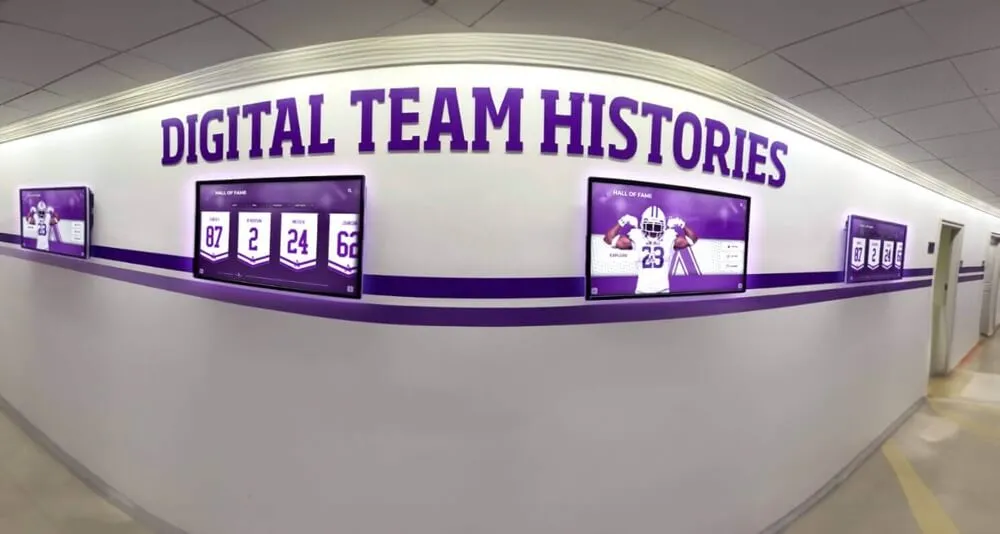
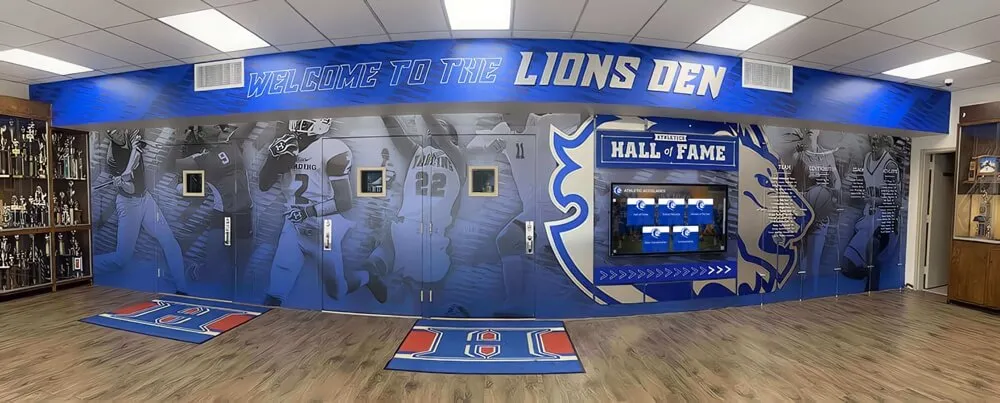
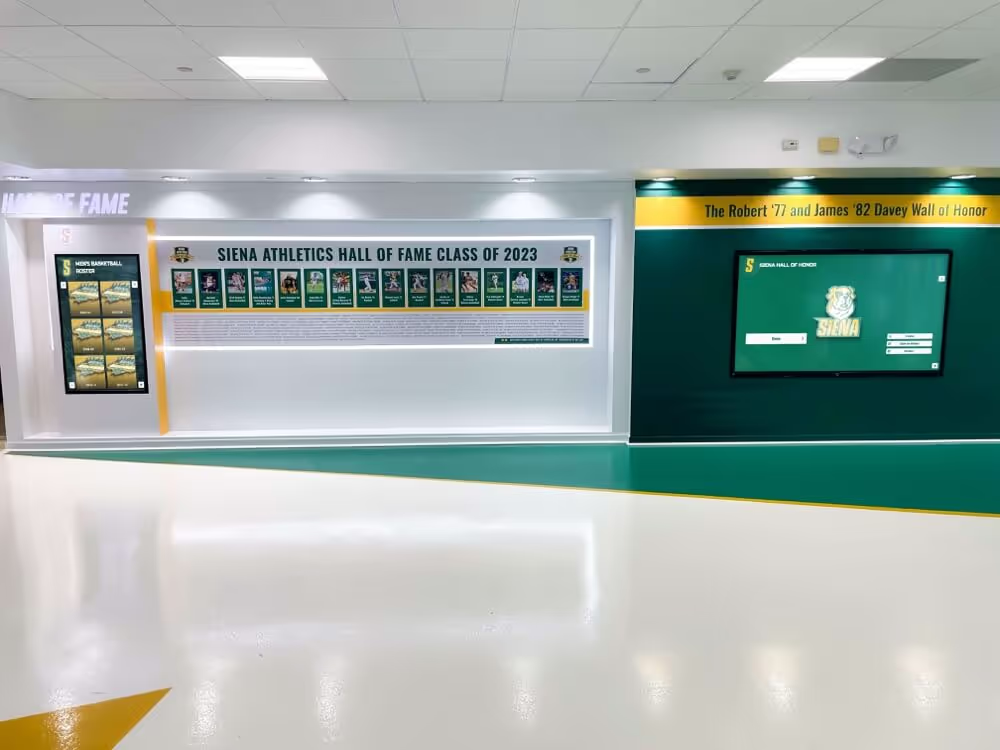
Digital recognition displays in school hallways require that the report queries feeding them execute against a stable, internally consistent snapshot of the awards database — not a view that shifts as concurrent imports write new records
What Is Snapshot Isolation in an Athletic Awards Database?
Snapshot isolation is a transaction concurrency model in which each transaction reads from a consistent point-in-time snapshot of the database rather than from the live, continuously changing record set. The snapshot is established when the transaction begins and held for the transaction’s duration. Rows inserted, updated, or deleted by concurrent transactions after the snapshot was taken are invisible to the reading transaction — as if those changes had not yet occurred — while the reading transaction remains open.
The underlying mechanism is Multi-Version Concurrency Control (MVCC). Instead of overwriting a row in place when an update occurs, an MVCC database stores the new version of the row alongside the previous version, tagging each version with a transaction identifier or timestamp. A transaction operating under snapshot isolation reads the version of each row that was current when the snapshot was established, ignoring all newer versions created by concurrent transactions.
The practical effect for an athletic awards recognition program:
- Report queries do not block import writes. A season-end batch import writing hundreds of award records does not need to wait for an open report transaction to complete before it can commit. The two operations proceed in parallel — the report reads from its snapshot, the import writes new versions, and neither blocks the other.
- Import writes do not corrupt report reads. A report that begins before an import batch commits never sees a partial import result. The report’s snapshot was established before the first import row was written; from the report’s perspective, that import does not exist.
- Multi-step reports remain internally consistent. A report that executes three separate queries — award counts by sport, eligibility thresholds by athlete, and records-board rankings — sees the same version of the data in all three queries, because all three execute within the same snapshot.
Snapshot isolation is supported natively by PostgreSQL (as the default Repeatable Read level), SQL Server (as an explicit READ_COMMITTED_SNAPSHOT or SNAPSHOT isolation setting), Oracle (as the default multi-version read model), and MySQL InnoDB (through its MVCC implementation at Repeatable Read). The specific configuration syntax differs by database engine; the policy must specify both the intended isolation behavior and the engine-specific setting that implements it.
Why Report Consistency Matters for Athletic Recognition Programs
School athletic recognition databases operate in two distinct traffic modes simultaneously and frequently: administrative sessions adding or correcting records, and reporting sessions reading those records to generate eligibility summaries, display content, and ceremony documentation. These modes overlap most intensely during the exact periods when report accuracy is most consequential — season-end imports, ceremony preparation, and hall of fame nomination windows.
Three operational scenarios illustrate how inconsistent reads corrupt athletic recognition reports when snapshot isolation is absent:
1. Season-end award batch and eligibility verification running concurrently. When a school closes out fall sports awards, coaching staff often run eligibility summaries — checking which athletes qualify for multi-year scholar-athlete honors, confirming award category counts are complete, or verifying that induction criteria thresholds have been met. If those eligibility queries execute without snapshot isolation while the award batch is still importing, a query that runs a count at step one of the report and a second count at step two of the same report may return different totals — because the import committed additional records between the two query executions. The report shows a total that was never actually true at any single point in time. At a ceremony organized around carefully staged sports banquet recognition moments, an eligibility count that shifts between the coach’s review and the awards announcement creates a credibility problem that cannot be retroactively corrected in the room.
2. Display refresh queries intersecting with mid-import table state. Recognition displays in athletic hallways and lobbies refresh their content from database queries on a scheduled cycle — often every few minutes for active periods, or on a push trigger when records are updated. If a display refresh cycle begins during an active batch import and the refresh queries execute without isolation, the display may render a records board that includes some of the new season’s entries but not others, producing totals that are internally inconsistent: a basketball records table showing updated field goal percentages but not yet updated game counts. Schools designing hall of fame display criteria and selection workflows for public-facing touchscreens depend on consistent record reads — a display that shows partial-import data during a live event undermines the program’s presentation of its own recognition history.
3. Nomination count reads during open submission windows. Hall of fame and award nomination systems that accept submissions through a web interface write to the same database as the reporting layer. A nomination-count summary for an administrator — showing how many nominations each candidate has received — may execute multiple sub-queries during report generation. If nominations arrive continuously from staff submitting via the web form during the same window, and the report executes without snapshot isolation, the total shown for candidate A may reflect a snapshot from 9:52 a.m. and the total shown for candidate B may reflect a snapshot from 9:53 a.m. The comparison is not coherent. The policy requirement is that both totals come from the same snapshot.
How Snapshot Isolation Works: MVCC and Isolation Level Configuration
Understanding the technical mechanism that implements snapshot isolation allows IT staff to configure the database correctly and verify that the configuration is in effect at runtime.
MVCC version chain. When a row is updated in an MVCC database, the previous version is retained in an internal structure (the version chain, undo log, or rollback segment, depending on the database engine). A reading transaction with a snapshot established before the update sees the pre-update version; a reading transaction with a snapshot established after the update sees the post-update version. The database engine resolves which version to return based on the transaction’s snapshot timestamp and the version’s commit timestamp.
Snapshot establishment timing. Under standard snapshot isolation, the snapshot is taken at transaction start. A transaction that begins at 10:00:00 reads a consistent view of the database as of 10:00:00 — even if the transaction is still executing queries at 10:00:45. This is the property that makes multi-step reports internally consistent: all queries within the transaction read from the same 10:00:00 baseline regardless of how long the report takes to complete.
Isolation level mapping by database engine:
| Database Engine | Isolation Level Name | Snapshot Isolation Behavior |
|---|---|---|
| PostgreSQL | REPEATABLE READ | Snapshot taken at first query in transaction; concurrent inserts and updates invisible until transaction ends |
| PostgreSQL | SERIALIZABLE | Full serializable semantics; detects write-skew anomalies that snapshot isolation may miss |
| SQL Server | SNAPSHOT | Explicit snapshot isolation; snapshot taken at transaction start; requires enabling at the database level |
| SQL Server | READ_COMMITTED_SNAPSHOT | Per-statement snapshots; consistent read-committed semantics without read locks |
| Oracle | READ COMMITTED (default) | Statement-level MVCC; each statement sees a consistent snapshot as of its own start time |
| Oracle | SERIALIZABLE | Transaction-level snapshot; full point-in-time consistency for all queries in the transaction |
| MySQL InnoDB | REPEATABLE READ (default) | Snapshot taken at first read in transaction; gap locks prevent phantom inserts in predicate ranges |
For athletic award database report transactions — where the entire report must be internally consistent — the required behavior is transaction-level snapshot isolation (PostgreSQL REPEATABLE READ or SERIALIZABLE, SQL Server SNAPSHOT, Oracle SERIALIZABLE). Per-statement isolation (Oracle READ COMMITTED default, SQL Server READ_COMMITTED_SNAPSHOT) provides statement-level consistency but not transaction-level consistency; a multi-query report under per-statement isolation may see different data versions in different queries within the same report execution.
Write-conflict behavior. Snapshot isolation’s non-blocking read guarantee comes with a tradeoff for write-write conflicts. If two transactions both read the same snapshot, then both attempt to write to the same row based on what they read, snapshot isolation may allow both writes to commit — a “write skew” anomaly that Serializable isolation prevents. For read-only report transactions (which comprise the vast majority of athletic award report traffic), write skew is not possible. Write skew risk applies only to transactions that read and then write based on what was read. The policy must identify any read-write report transactions and require Serializable isolation for those specifically.
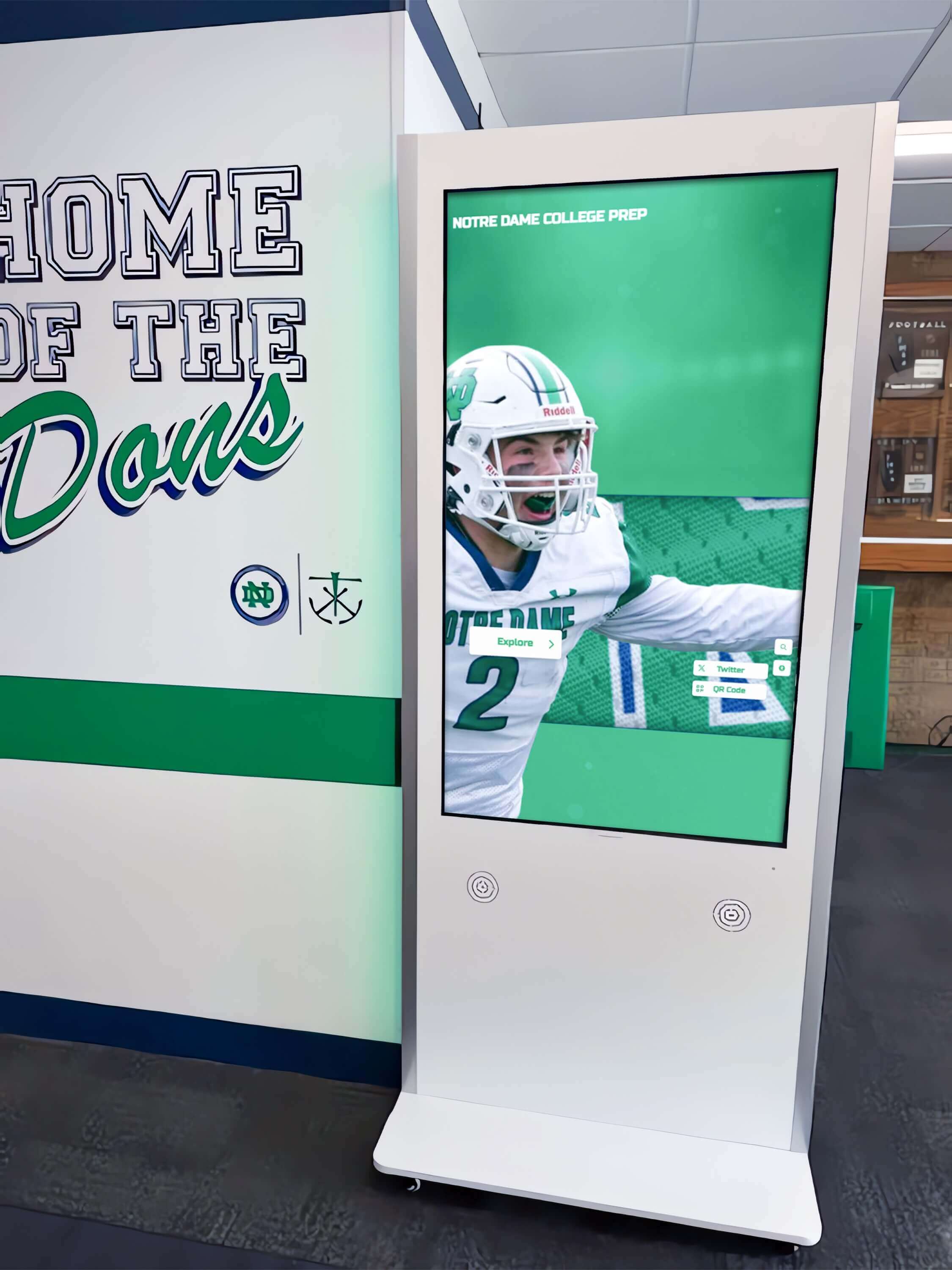
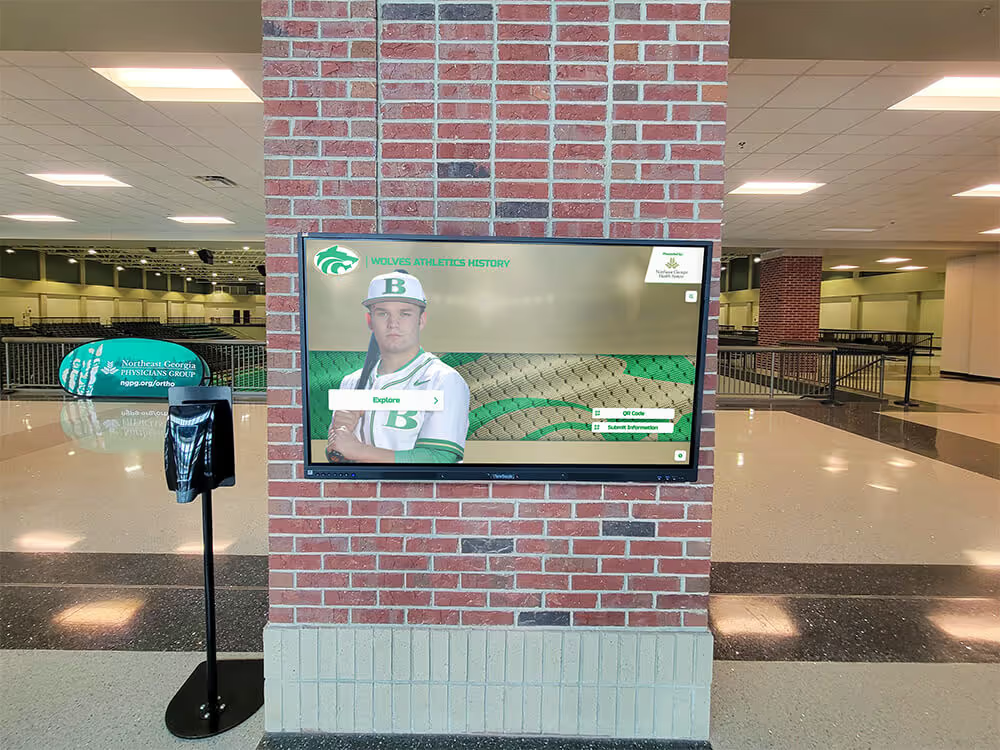
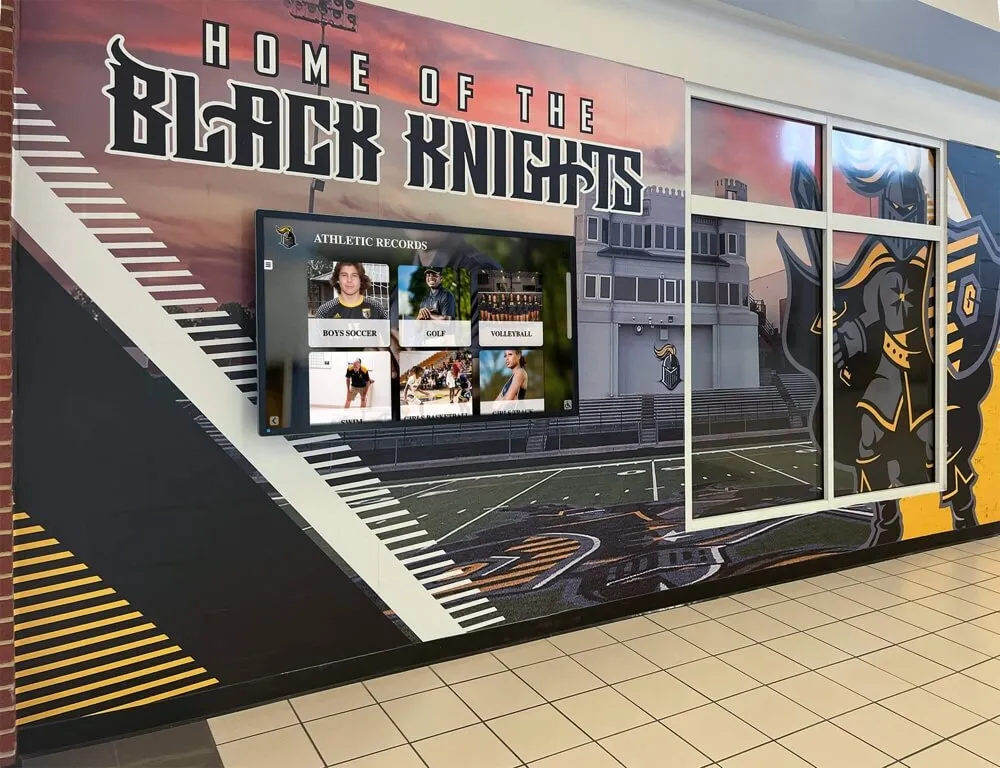
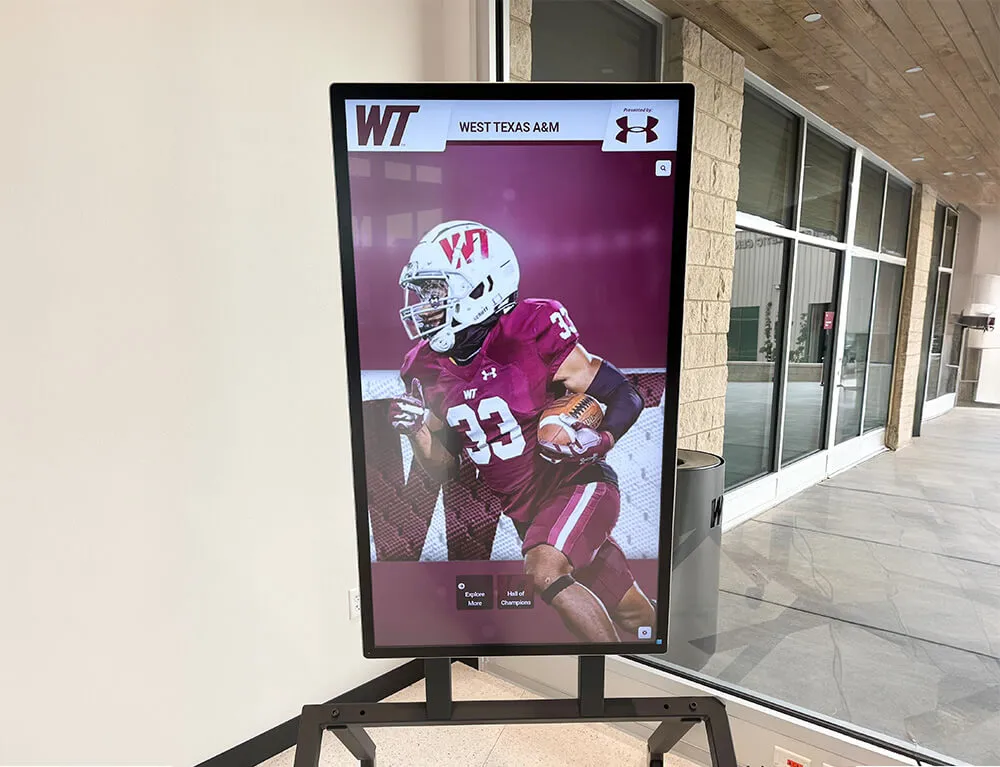
Touchscreen recognition kiosks query athletic award records using multi-step report logic — snapshot isolation ensures that all queries within a single display refresh cycle read from the same consistent point-in-time view of the database
The Five-Component Athletic Awards Database Snapshot Isolation Policy
A complete athletic awards database snapshot isolation policy addresses five components. Together they define which transactions require snapshot isolation, how isolation is configured for each connection type, how write conflicts are detected and resolved, how long a snapshot may remain open before staleness becomes a concern, and what exceptions are permitted and under what conditions.
Component 1: Transaction Scope and Snapshot Establishment
The policy defines which transactions must establish a snapshot at start and hold it for the full transaction duration.
Policy scope: All multi-query recognition reports — eligibility verification summaries, records-board rankings, nomination count compilations, season-end award totals, and display refresh cycles that execute more than one SELECT statement against award data — must execute within an explicit transaction with isolation level set to the engine’s transaction-level snapshot mode before any query executes.
Out of scope: Single-statement display queries (a single SELECT that returns the top-ten all-time records for one sport), administrative form data lookups (fetching one athlete’s record to populate an edit form), and category enumeration queries (SELECT DISTINCT award_type) may execute at the database’s default isolation level without a wrapping transaction. These are inherently point-in-time consistent by nature of being single statements.
Snapshot establishment timing: The transaction-level snapshot must be established before the report’s first query executes. Transactions that begin in a lower isolation level and then attempt to upgrade mid-report do not establish a consistent snapshot; the policy prohibits isolation level changes after a transaction’s first query.
Component 2: Isolation Level Configuration by Connection Type
Recognition system databases typically use multiple connection types — separate pools for administrative sessions, batch import jobs, display refresh cycles, and report generation. The policy specifies the isolation level for each connection type independently.
Recommended isolation level assignments:
| Connection Type | Recommended Isolation Level | Rationale |
|---|---|---|
| Report generation (multi-query) | Transaction-level Snapshot / Serializable | Full transaction-level consistency required |
| Display refresh (multi-query) | Transaction-level Snapshot | Consistent view for all display sub-queries |
| Batch import jobs | Read Committed (default) | Imports write new records; no read consistency needed |
| Administrative form sessions | Read Committed (default) | Single-record lookups; no multi-step report logic |
| Ad hoc query sessions | Configurable; default Read Committed | Elevated on request for multi-step queries |
| Nomination submission | Read Committed (default) | Single insert per submission; no multi-read pattern |
The policy must document these assignments in a connection-type matrix and require that the recognition system’s connection pool configuration matches the matrix. Isolation level configuration at the connection pool level — rather than in application code per query — ensures that a coding error cannot inadvertently run a report at a lower isolation level than the policy requires.
For display systems that serve accessibility-compliant interactive kiosks — including those subject to digital hall of fame status message accessibility requirements — the display refresh connection type requires transaction-level snapshot isolation so that the status messages, record counts, and eligibility indicators rendered together on screen always reflect the same coherent data state.
Component 3: Write-Conflict Detection and Retry Rules
For the subset of recognition system transactions that read under snapshot isolation and then write based on what was read, the policy must define how write conflicts are detected and what the retry behavior is.
Write-conflict scenarios in athletic award databases:
- Duplicate-check-then-insert: A nomination system that reads the existing nomination count for a candidate before inserting a new nomination. If two concurrent sessions both read a count of zero and both then attempt to insert, snapshot isolation may allow both inserts — producing a duplicate if the system’s intent was to limit nominations per cycle.
- Threshold-check-then-award: An eligibility system that reads an athlete’s existing award count, checks whether the count has reached the multi-year threshold, and inserts the culminating award. If two sessions execute this logic concurrently on the same athlete, both may read a count below the threshold and both may attempt to insert the culminating award.
Policy requirements for write-conflict scenarios:
- Transactions that read and then write based on the read result must use Serializable isolation (not merely Snapshot isolation) to prevent write-skew anomalies.
- The recognition system must handle serialization failure errors (PostgreSQL
40001, SQL Server1205deadlock victim, OracleORA-08177) with an automatic retry up to three times before surfacing an error to the user. - The retry delay must use exponential backoff starting at 100 milliseconds to avoid thundering-herd retry contention.
- Transactions that fail after three retries must log the failure with the transaction type, the conflicting records, and the timestamp, and must surface a conflict notification to the administrative user rather than silently discarding the write.
Component 4: Snapshot Age Limits and Staleness Policy
MVCC databases retain old row versions for as long as any open transaction holds a snapshot that requires access to those versions. A long-running report transaction that holds a snapshot from 9:00 a.m. until 10:30 a.m. forces the database to retain all row versions created during that window — consuming storage, increasing version-chain scan costs, and potentially degrading the performance of concurrent writes.
Policy snapshot age limits:
| Report Transaction Type | Maximum Snapshot Age | Enforcement Mechanism |
|---|---|---|
| Standard eligibility report | 5 minutes | Application-level query timeout |
| Records-board full refresh | 3 minutes | Connection-level statement timeout |
| Season-end batch report | 30 minutes | Explicit policy exception; requires admin approval |
| Nomination count summary | 2 minutes | Application-level timeout |
| Display refresh cycle | 90 seconds | Display system configuration |
A snapshot held beyond its policy limit must be terminated (transaction rolled back) and re-executed with a fresh snapshot. The policy must specify that report queries longer than the limit are a maintenance signal — they should trigger a review of query plan efficiency, index coverage, or batch size, not a blanket extension of the timeout.
For cross-country and multi-event sports programs where performance records span many athletes across many events — such as track and cross-country training programs that generate large volumes of time and distance records per athlete — records-board queries that aggregate across many seasons and athletes can be among the longest-running report transactions. These are the queries most likely to exceed snapshot age limits and most likely to benefit from composite index coverage on (sport, event, season, athlete_id) columns.
Component 5: Exception and Override Documentation
Some recognition system operations have legitimate performance requirements that cannot be met under transaction-level snapshot isolation. The policy must define the exception process.
Permissible exceptions:
- Single-statement display queries on historical data (records more than five years old, where mid-import inconsistency is impossible by definition) may execute at Read Committed without a wrapping transaction
- Background analytics aggregations that run on a read replica rather than the primary database may operate at the replica’s default isolation level if the replica’s replication lag policy ensures the data is no more than 60 seconds behind the primary
- Administrative dashboard queries that aggregate data for non-public internal use may use Snapshot Isolation even when Serializable would be stricter, if write-skew risk is assessed as non-applicable to the specific query
Exception documentation format: Each exception must be documented with the query or transaction type, the isolation level applied, the performance justification, the risk assessment (what inconsistency scenario is accepted and why it is tolerable), the approving administrator, the approval date, and the annual review date. The exception register is a governance document that must be stored alongside the policy and reviewed at least once per year.
Implementation Checklist
Before the policy is considered operational, IT staff responsible for the athletic recognition database should verify all of the following:
- Multi-query report transactions identified and listed in the policy’s protected transaction registry
- Isolation level confirmed for each connection type and documented in the connection-type matrix
- Database engine’s transaction-level snapshot isolation feature enabled (SQL Server:
ALTER DATABASE SET ALLOW_SNAPSHOT_ISOLATION ON; PostgreSQL: no global enable required; Oracle: SERIALIZABLE available by default) - Connection pool configuration for each connection type verified against the matrix
- Report generation code confirmed to open an explicit transaction at the correct isolation level before first query
- Write-conflict retry logic implemented and tested with a simulated serialization failure
- Snapshot age limits configured as application-level and connection-level timeouts
- Exception register created and any currently approved exceptions documented
- Test executed: concurrent import and multi-query report run simultaneously; report output verified identical across all sub-queries
For classroom-based and smaller recognition programs that maintain award display records for academic competitions and school events — such as programs described in classroom recognition display planning guides — a lightweight snapshot isolation implementation using a single dedicated read connection with REPEATABLE READ isolation and a short timeout may be sufficient without a full connection-type matrix, as long as the essential property is preserved: every multi-query report executes within a single transaction.
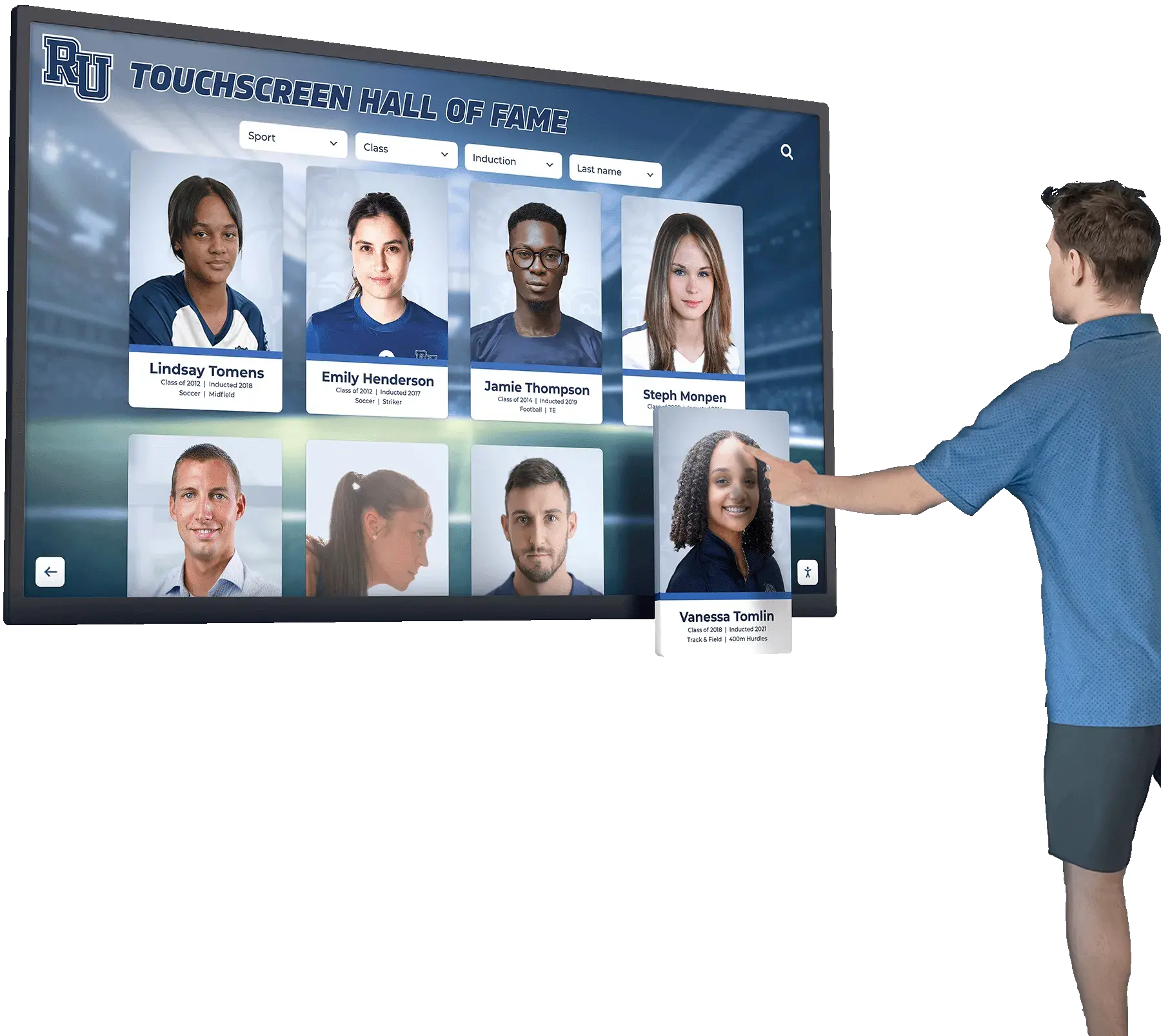
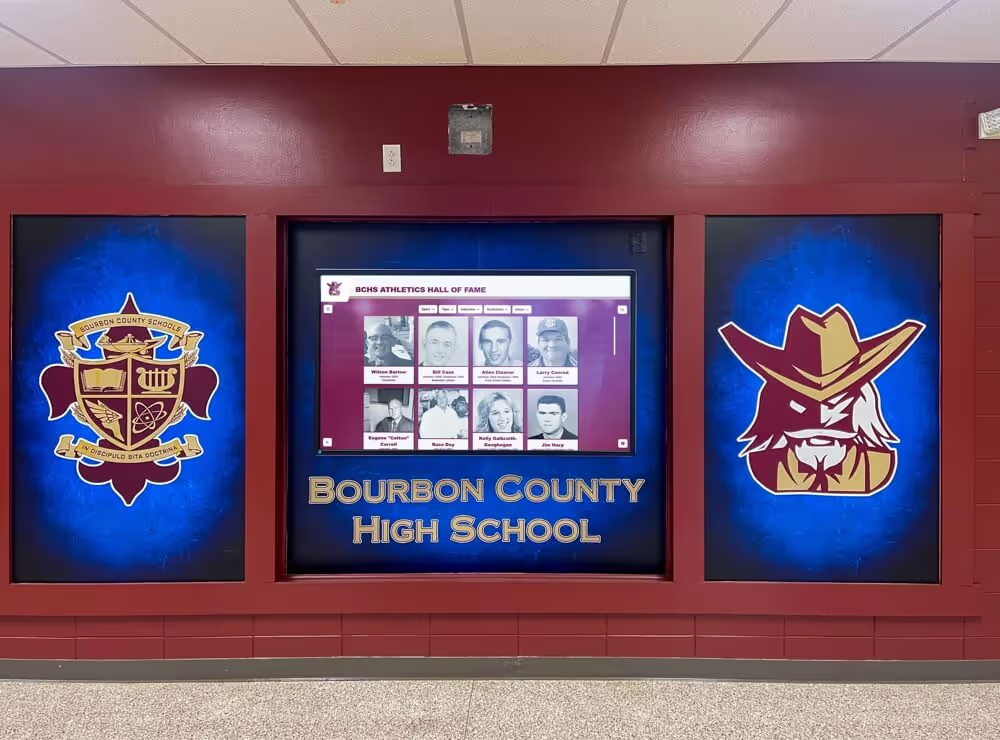
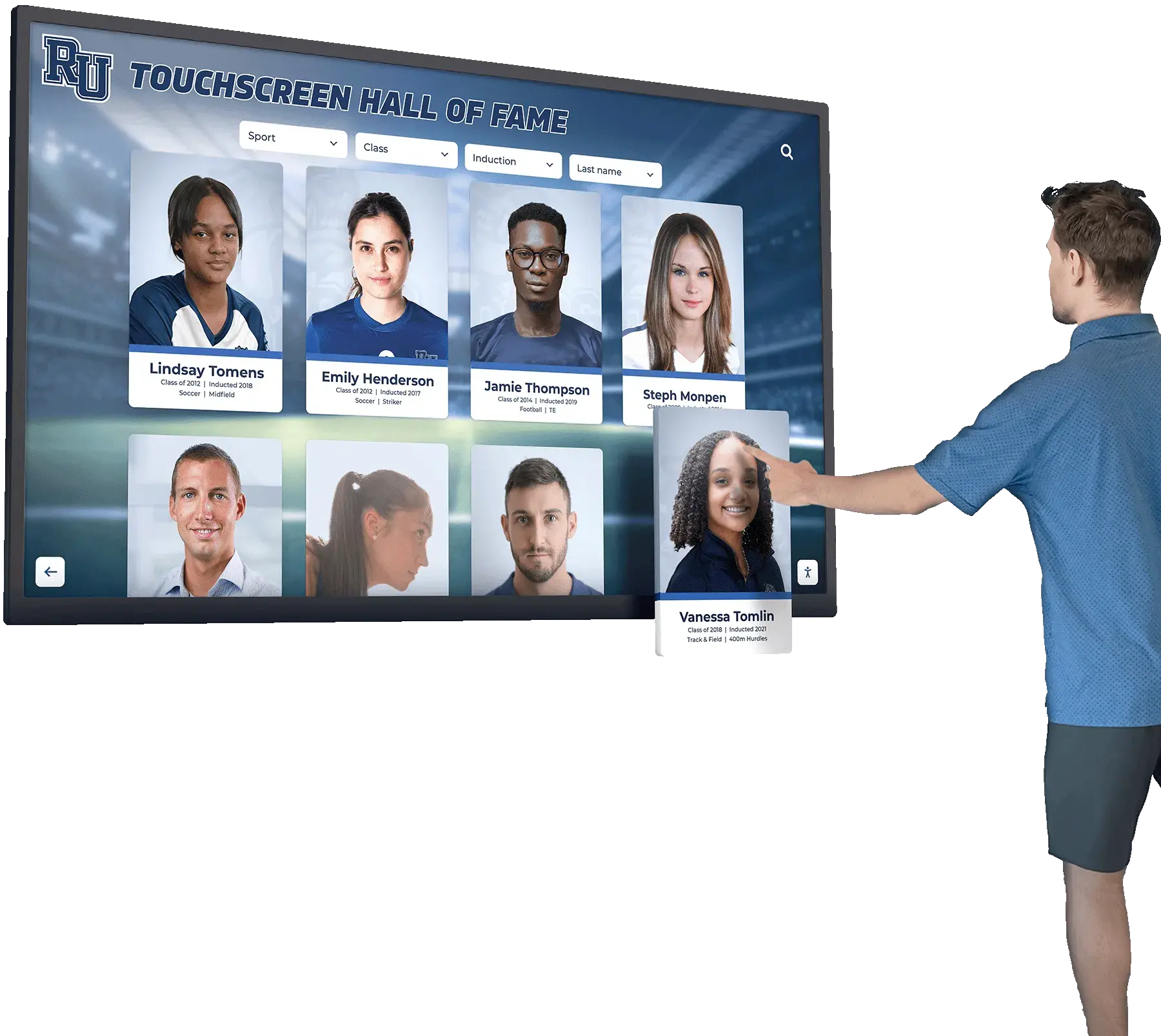
Hall of fame touchscreen kiosks render multiple data elements from the same recognition record in a single interaction — the snapshot isolation policy ensures all those elements reflect the same point-in-time view, not a mix of pre-import and post-import versions
Monitoring and Compliance Verification
A written policy produces no operational benefit unless the isolation levels it specifies are applied at runtime and the snapshot age limits it sets are enforced. Monitoring requirements for an athletic awards database snapshot isolation policy include:
Isolation level sampling. During peak import seasons — season-end, ceremony preparation, and hall of fame nomination periods — query the database’s session and transaction monitoring views weekly to confirm that active report transactions are running at the isolation level the policy requires. Any report session observed running at Read Committed when the policy requires Snapshot Isolation or Serializable should trigger an immediate investigation of the connection pool configuration.
Long-transaction alerting. Database engines track the oldest active transaction timestamp (PostgreSQL: pg_stat_activity.xact_start; SQL Server: sys.dm_tran_active_transactions). Configure alerting on any transaction open longer than the policy’s maximum snapshot age limit. A report transaction open for 20 minutes when the limit is 5 minutes either has a hanging session that was not properly closed, or is executing against a table with poor index coverage.
Version bloat monitoring. MVCC databases accumulate dead row versions when long-running transactions hold snapshots. PostgreSQL reports this as table bloat visible in pg_stat_user_tables.n_dead_tup; SQL Server tracks version store usage in sys.dm_tran_version_store_space_usage. A growing version store during import periods indicates that import writes are being retained because report transactions are holding snapshots open longer than the import window — a scheduling alignment problem that the policy’s import coordination rules should address.
Report consistency verification test. Before each seasonal peak, execute a two-query consistency test inside a single transaction under the policy’s required isolation level: run an award count query, simulate a concurrent insert of a qualifying record using a second connection, then run the same award count query again within the first transaction. Confirm that both queries return identical counts. This test validates that the isolation configuration is functioning as expected for the specific database engine version, driver version, and connection pool configuration currently deployed.
Display consistency sampling. For recognition programs that use automated touchscreen recognition display interaction testing to verify display responsiveness and data rendering correctness, add a data-consistency check to the test suite: trigger a display refresh during a simulated concurrent import, then verify that the rendered values on the display match the values from a snapshot-isolated report query executed at the same moment. A rendered value that does not match the snapshot-isolated query result indicates that the display refresh connection is not operating under the policy’s required isolation level.
FAQ: Athletic Awards Database Snapshot Isolation Policy
What is the difference between snapshot isolation and serializable isolation? Snapshot isolation provides a consistent point-in-time view of the database for all queries within a transaction, preventing dirty reads, non-repeatable reads, and phantom reads for read-only transactions. Serializable isolation provides all of those guarantees plus protection against write-skew anomalies — scenarios where two transactions each read a consistent snapshot and then each write in a way that would have been prevented if they had run sequentially. For read-only recognition reports, snapshot isolation and serializable isolation provide equivalent consistency guarantees. For transactions that read then write based on the read (nomination count checks, eligibility threshold inserts), serializable isolation is the correct choice.
Does snapshot isolation slow down batch import jobs? No. Snapshot isolation’s non-blocking read property means that report transactions under snapshot isolation do not acquire read locks on the rows they read. Import writes proceed without waiting for open report transactions to complete. The performance tradeoff runs in the other direction: long-lived report snapshots cause the database to retain dead row versions longer than necessary, increasing storage consumption and potentially slowing import-period vacuum or cleanup processes. The snapshot age limits in Component 4 of the policy address this tradeoff explicitly.
Do cloud-based athletic recognition platforms require this policy? Cloud-based recognition platforms — including Rocket Alumni Solutions’ touchscreen hall of fame platform, which serves 600+ institutions with remote CMS access, auto-ranking record boards, and unlimited award entries — manage database transaction semantics at the platform layer. Schools using Rocket’s cloud platform do not configure isolation levels directly; consistent report reads are handled by the platform’s data architecture. The snapshot isolation policy framework in this guide applies to schools operating their own on-premises or self-hosted recognition databases, or integrating award data from external systems through direct database connections.
How does snapshot isolation interact with the connection pooling policy?
Connection pooling and snapshot isolation operate at different layers of the database stack, but their settings must be consistent. A connection pool that recycles connections aggressively — closing and reopening connections after each query — may reset session-level isolation level settings if the connection driver restores the session to its default state on return to the pool. The snapshot isolation policy must be configured at the connection pool initialization level (using a pool init_command or equivalent), not just in application-level transaction code, to ensure that recycled connections re-enter the pool with the correct isolation level already set.
What happens if a report transaction exceeds the snapshot age limit? When a report transaction exceeds the policy’s maximum snapshot age limit, the application should terminate the transaction — rolling it back — and re-execute the report with a fresh snapshot established at the current time. The re-execution captures a more recent view of the database than the original snapshot, but the new snapshot is internally consistent. The policy should log the timeout event, the report type, and the timestamp so that IT staff can identify which report types are most frequently hitting the limit and prioritize query optimization for those.
Connecting Snapshot Isolation to the Broader Data Governance Framework
An athletic awards database snapshot isolation policy operates at the transaction layer of a complete athletic recognition data governance program. Its upstream dependency is data quality and validation: snapshot isolation ensures that a consistent view of records is read for reporting, but if the underlying records contain entry errors or missing values, those errors are consistently reproduced in every report. Validation rules and data quality checks belong in the layer that precedes report generation, not inside the snapshot isolation policy itself.
Its downstream dependency is the display publication layer. A report that correctly generates a consistent eligibility count under snapshot isolation is only as useful as the process that publishes that count to the recognition display within a timely window after the report runs. Designing the selection criteria and display architecture for school hall of fame programs involves decisions about how frequently display content refreshes and what triggers a refresh — decisions that must account for the snapshot age limits the policy enforces, since a display that refreshes every 90 seconds requires a snapshot isolation configuration that can consistently complete a multi-query refresh within that window.
The snapshot isolation policy is also related to, but distinct from, the phantom-read prevention policy and the advisory lock policy. Phantom-read prevention focuses specifically on predicate-based queries that may see new rows between executions — snapshot isolation prevents this as a side effect, but the phantom-read policy adds explicit documentation of which query classes require protection and what predicate indexing must support it. The advisory lock policy focuses on serializing concurrent imports so that two import jobs for the same season cannot run simultaneously — snapshot isolation ensures that report queries do not see partial import results, but it does not prevent two import jobs from writing conflicting records into the database. Each policy addresses a distinct layer of the concurrency problem; together they provide defense in depth.
Schools that treat snapshot isolation as a one-time database configuration task rather than a maintained policy component often find that the configuration drifts over time: a database engine upgrade changes default isolation behavior, a new connection pool library resets session isolation on connection recycle, or a new developer adds a report query outside the standard transaction wrapper. The policy’s monitoring requirements — isolation sampling, long-transaction alerting, and periodic consistency verification tests — exist specifically to catch those drifts before they affect report output during a ceremony or eligibility determination window.
Schools evaluating cloud-based athletic recognition platforms that handle snapshot isolation, import coordination, and report consistency at the platform layer — rather than requiring per-installation database configuration — can schedule a custom demo with Rocket Alumni Solutions to see how the platform delivers consistent, real-time recognition data across its 600+ institutional installations.
See Consistent Award Data on Every Screen
Rocket Alumni Solutions manages snapshot isolation, concurrent import coordination, and report consistency at the platform layer — so athletic directors and IT staff focus on recognition programs, not database configuration. Serving 600+ institutions with cloud-based touchscreen displays, auto-ranking record boards, unlimited award records, and remote CMS access from anywhere.