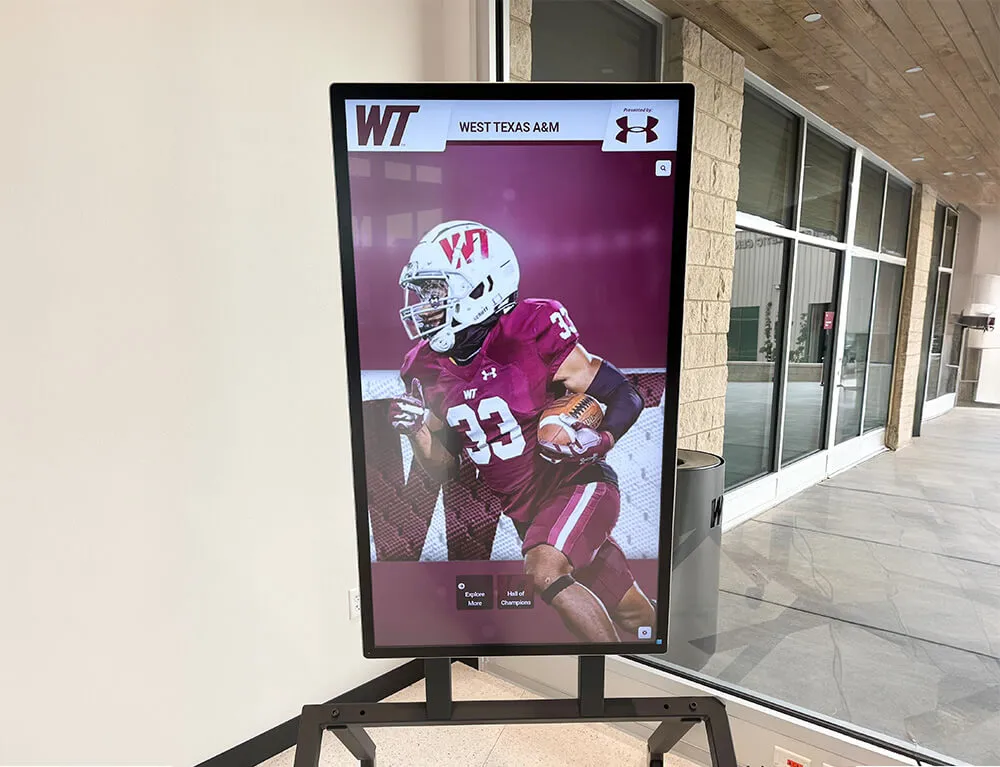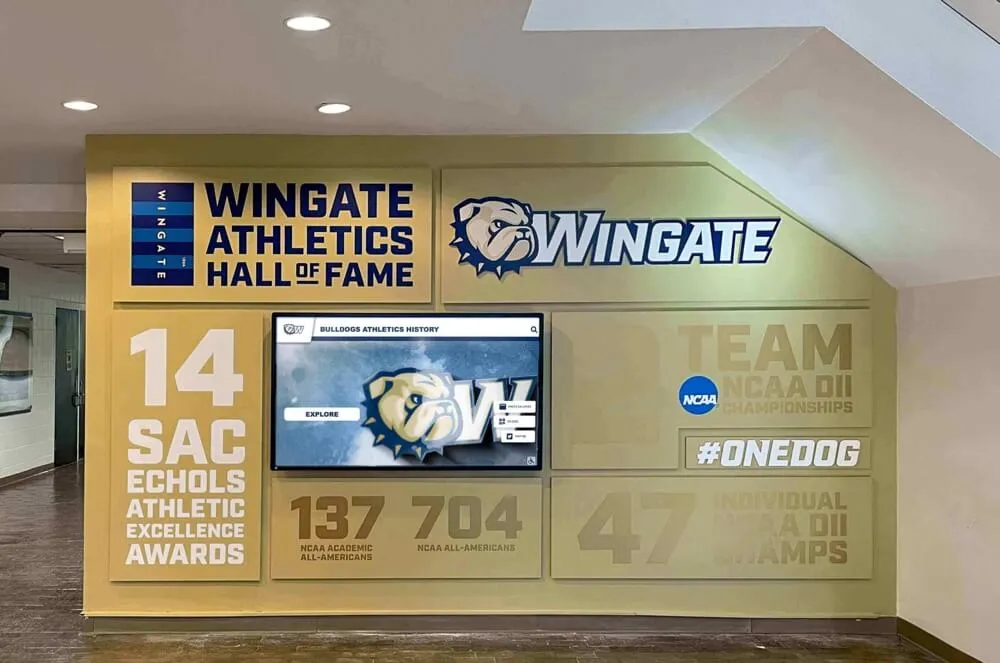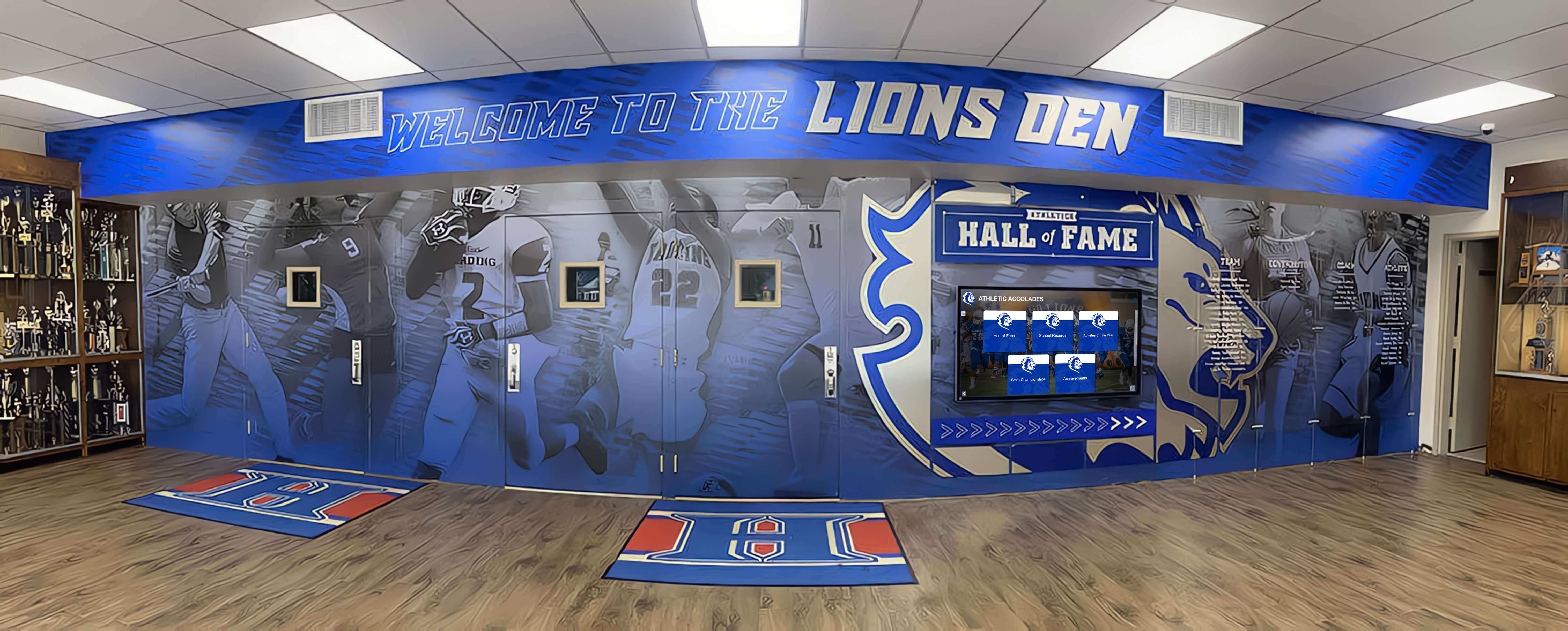




The first question most athletic directors face when planning recognition upgrades is not which system is better — it is where the new trophies are supposed to go. The glass-fronted award display case lining the main hallway is full. The championship banners are double-hung. The plaque wall ran out of space two seasons ago, and every year the school orders more hardware that competes for the same twelve linear feet of corridor. The space problem is real, and it is not solved by buying another case. It is solved by rethinking what a recognition display is supposed to do.
This guide compares traditional award display cases with digital awards displays across five dimensions that matter to schools: physical space, historical coverage, visitor experience, maintenance overhead, and total cost of ownership. It is written for athletic directors, principals, advancement staff, and facilities managers who need to make an evidence-based case for whichever direction they choose — or who need to explain why a hybrid approach is the right answer for their specific building.
Every recognition decision a school makes eventually collides with a physical constraint. An award display case holds what it holds. When programs grow, when championships accumulate, and when the alumni relations office wants to add donor recognition beside the trophies, the case runs out of room before the history does. Understanding both traditional and digital options — and the realistic trade-offs between them — is the starting point for any school that wants recognition that serves the next fifty years, not just the next five.

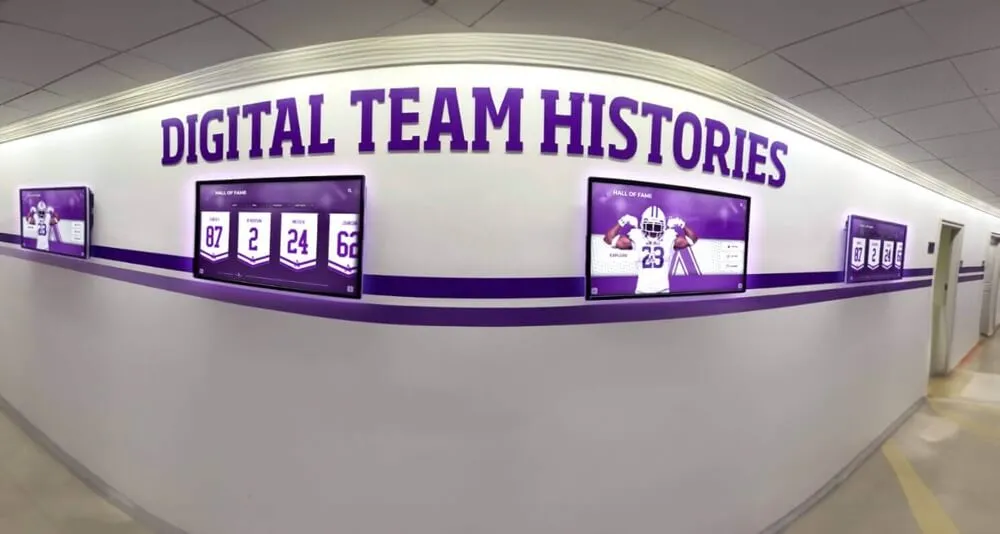
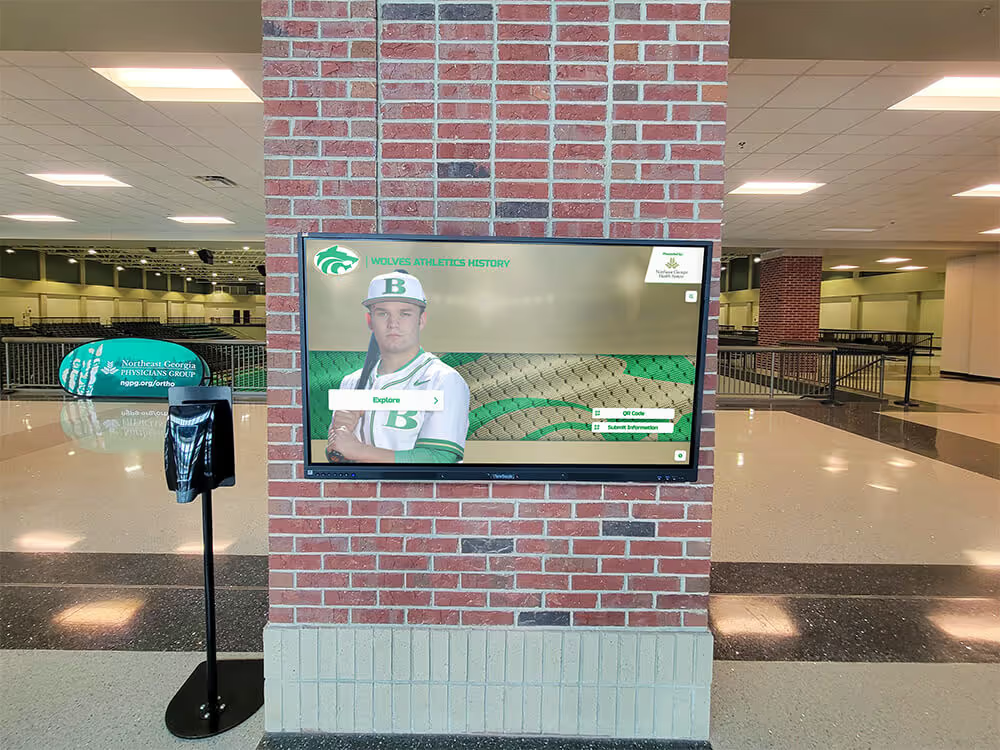
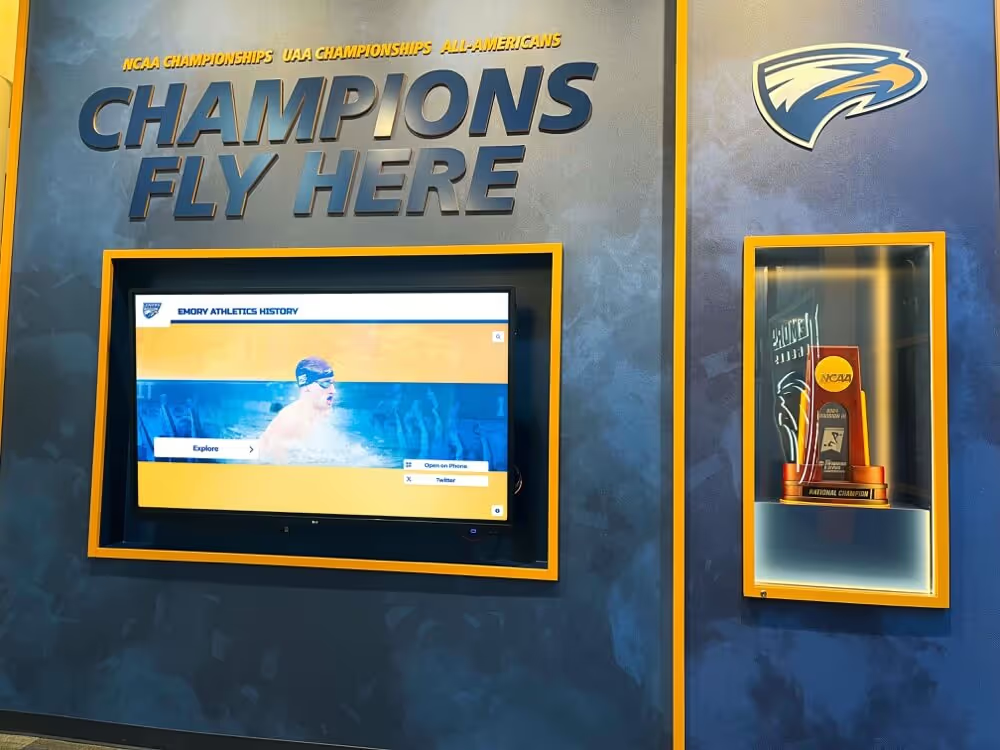
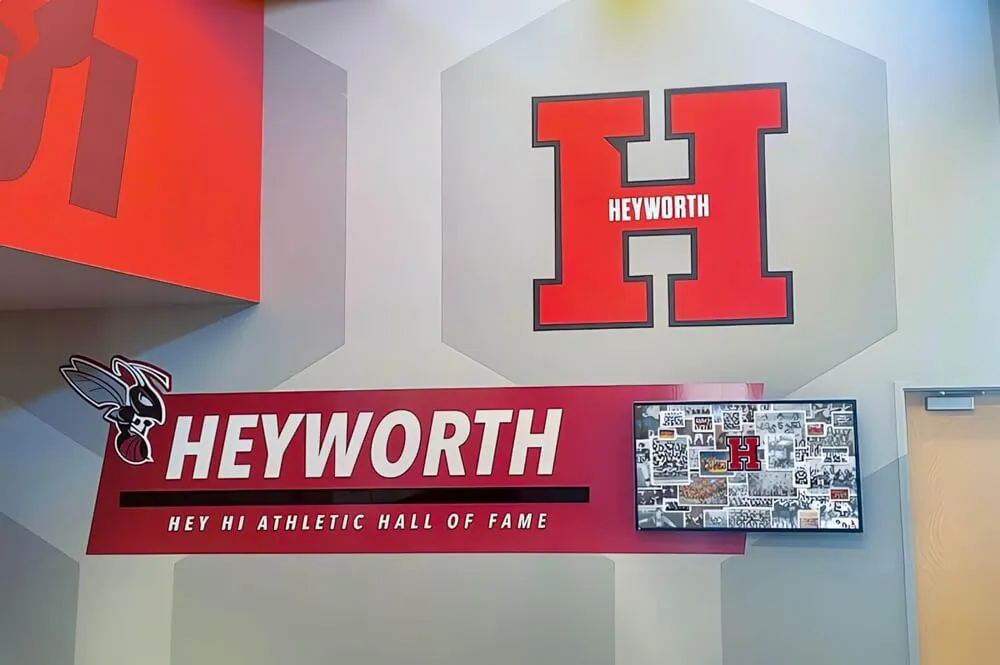
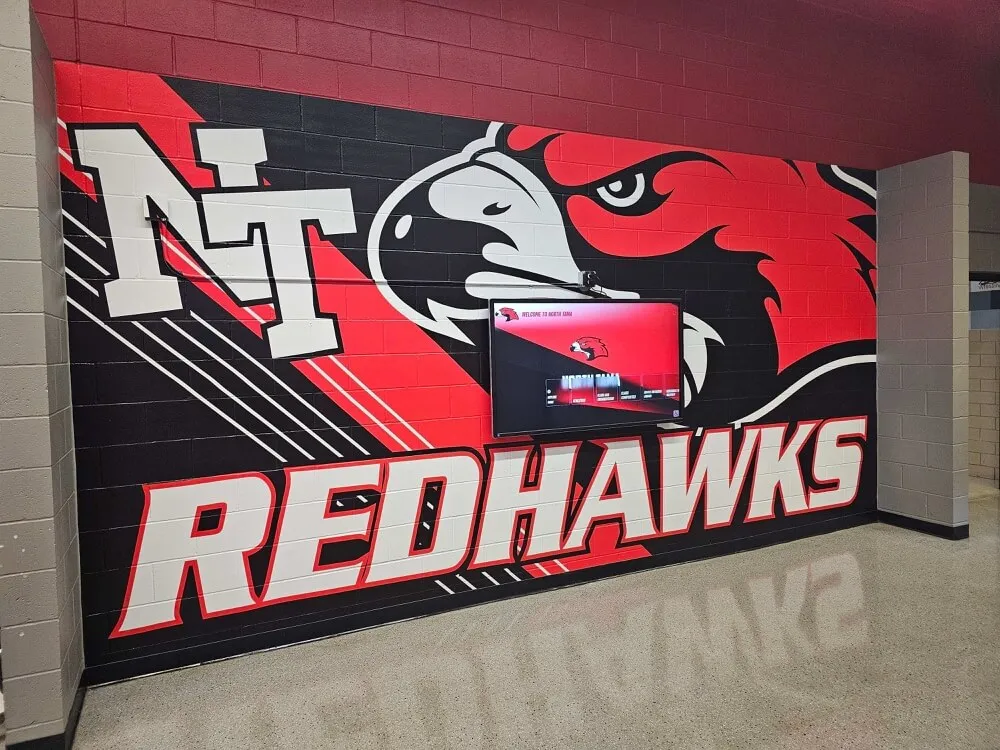
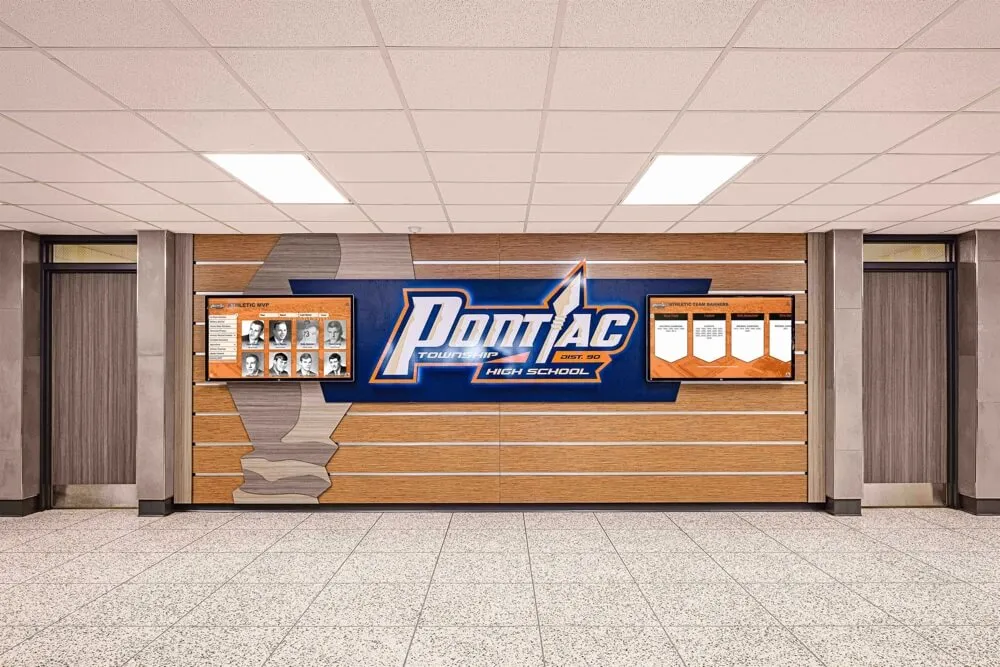
Many schools reach a point where physical trophy cases and digital displays coexist in the same hallway — a natural transition point, not a problem to eliminate
What Is an Award Display Case and What Does It Actually Solve?
An award display case is a lockable, glass-fronted cabinet designed to showcase trophies, plaques, medals, championship banners, and other physical recognition hardware in a school corridor, lobby, or gymnasium entrance. Display cases are the default recognition infrastructure for most secondary schools, typically installed during construction or renovation and then maintained as program history accumulates inside them.
Cases solve a specific problem well: they protect physical objects while making them visible. A state championship trophy inside a locked glass case communicates success, creates identity for new students walking past it on the first day, and provides a gathering point for alumni who return to find their era’s hardware still on display. These are genuine functions that no system replaces entirely.
What cases do not solve — and what they actively create as a problem — is the space constraint. A standard athletic display case occupies between 24 and 72 inches of wall space. A school that wins ten state championships over four decades fills that case. A school that wins twenty fills two. The physical recognition inventory keeps growing at a rate that fixed infrastructure cannot match.
Standard Award Display Case Dimensions and What Fits
Most off-the-shelf school display cases fall into a few standard size ranges:
- Wall-mounted single-door cases: typically 30–48 inches wide, 12–18 inches deep, 12–48 inches tall. Suitable for a single sport’s seasonal trophies or a rotating display of current-year awards.
- Floor-standing double-door cases: typically 48–72 inches wide, 18–24 inches deep, 72–84 inches tall. These are the cases that anchor most school lobbies.
- Corner cases: designed to fit in a 90-degree corner, maximizing floor space in tight corridors.
A typical floor-standing double-door case can hold somewhere between 20 and 40 mid-size trophies depending on height, along with several plaques on the back wall and a few framed photographs. For a school with 25 sports and a program history spanning 50 years, that is nowhere near enough.
The Physical Space Problem Spelled Out
The arithmetic of athletic recognition is unforgiving. A program that gives five major awards per year accumulates 250 award items per decade. A school with 15 active sports programs could easily generate 50 to 75 significant recognitions per year across all programs. After 30 years, that is 1,500 to 2,250 physical objects competing for space in cases designed to hold 40.
Most schools resolve this arithmetic by rotating: old trophies get moved to storage, packed in boxes, or quietly given to retiring coaches. The effect is that recognition disappears. A student who asks what the school won in 2003 finds that the answer is in a cardboard box in the equipment room, not on the wall where it belongs.
The space problem is also asymmetric by sport. Football trophies are large. Swimming plaques are numerous. Cross-country programs accumulate individual medals by the dozens each season. Case allocation decisions are rarely made systematically — they emerge from who asks first, whose coach complains loudest, and what fits in the remaining space. For athletic departments trying to build equitable recognition cultures, arbitrary triage is a real equity problem. Comprehensive guides to cross-country awards and recognition ideas often note how running programs specifically are underrepresented in trophy case allocations relative to the number of individual competitors they recognize.
Digital Awards Displays: What They Are and How They Work
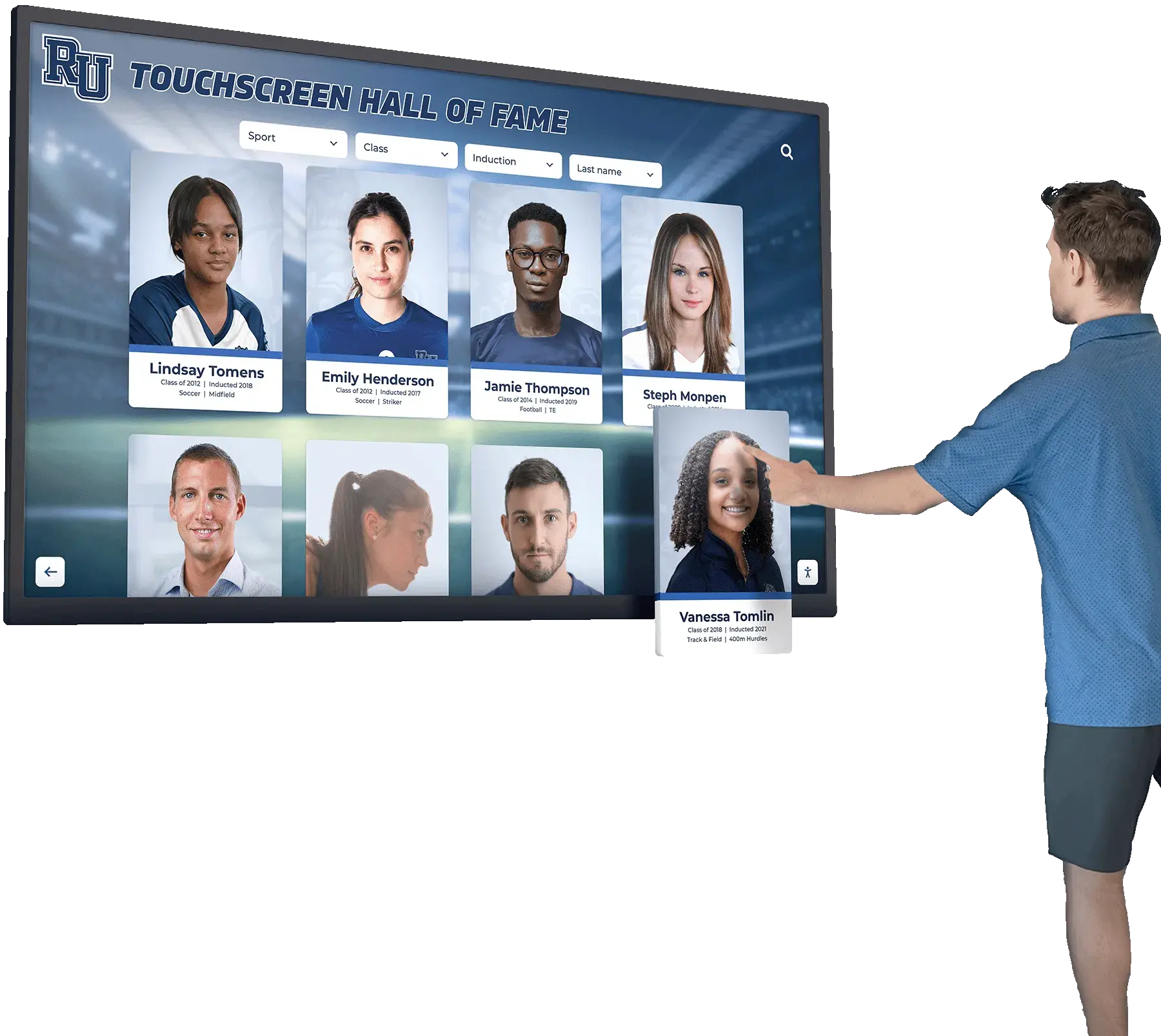
A digital awards display replaces or supplements the glass case with a screen-based system that can surface any amount of recognition content in a fixed physical footprint. The simplest version is a mounted monitor running a rotating slideshow. The most sophisticated versions are touchscreen walls that allow visitors to search by athlete name, sport, year, or award category — and to pull up photos, statistics, career summaries, and archived media from any era of program history.
The category includes several distinct product types, which matter for budget and planning purposes:
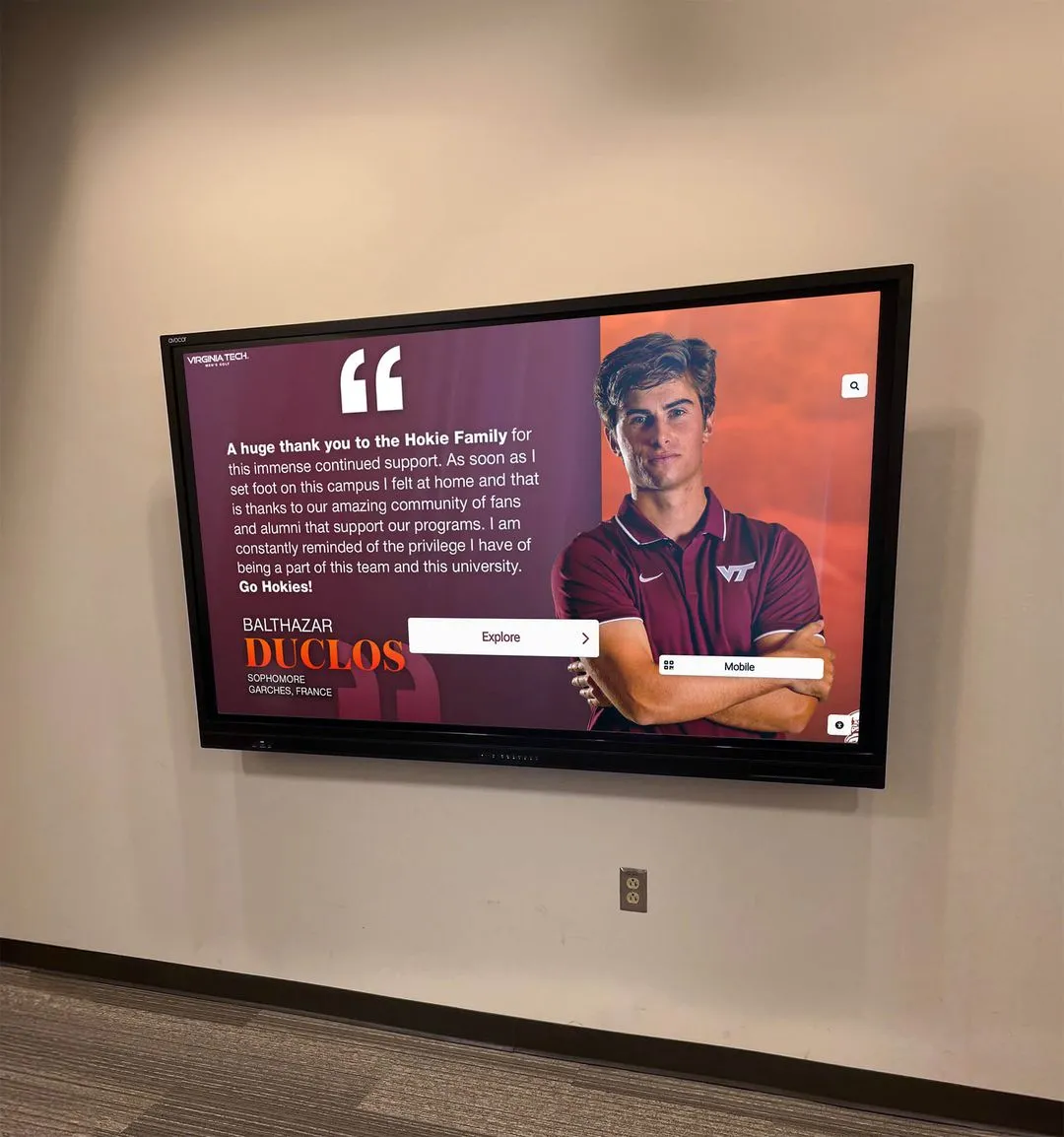
Static digital displays: A mounted screen cycling through award images, team photos, and recognition slides on a scheduled loop. No interactivity; content is updated manually or automatically. Low upfront cost, minimal ongoing maintenance.
Interactive kiosk systems: A touchscreen panel — typically 43 to 75 inches — with software designed specifically for school recognition. Visitors can navigate by sport, year, or inductee. Content is managed through a cloud dashboard, so updates can be made without touching the hardware. Rocket Alumni Solutions builds systems in this category, with products including touchscreen walls of fame, digital trophy cases, and athletic record boards that schools manage remotely.
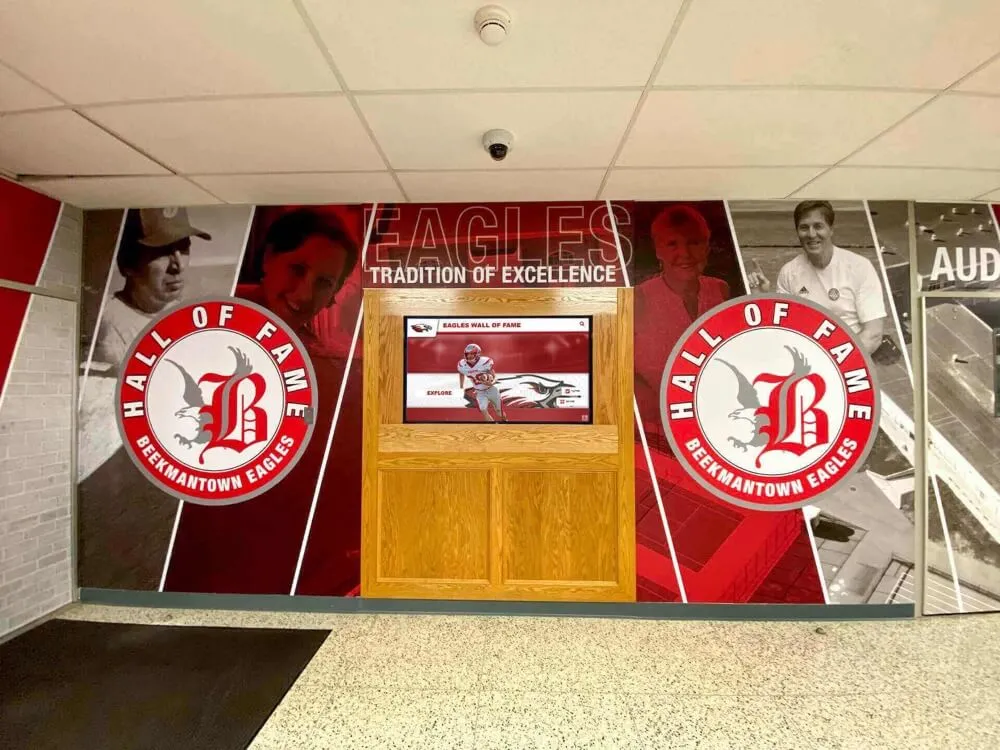
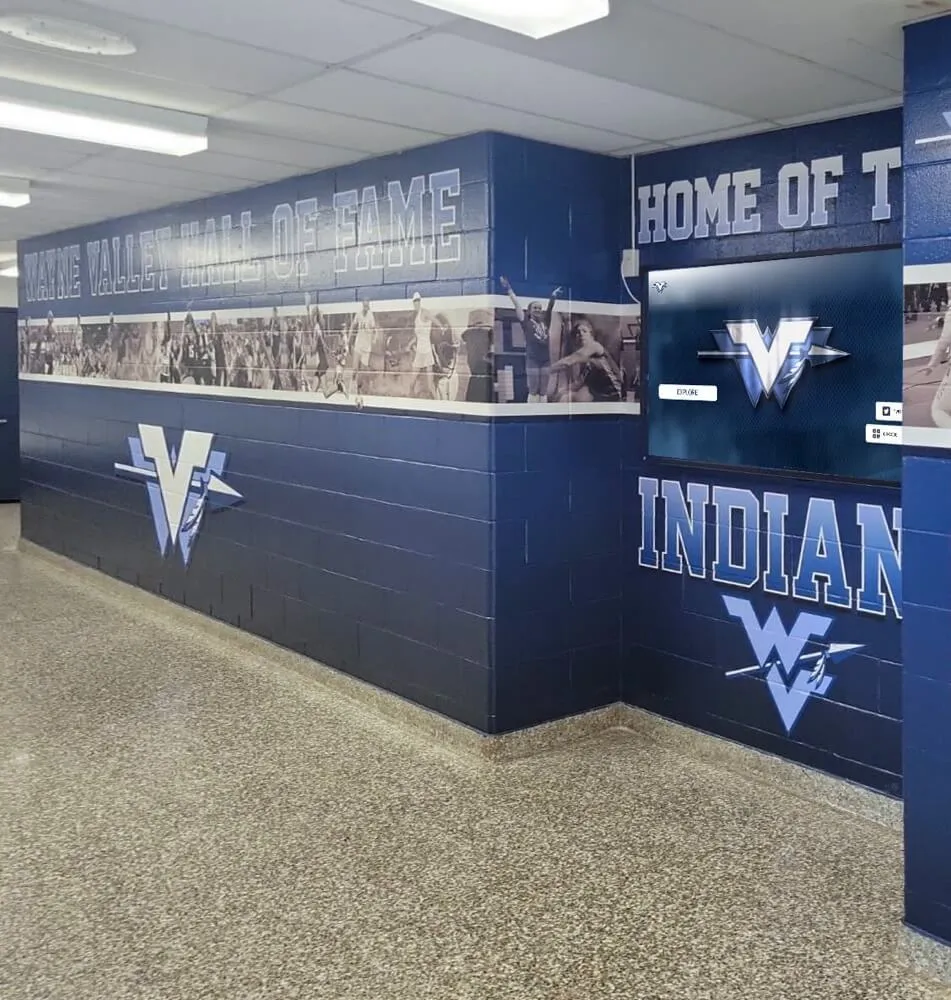
Large-format touchscreen walls: Multi-panel installations spanning 8 to 20 feet of wall space, combining mural-quality visuals with embedded interactive screens. These are the premium end of the market and are most common in new construction or major renovation projects.
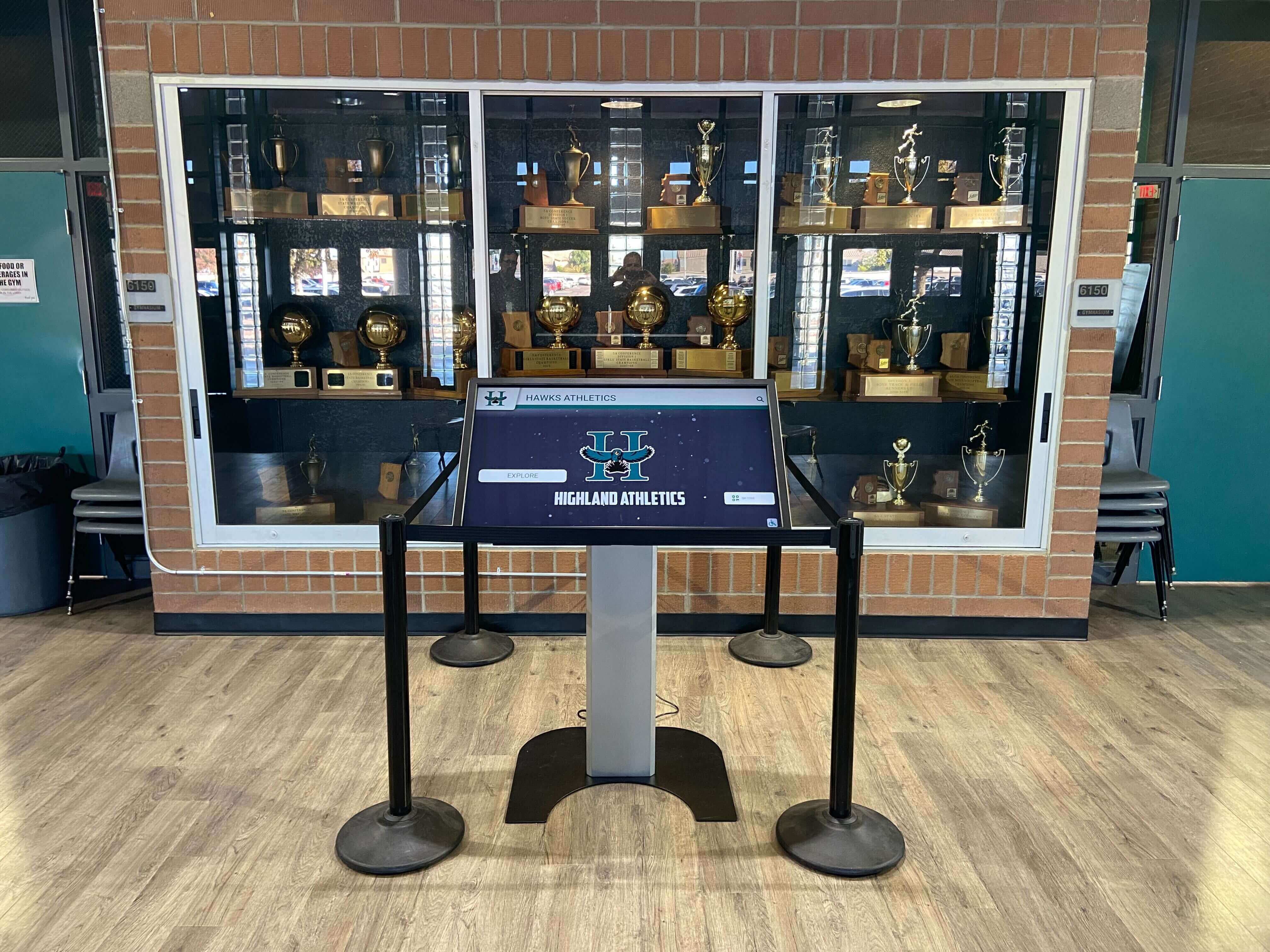
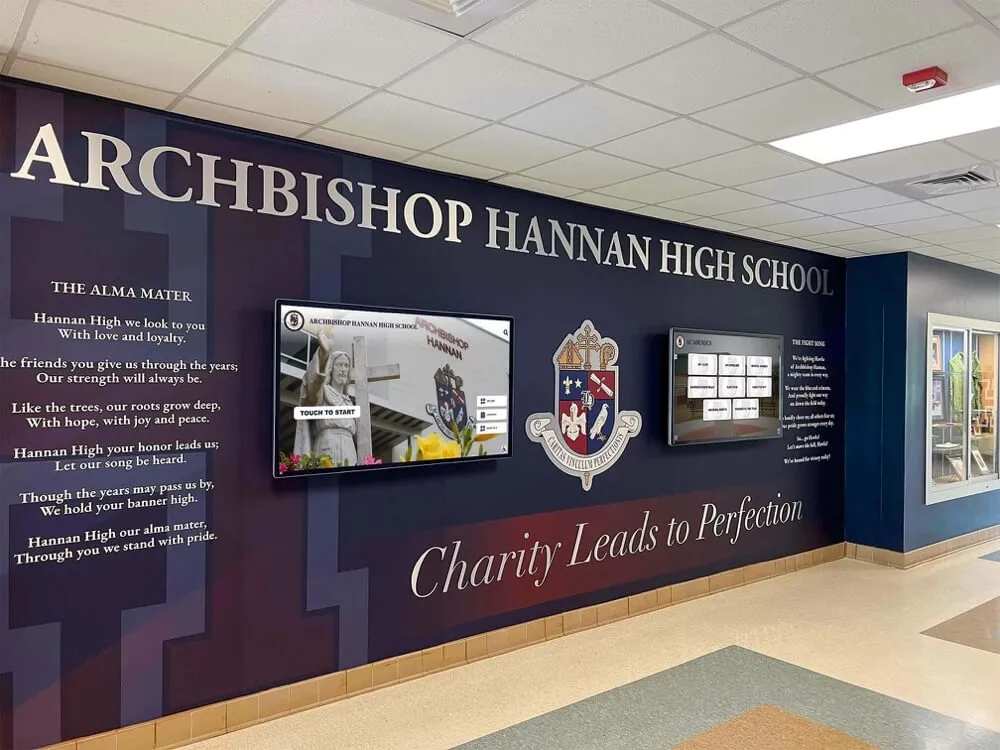
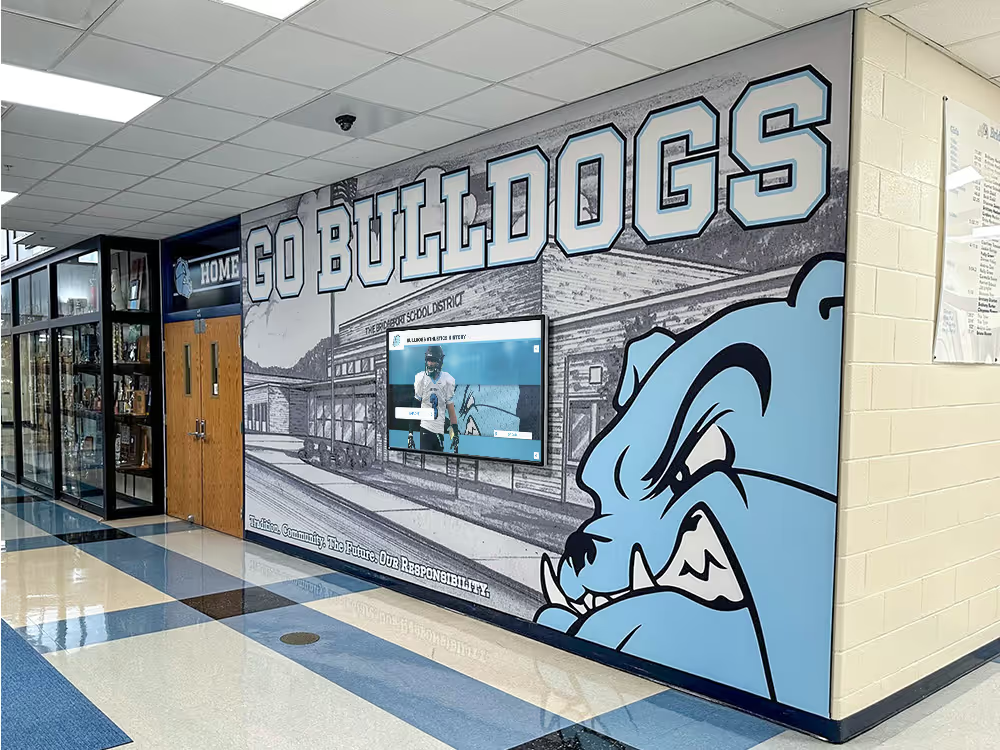
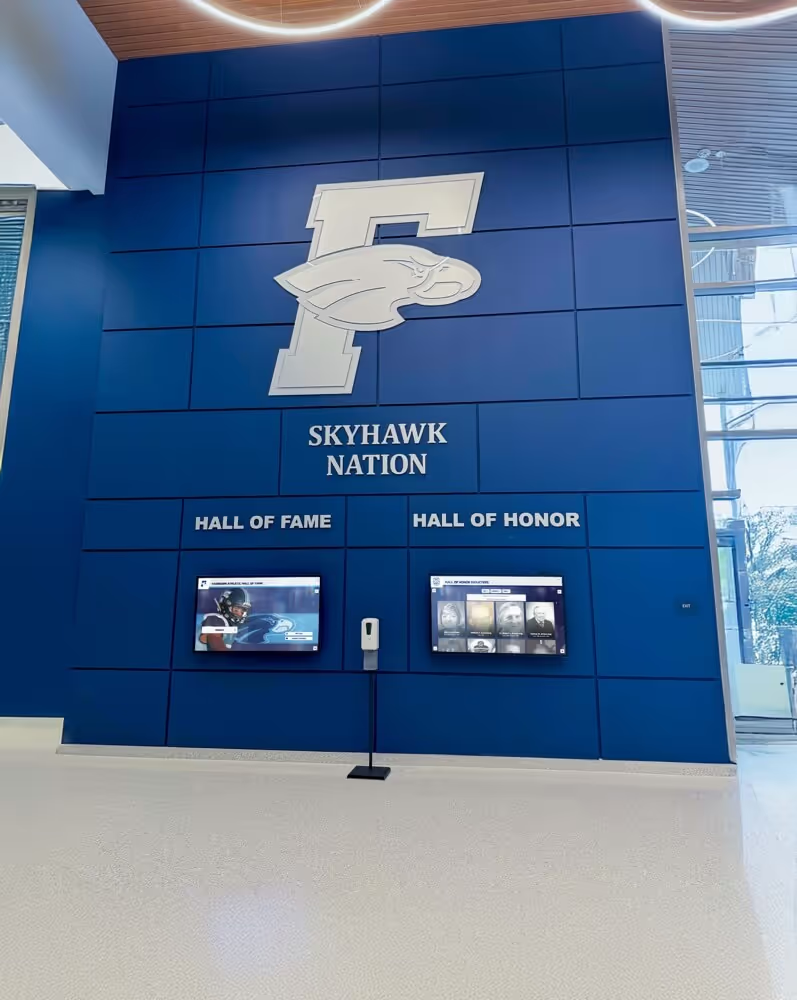
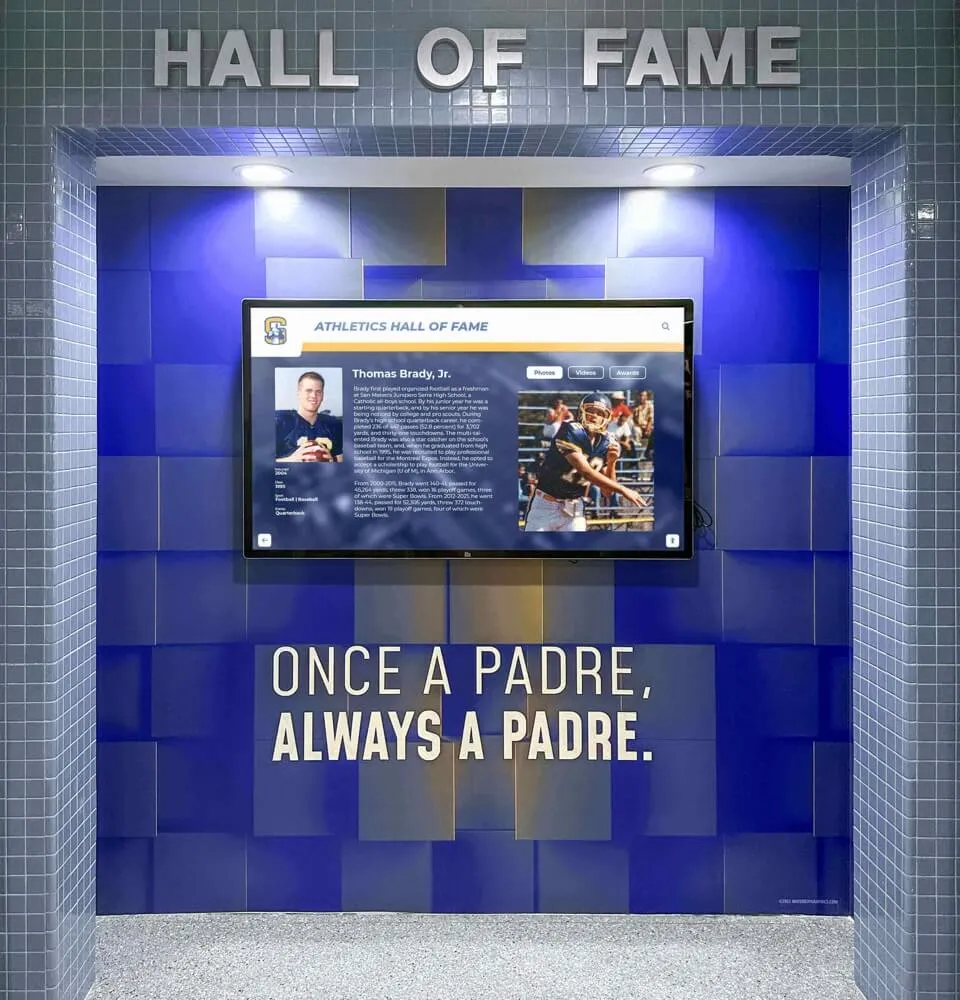
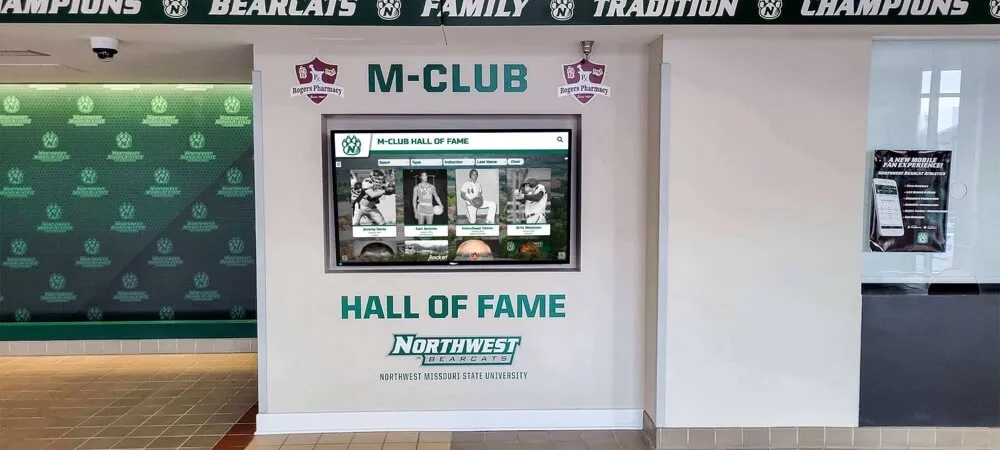
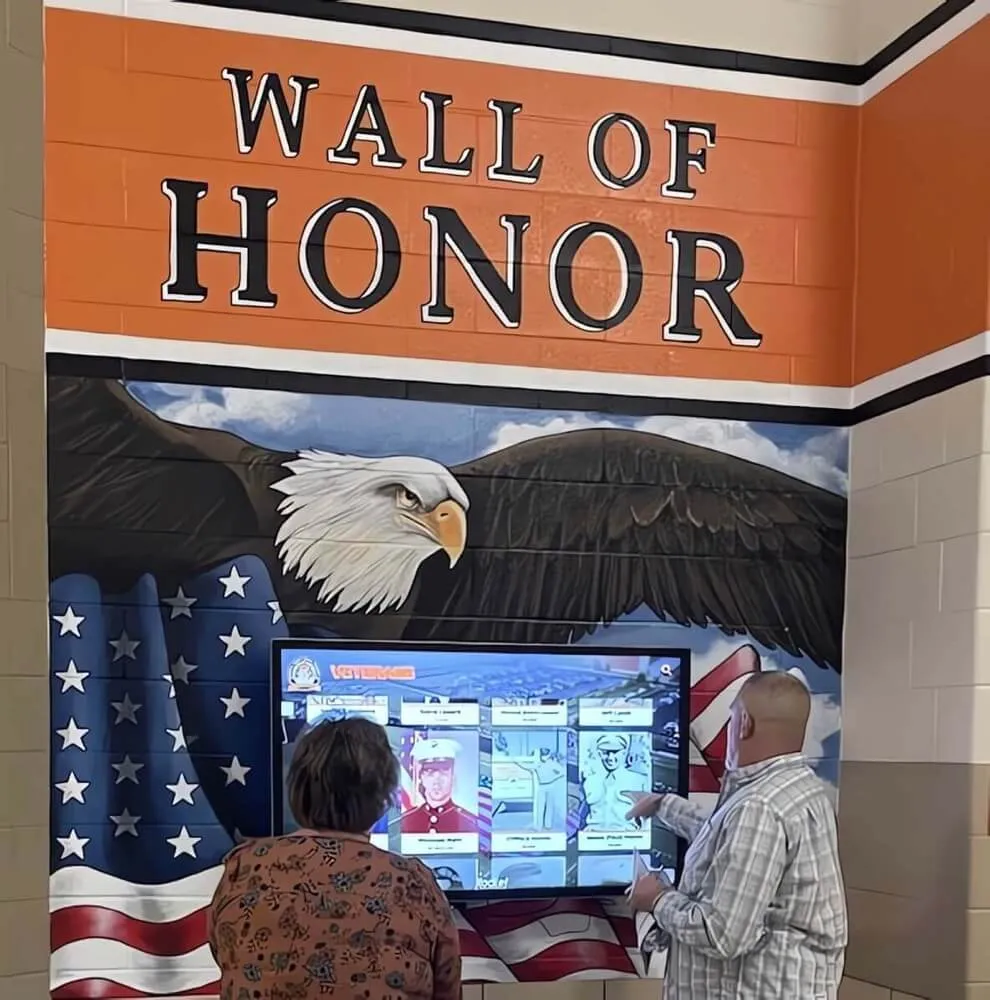
Touchscreen kiosks can be installed alongside or within existing trophy case installations, allowing schools to transition incrementally rather than replacing physical displays all at once
Side-by-Side Comparison: Award Display Case vs Digital Awards Display
The following comparison covers the five dimensions that drive most school recognition decisions.
1. Physical Space Efficiency
Award display case: Each case occupies fixed wall or floor space. Expanding coverage requires purchasing additional cases and finding wall space to mount them. A comprehensive 50-year athletic history would require dozens of cases — more corridor footage than most schools have available.
Digital display: A single 55-inch touchscreen can surface 50 years of program history. The physical footprint is one mounting location; the information capacity is theoretically unlimited. Schools that add a digital display to an existing case installation immediately multiply their recognition coverage without adding square footage.
Advantage: Digital, by a wide margin, for schools with programs older than 10 to 15 years.
2. Historical Coverage
Award display case: Physical constraints force curation. Most schools keep the most recent 3 to 5 years of major trophies accessible in the case and move older items to storage. Program history effectively disappears from the wall as it ages.
Digital display: All historical records can be maintained in the system simultaneously. A student in 2026 can browse every season MVP since 1978 as easily as they browse last year’s. For alumni engagement, this is transformative — former athletes who graduated decades ago can find their own recognition visible in the hallway when they return.
Advantage: Digital, with the qualification that historical data must be researched and entered — which requires investment of staff time or vendor assistance.
3. Visitor Experience
Award display case: Passive. Visitors read what is on display and move on. There is no mechanism to learn more, search for a specific athlete, or understand the story behind an award. The experience is identical for a first-time visitor and a 40-year alumni.
Digital display: Active. Visitors can search, browse, discover unexpected connections, and linger over content that matters to them specifically. Touch interactions increase engagement time — a metric that correlates with fundraising outcomes, alumni relationship strength, and student motivation in schools that have studied the effect. The experience scales with visitor knowledge and interest.
Advantage: Digital, particularly for alumni engagement and donor cultivation contexts.
4. Maintenance Overhead
Award display case: Cases require dusting, occasional hardware repairs, and ongoing curatorial decisions about what stays displayed and what gets rotated to storage. New trophies must be physically acquired, engraved, transported, and placed. For a large athletic department generating significant recognition hardware each year, this is a real staff time investment.
Digital display: Hardware maintenance is minimal — screens, like any AV equipment, require occasional cleaning and eventual replacement (typically every 7 to 10 years at consumer-grade hardware longevity). The ongoing content work is data entry rather than physical curation: entering new award winners, uploading photos, updating statistics. Cloud-managed systems allow this to be done from any browser without IT involvement.
Advantage: Roughly comparable; the type of maintenance work differs but the total effort is similar for programs actively generating new recognition content.
5. Total Cost of Ownership
Award display case: A quality floor-standing double-door athletic display case typically costs between $800 and $3,000 depending on size, materials, and customization. Schools that add cases incrementally can spend $10,000 to $20,000 over a decade and still lack the capacity to show comprehensive program history.
Digital display: Interactive kiosk systems from vendors like Rocket Alumni Solutions range from approximately $5,000 to $25,000 or more for custom installations, depending on screen size, software capabilities, and installation complexity. Annual software and content management fees apply for cloud-managed systems. The per-unit cost is higher than a single display case, but the information capacity comparison is not between one case and one screen — it is between dozens of cases and one screen.
Advantage: Depends on the comparison framing. For a school evaluating a single purchase, cases are cheaper upfront. For a school evaluating comprehensive recognition infrastructure, digital systems deliver more coverage per dollar over time.
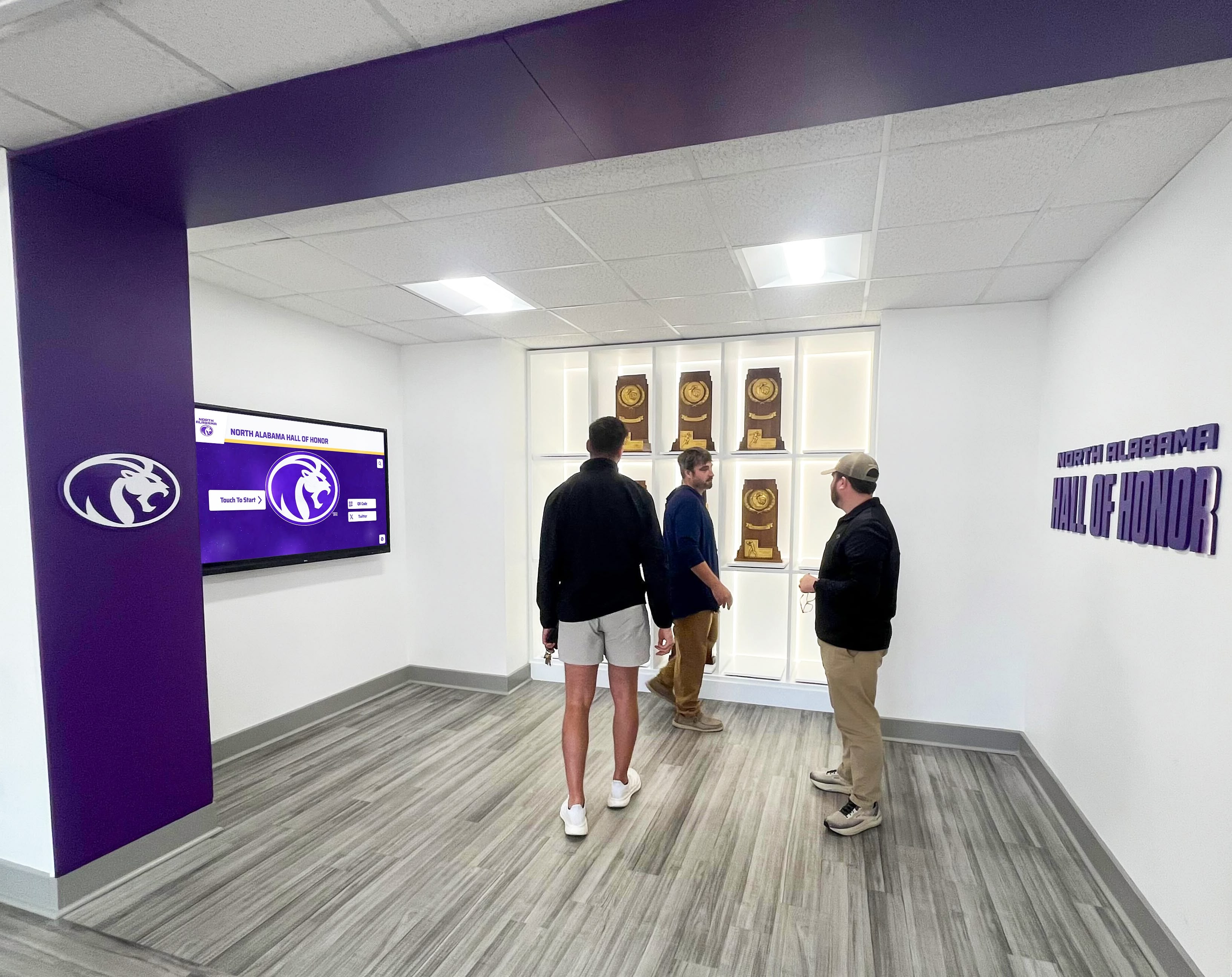
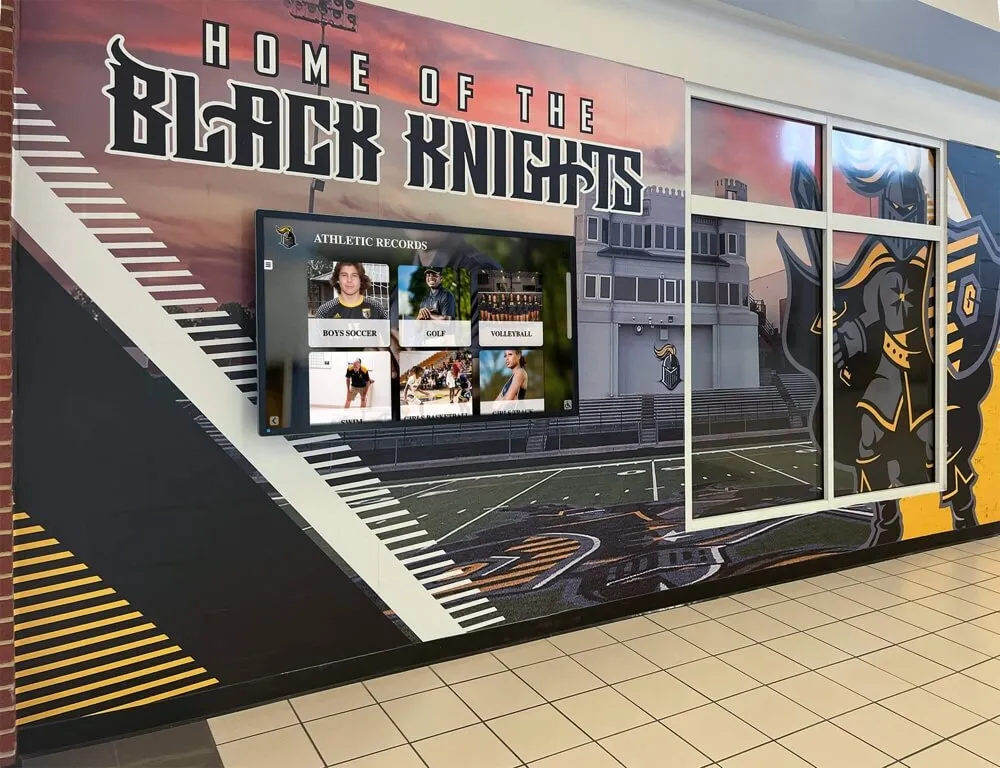
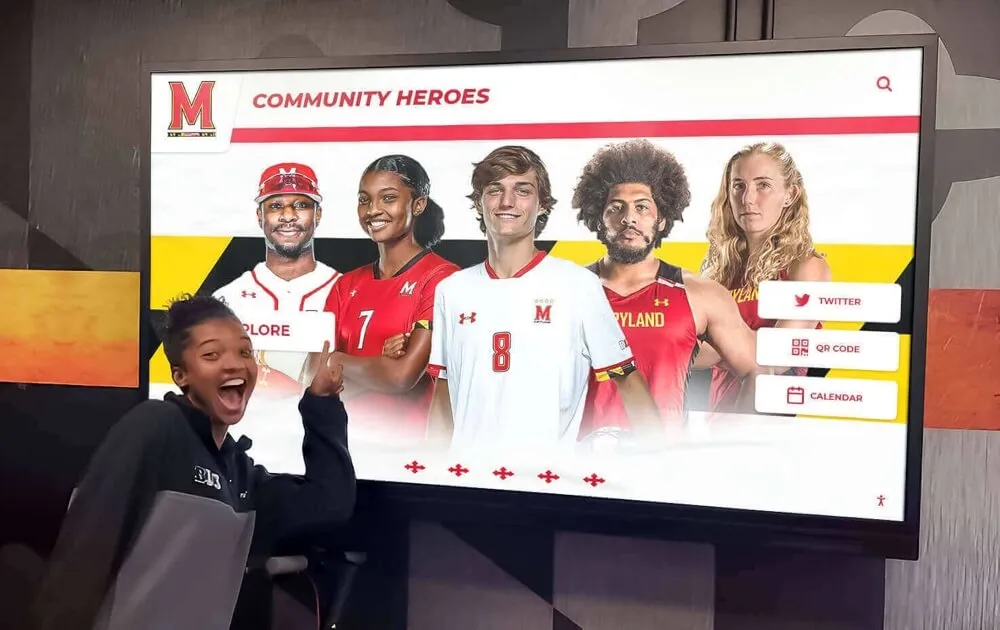
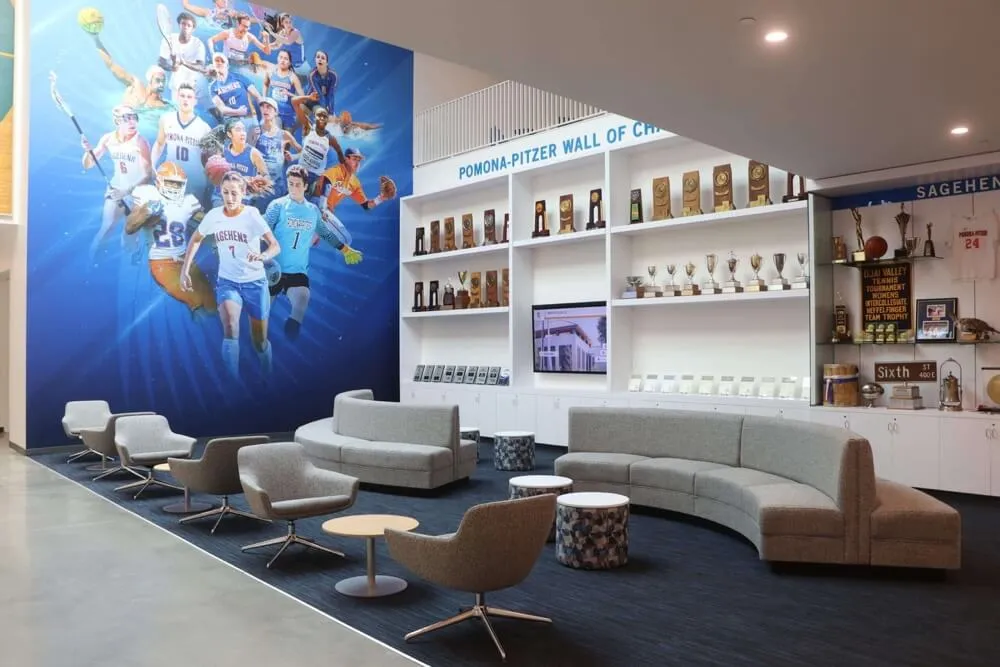
Well-designed physical trophy displays draw visitors and create gathering points — a strength that digital systems complement rather than replace
When a Traditional Award Display Case Is the Right Answer
Not every school should prioritize a digital transition. There are legitimate scenarios where a traditional case is the better investment:
New programs with limited history: A sports program in its third year does not yet have the depth of historical content that makes a digital archive valuable. A physical case that displays current achievements clearly and professionally is the right tool for this stage.
Schools with strong physical trophy culture: Some communities place deep value on the physical object — the actual trophy, the actual plaque — as distinct from a digital representation. In these contexts, attempting to replace physical recognition with screens can feel like a reduction in seriousness. The right response is usually a hybrid approach, not wholesale replacement.
Low-traffic recognition spaces: A case installed in a rarely visited equipment room or coaching office serves a different function than one in the main lobby. For low-traffic contexts, the interactivity premium of a digital system may not be worth the cost.
Budget-constrained decisions: When capital budget is severely limited, a high-quality physical case in a visible location is a better investment than a cheap screen with inadequate software. Quality matters more than format.
When a Digital Display Is the Right Answer
The case for digital recognition becomes compelling in several specific circumstances:
Program history exceeds case capacity: The most common trigger. When athletic directors report trophies in storage, when retired coaches have hardware at home that should be on the school’s wall, or when alumni ask about records and the answer requires digging through filing cabinets — that is the profile of a program that has outgrown physical case infrastructure.
Alumni engagement is a strategic priority: Schools actively engaged in alumni relations, reunion programming, or athletic fundraising benefit disproportionately from digital recognition. A touchscreen display that allows a 1992 graduate to find their junior year championship record during a reunion visit creates a connection that a case of current trophies cannot. Resources on youth sports award recognition ideas and broader alumni programming often note how visible historical recognition correlates with giving rates among athletic alumni.
New construction or major renovation: The most cost-effective moment to install a digital recognition system is when walls are already open. Integration with electrical and network infrastructure during construction is significantly cheaper than retrofit installation.
Equitable multi-sport recognition: Schools with 15 or more varsity sports struggle to allocate physical case space equitably. Digital systems allow every sport to receive equivalent visibility — a 24/7 lobby touchscreen does not favor football over swimming based on trophy size.
The Hybrid Approach: What Most Schools Actually Do
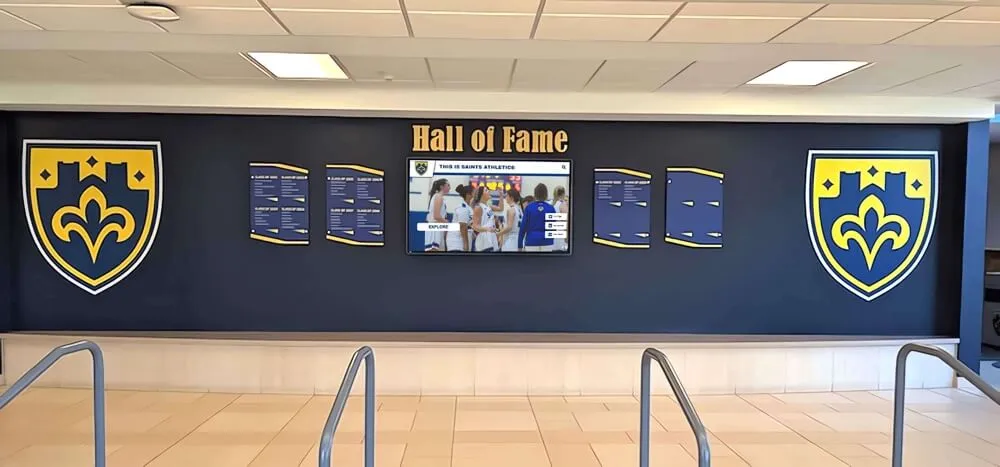
The most common outcome for schools navigating this decision is not replacement — it is layering. Physical cases remain, typically maintained to showcase the most recent major hardware and championship banners that carry strong visual identity. Digital systems are added alongside, handling the depth of program history, individual athlete recognition, alumni archives, and searchable records.
This approach works because the two systems serve different audiences simultaneously. A first-time visitor to the main lobby sees the state championship trophy in the case and understands immediately that this is a serious program. The same visitor, curious about more, can step to the touchscreen and explore forty years of season records in three minutes. An alumnus returning for the first time since graduation finds both their era’s championship hardware — still in the case because it was significant enough to keep — and their individual athlete profile accessible in the digital system.
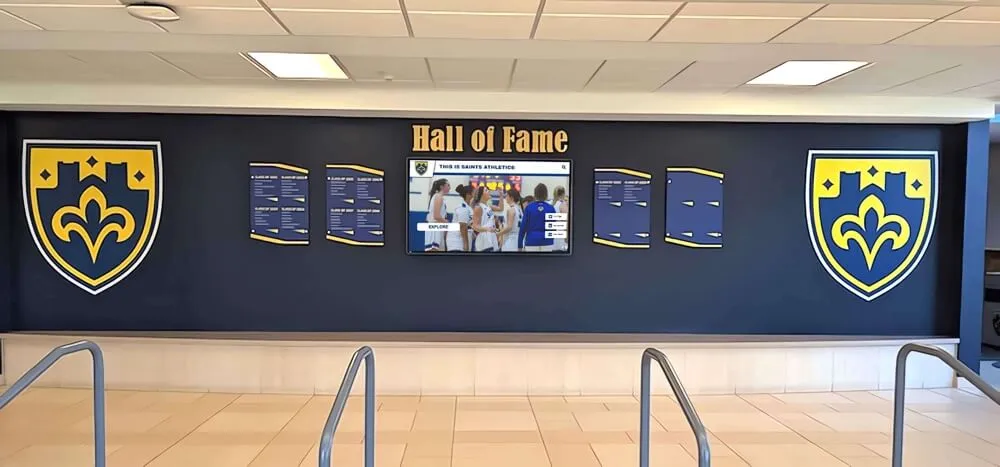
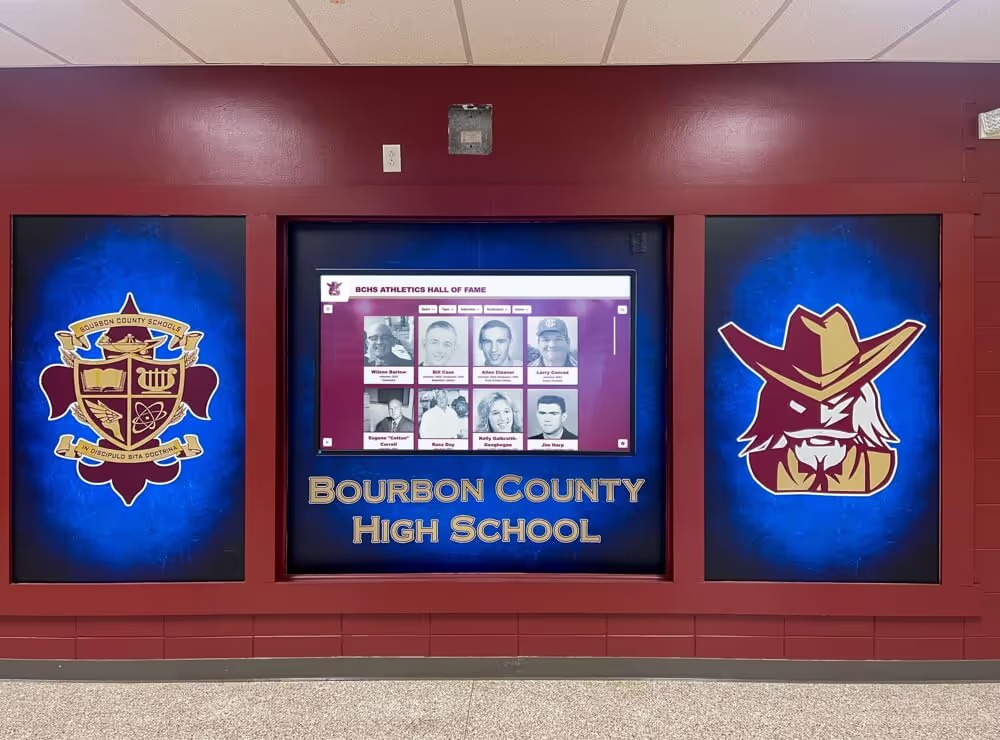
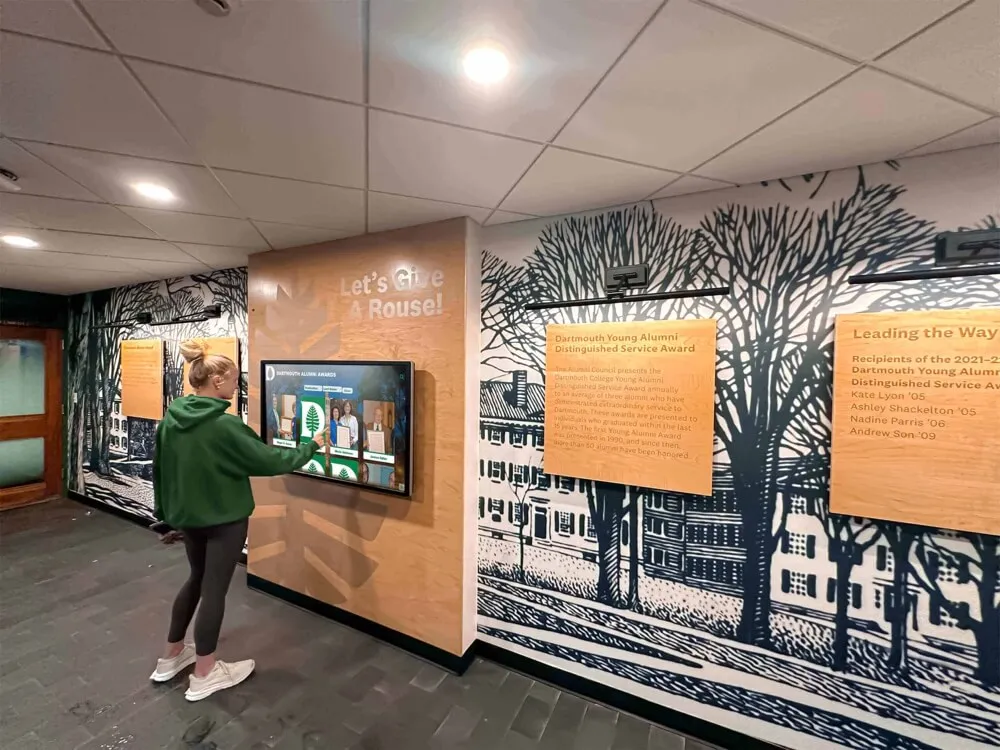
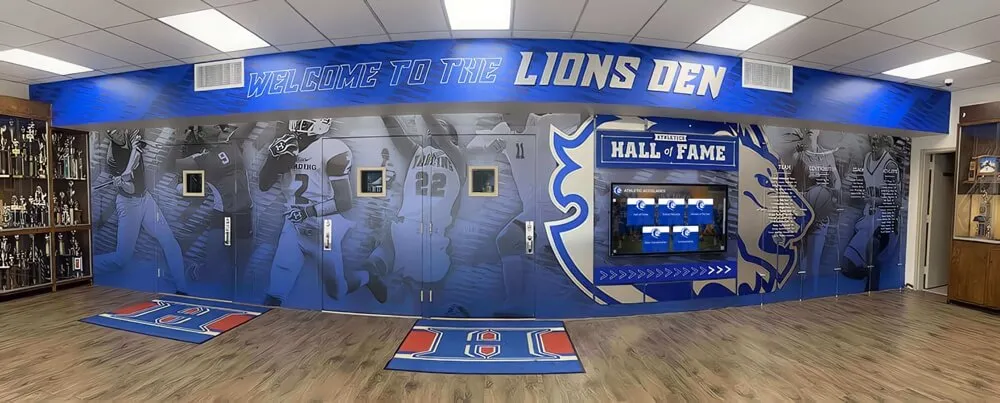
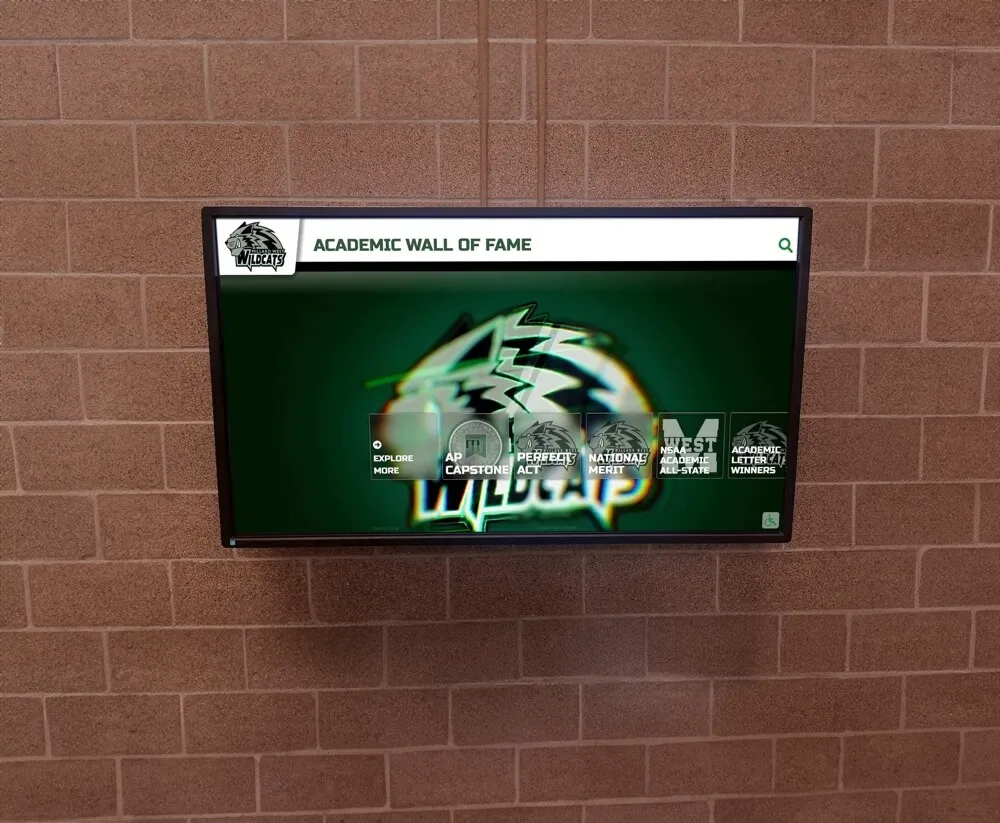
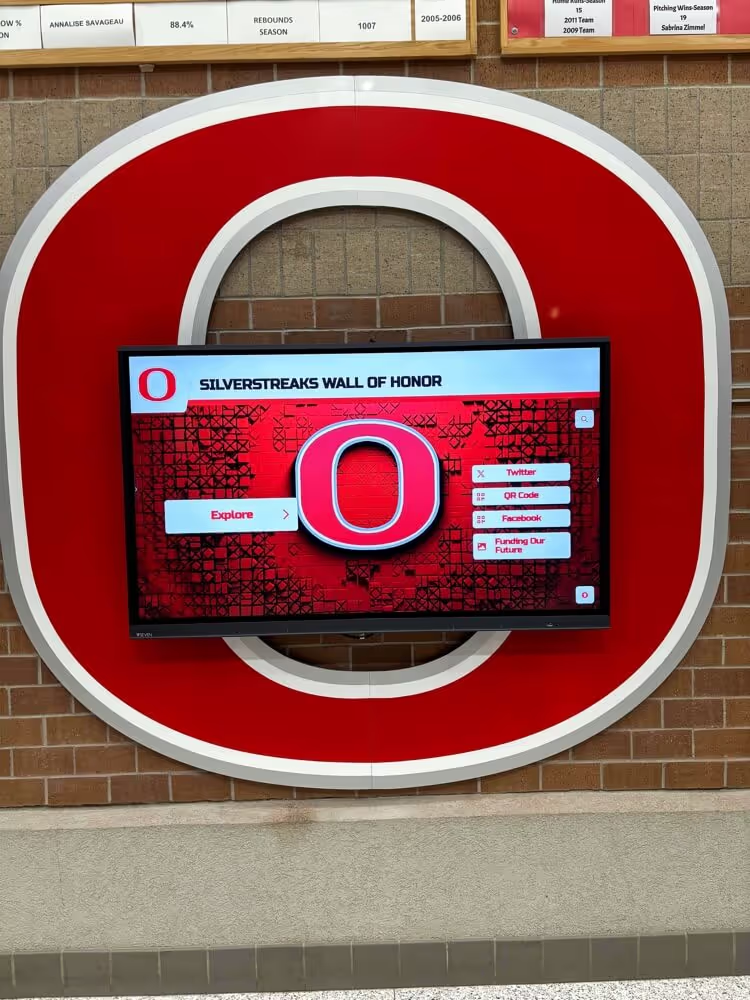
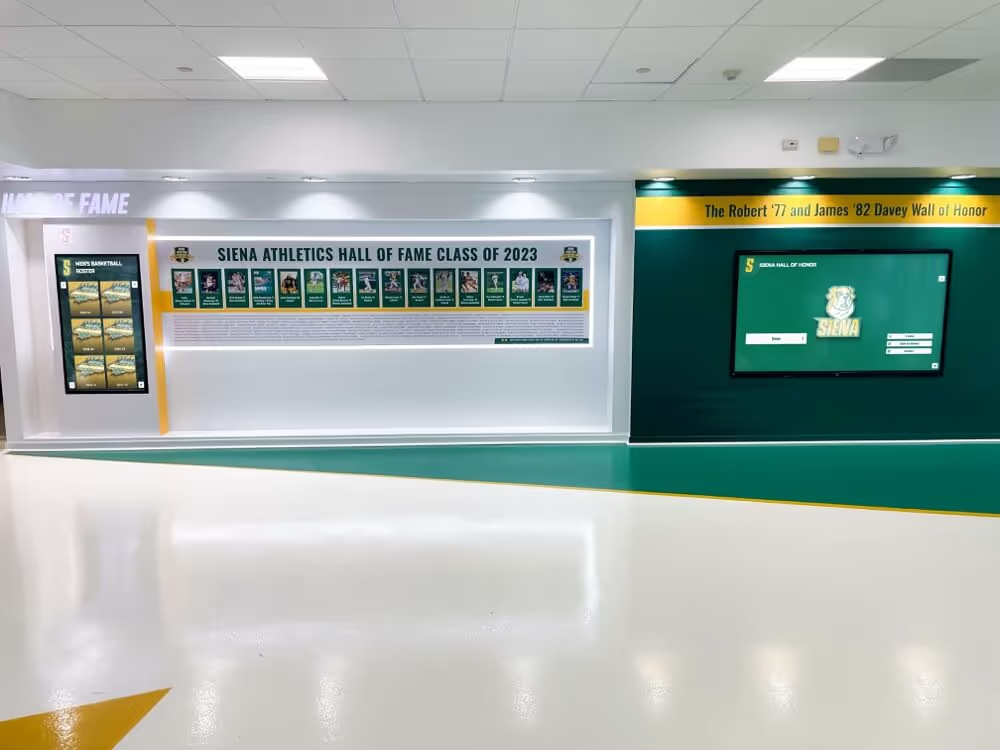
Hybrid installations combine the visual weight of physical plaques and shields with the information depth of digital screens — both audiences are served simultaneously
Rocket Alumni Solutions: What the Digital Option Looks Like in Practice
For schools evaluating the digital side of this comparison, Rocket Alumni Solutions builds interactive recognition systems specifically for K-12 and university athletic programs. Their product line includes touchscreen walls of fame, digital trophy cases, athletic record boards, and donor recognition displays — all managed through a cloud content system that allows staff to add award winners, update records, and upload media from any browser.
Rocket’s systems are designed to solve the space problem directly: a single touchscreen installation can hold an unlimited number of athlete profiles, award records, championship histories, and team archives. For schools that have significant history locked in filing cabinets or storage rooms, Rocket also offers content migration assistance to bring historical records into the digital system.
The Rocket Alumni Solutions demo request allows athletic directors, principals, and advancement teams to see a configured system before committing to a purchase — a useful step for any school comparing physical and digital options for the first time.
Recognition Equity: The Argument Most Schools Underweight
The space constraint created by physical cases has a distributional consequence that gets less attention than it deserves. When case space is limited, athletic programs with larger hardware — football, basketball, large-team sports — tend to dominate the allocation. Smaller programs, individual sports, and programs with older history get rotated to storage first.
This matters for student motivation. A swimmer who wins a conference championship deserves to see that recognition on the wall just as much as a basketball player. A track and field athlete who breaks a school record deserves a record board entry as permanent and visible as any team trophy. When recognition infrastructure has finite space, equity requires active management.
Digital systems distribute this equity automatically. Every sport, every athlete, every year gets the same access to the display. Award guides covering team recognition categories often note that programs which establish clear, permanent records for individual sports alongside team championships see broader athlete engagement with the recognition culture — because more students can see themselves in it.
Preservation and Archiving: The Dimension That Outlasts Both Systems
Whether a school chooses a physical case, a digital display, or a hybrid, the underlying question of recognition preservation is the same: what happens to this record in 20 years?
Physical trophies are vulnerable to damage, loss, and the decisions of future staff who may not share the current administration’s commitment to preservation. A new principal who cleans out storage — a documented phenomenon in schools with leadership turnover — can eliminate decades of athletic history in an afternoon.
Digital records, properly managed, are more durable. A cloud-managed system maintains records independently of the physical hardware; if a screen fails, the data is not lost. For schools with donor recognition alongside athletic history, the same durability argument applies: a donor wall built in stone or bronze is dependent on the building remaining intact; a digital donor record exists regardless of physical infrastructure changes.
For programs working through the early stages of historical digitization — scanning documents, recovering old yearbooks, building records databases — the process of archiving track and field results from multiple decades is covered in depth in resources like the track and field awards recognition guide, which outlines how to structure event-by-event records for digital display.
How to Audit Your Current Award Display Case Situation
Before making any purchase decision, an honest audit of current conditions saves budget and prevents misaligned investments. The following questions guide a useful 30-minute self-assessment:
Inventory the physical hardware currently in storage. Count the items that are not on display. If the number is larger than what is displayed, the program has already outgrown its physical infrastructure.
Identify the oldest award currently visible in the primary case. If the oldest visible hardware is from within the past five years, everything older has been rotated out — and a school with a 30-year program history has 25 years invisible.
Survey staff time spent on case management annually. Include time for ordering trophies, coordinating engraving, transporting hardware, and deciding what to rotate. For large programs, this is often 20 to 40 hours per year — a real cost.
Ask alumni what they look for when they return. Alumni typically want to see their era’s history. If the answer is “we don’t know what alumni are looking for,” that gap represents a lost engagement opportunity.
Calculate corridor footage consumed by current cases. Multiply by expected program growth over 10 years. If the arithmetic doesn’t work, the physical approach has a fixed horizon.
For programs considering recognition programs beyond individual sports, the youth sports awards resource at touchwall.us provides a framework for scoping recognition across 20 to 30 distinct award categories — a useful baseline for estimating how many recognitions per year a comprehensive program generates.
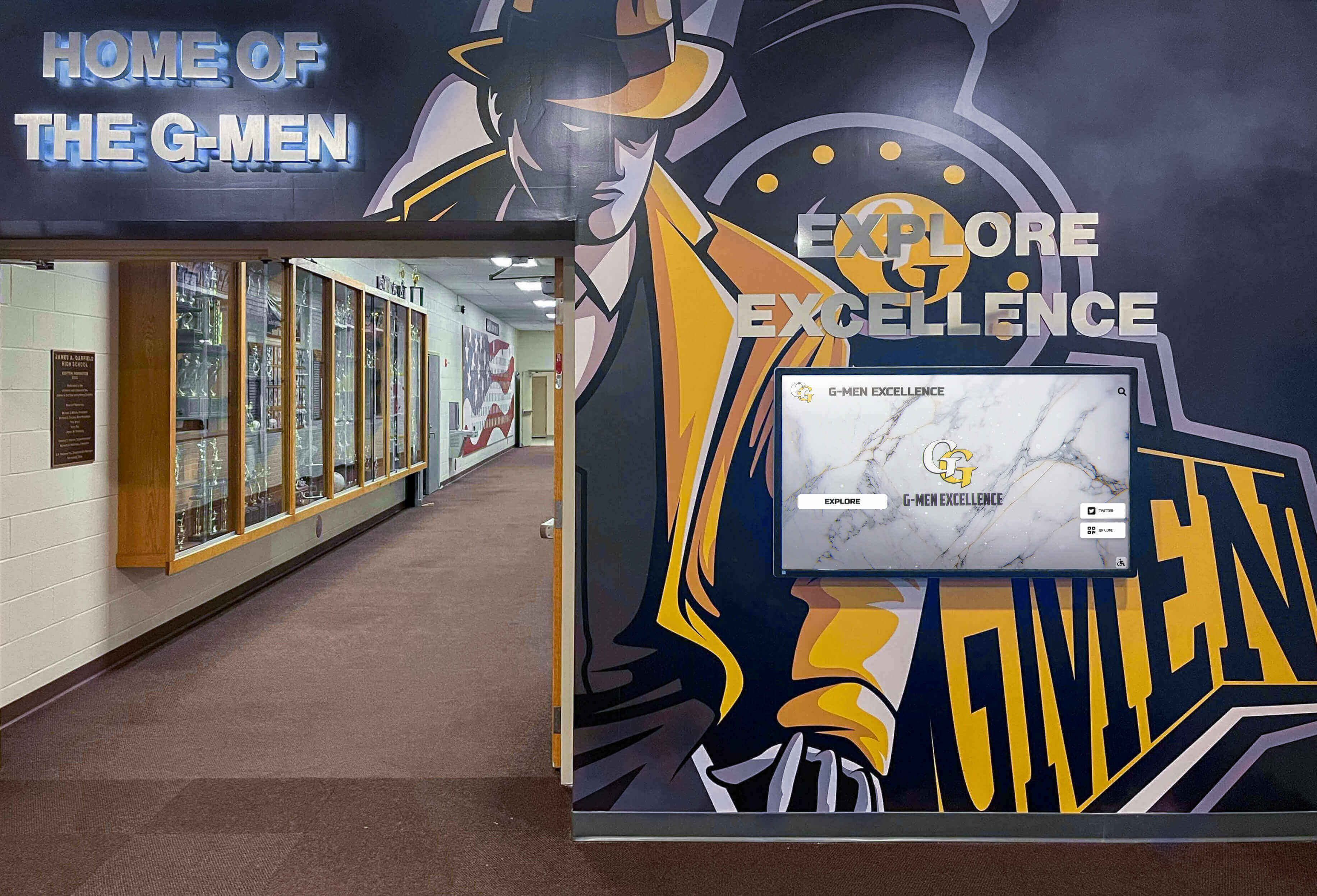
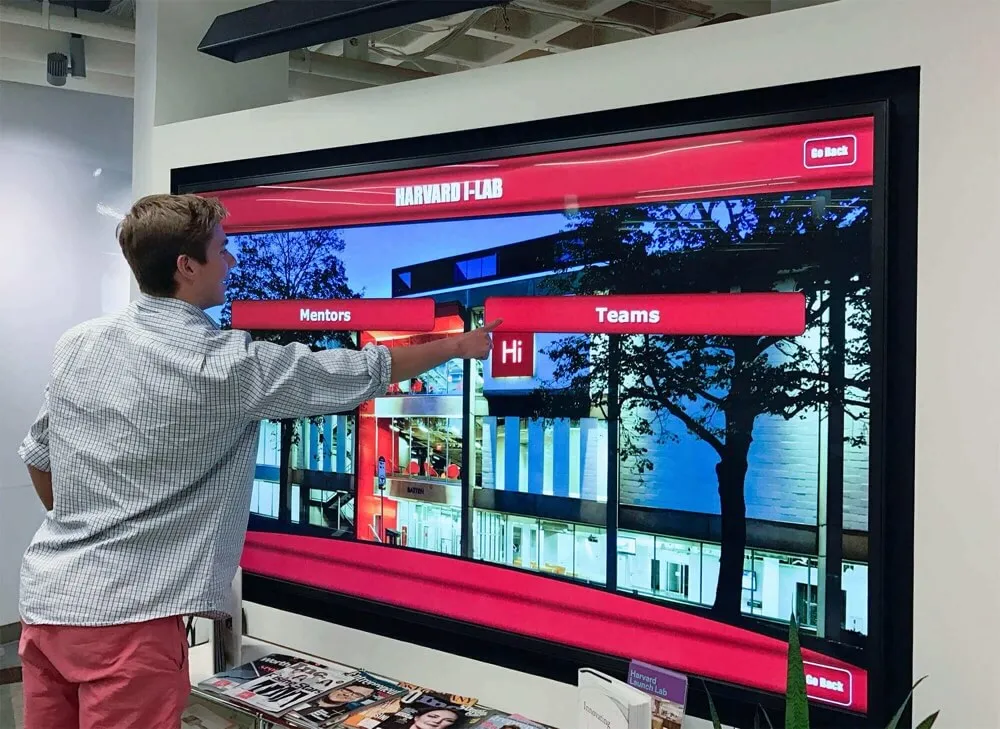
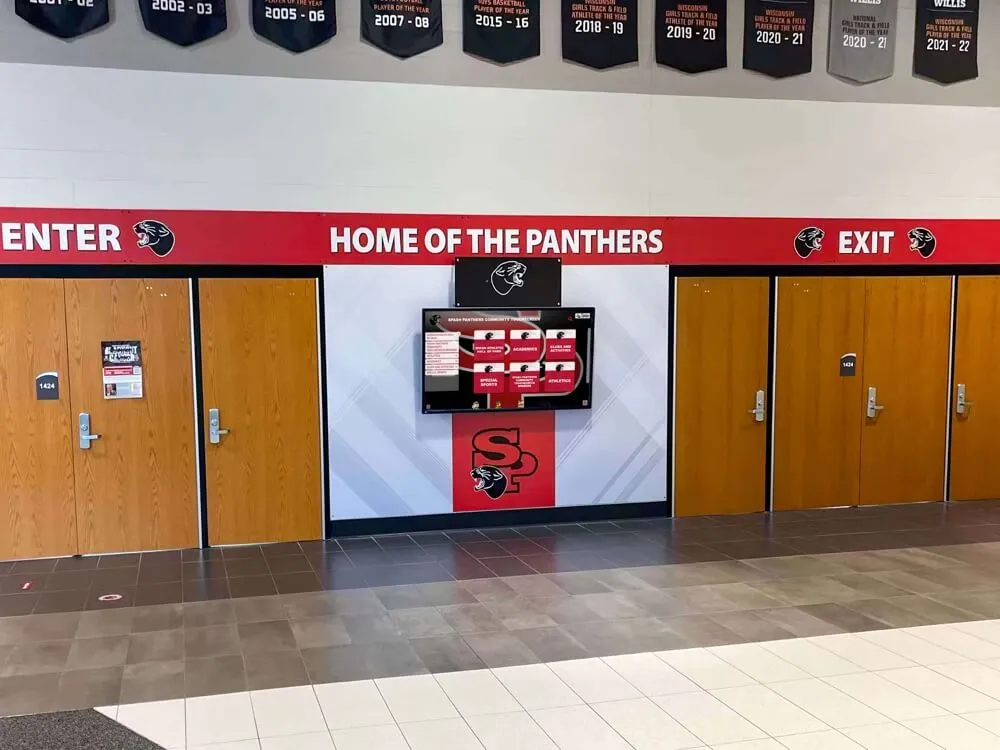
Schools that install digital displays alongside existing trophy cases typically see both systems become more valuable — physical cases gain curatorial focus, digital systems gain visibility
Making the Case Internally: Talking Points for Budget Conversations
Athletic directors who bring a digital display proposal to administration face a predictable set of objections. The following responses address the most common ones.
“We already have display cases — why do we need something else?” The cases show what they show, which is a small fraction of program history. A digital system does not replace the cases; it fills in what the cases cannot hold. The two systems serve different functions.
“We don’t have the staff to manage a digital system.” Cloud-managed systems require less staff time than physical cases, not more. The staff time currently spent on trophy ordering, engraving coordination, and storage rotation is comparable to — or greater than — the time required to enter annual award winners into a content management dashboard.
“How do we know students will actually use it?” Schools with interactive touchscreen displays consistently report that students engage with them — particularly when athlete profiles include photos, statistics, and personal details that connect to current athletes’ role models or family history. The halloffamewall.com resource on youth sports award ideas and hall of fame recognition documents how visible historical recognition affects current athlete motivation.
“The cost is too high.” Compare against the cost of a decade of physical cases, annual trophy budgets, and the opportunity cost of the alumni relationships not being built because 25 years of program history is invisible. The total cost of ownership comparison often surprises administrators who have been treating incremental case purchases as a zero-cost baseline.
Frequently Asked Questions
What should schools display in an award display case versus a digital system? Physical cases work best for large, visually impressive hardware — championship trophies, state finalist plaques, tournament banners — that communicates program status at a glance without requiring interaction. Digital systems work best for individual recognition, statistical records, multi-decade program history, and athlete profiles that require more detail than a physical label can hold. Most schools keep their most significant recent hardware in the case and use digital systems for everything else.
How much does it cost to upgrade from a trophy case to a digital awards display? Interactive touchscreen recognition systems from established vendors typically start in the $5,000 to $10,000 range for entry-level kiosks and can reach $25,000 or more for custom multi-panel installations. Annual content management fees apply for cloud-based systems. The investment is substantially higher upfront than a single display case but covers recognition capacity that dozens of cases could not match.
Can a digital display replace a physical award display case entirely? It can, but most schools choose not to. The physical case serves a different experiential function — it grounds program identity in tangible objects and provides a visual anchor that screens alone do not replicate. The more common and effective model is a hybrid installation where cases showcase selected current hardware and digital systems handle historical depth, individual athlete profiles, and searchable records.
How difficult is it to migrate historical records into a digital recognition system? The difficulty depends on how well the school has maintained its historical records. Programs with complete banquet programs, yearbooks, and season statistics from each year can typically build a comprehensive digital archive with moderate staff investment. Programs where historical records are fragmentary face more significant research work. Vendors like Rocket Alumni Solutions offer content migration assistance, and resources covering 100 youth sports awards ideas can help programs scope out which recognition categories to prioritize during an initial migration.
What are the space dimensions for a typical award display case installation? Standard wall-mounted athletic display cases range from 30 to 48 inches wide and 12 to 48 inches tall, requiring 4 to 10 inches of wall depth. Floor-standing cases typically measure 48 to 72 inches wide, 18 to 24 inches deep, and 72 to 84 inches tall. Corner cases vary by design but typically require a 36-by-36-inch floor footprint. Custom casework for major lobbies can span any dimension but generally costs significantly more than stock cases.
See How Schools Are Solving the Space Problem
Rocket Alumni Solutions builds touchscreen walls of fame, digital trophy cases, and athletic record boards that hold unlimited program history in a single display footprint. If your award display cases are running out of room, see what a digital recognition system looks like in a school similar to yours.
Request a DemoConclusion: The Space Problem Has a Structural Solution
An award display case does its job well, right up until the moment the program outgrows it — and most programs do. The cases fill. The trophies go into storage. The history disappears from the wall, taking with it the motivational and relational value that recognition is supposed to create.
Digital awards displays do not solve this problem by being better in every dimension. They solve it by removing the one dimension that creates the problem: physical space. A digital system holds everything — the last fifty years, the next fifty years, every sport, every individual, every record — in the same footprint as a single mounted screen.
The right decision for any school depends on its program history, its budget, its community culture, and its goals for alumni engagement. But the starting point for that decision is an honest look at the current situation: how much history is visible, how much is in storage, and what the cost is of leaving that history invisible for another decade.
For most schools with programs older than ten years, the cost is higher than it looks.