



Every school reaches the same breaking point. The main hallway plaque wall is full. The trophy case can’t hold another championship. The athletic director is rotating last decade’s banners to storage to make room for this year’s. And the academic honor wall — the one the principal added five years ago — already looks cluttered. Searching for award wall ideas that actually scale is the right instinct. The challenge is knowing which display type fits which recognition goal before ordering materials, reserving wall space, or asking facilities to make holes.
This guide organizes school award walls into a practical taxonomy: athletic, academic, team, hall of fame, and donor and sponsor recognition. For each category, it covers the display formats that work, the pitfalls that create clutter, and how digital systems extend the life of any physical installation without requiring additional square footage.
Award walls serve a function that goes beyond decoration. Research published by the American Psychological Association links visible, public recognition to stronger motivation, higher academic engagement, and increased student-athlete retention in extracurricular programs. But that function only works when the display is organized, current, and inclusive enough that students see themselves — or people who look like them — somewhere on the wall.
The award wall ideas below are organized by purpose, not by format, because the format decision should follow the goal. A school that needs to recognize 400 individual academic achievers per year has different constraints than one building a 30-year athletic hall of fame. Getting the taxonomy right first prevents the most common recognition wall mistake: building a display that solves today’s problem and creates next year’s space crisis.

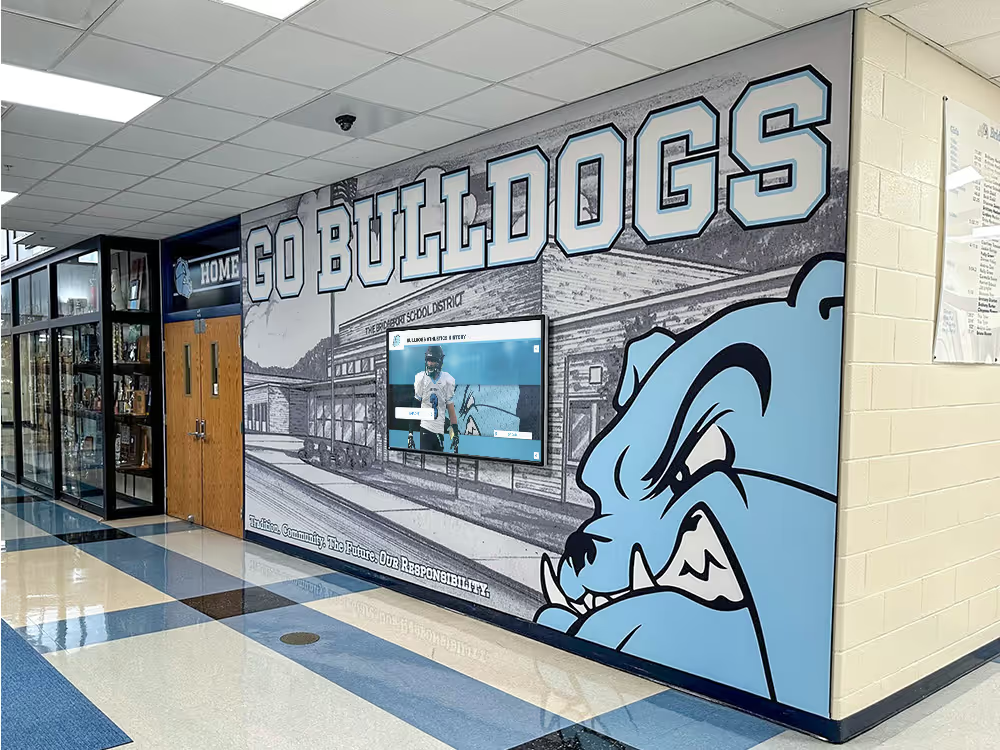
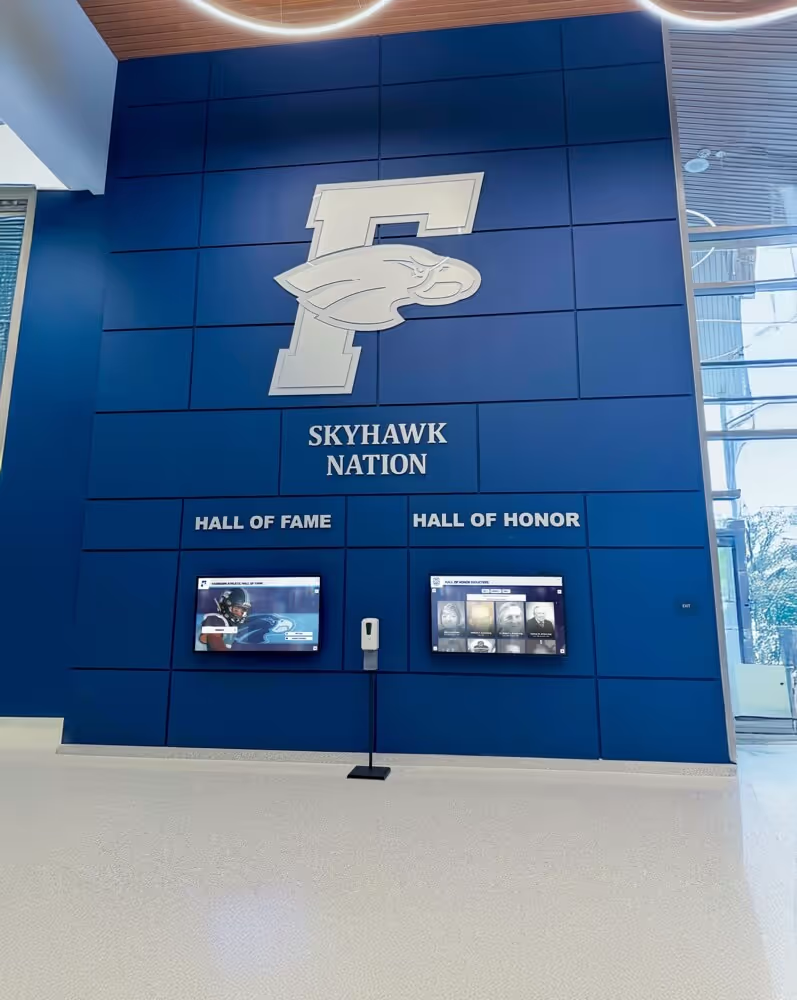
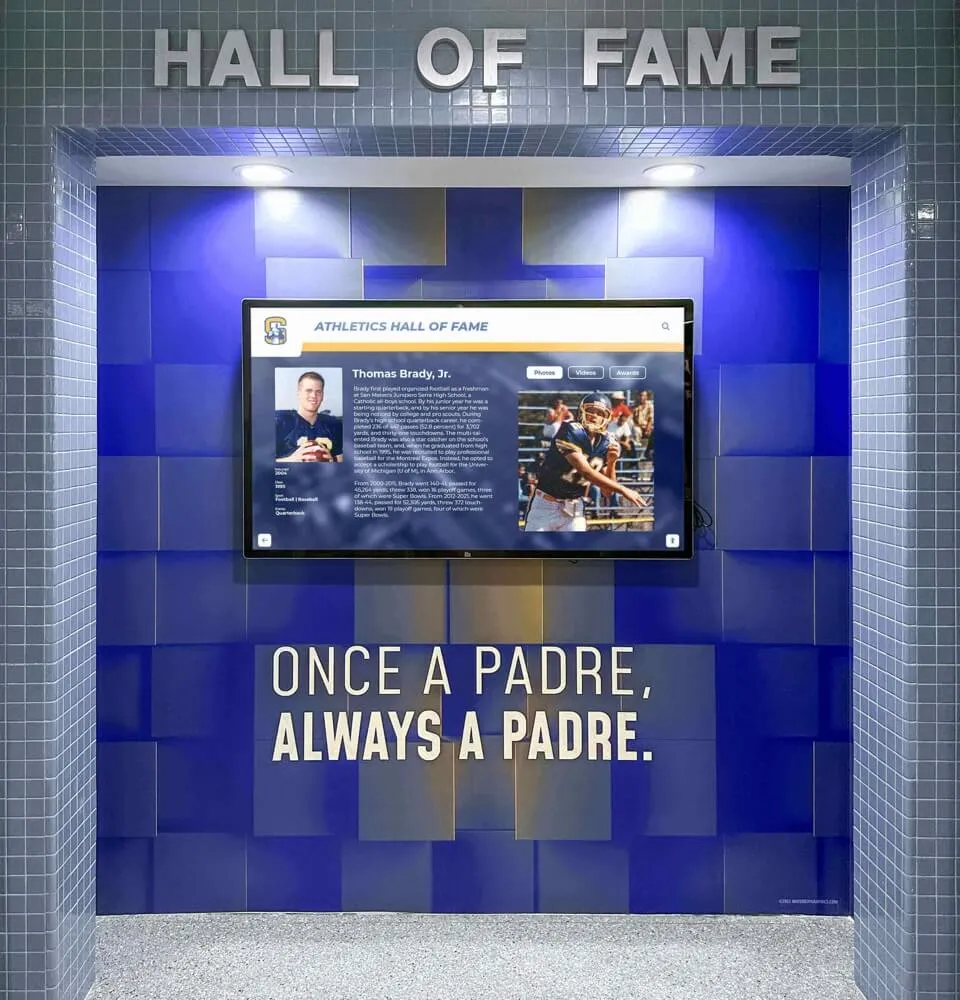
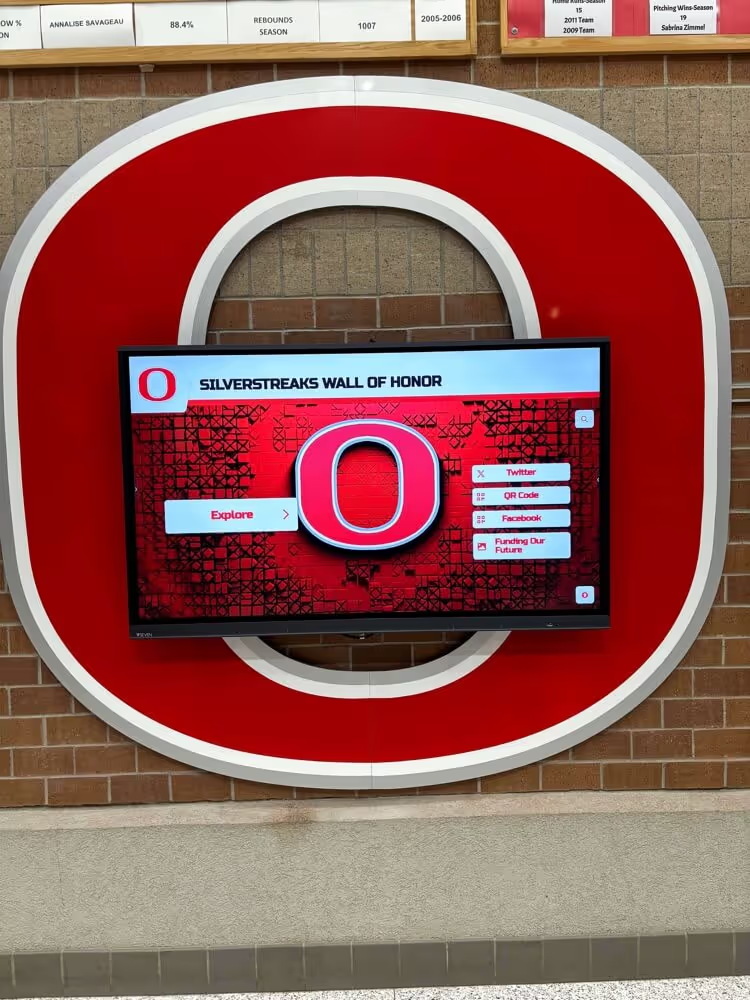
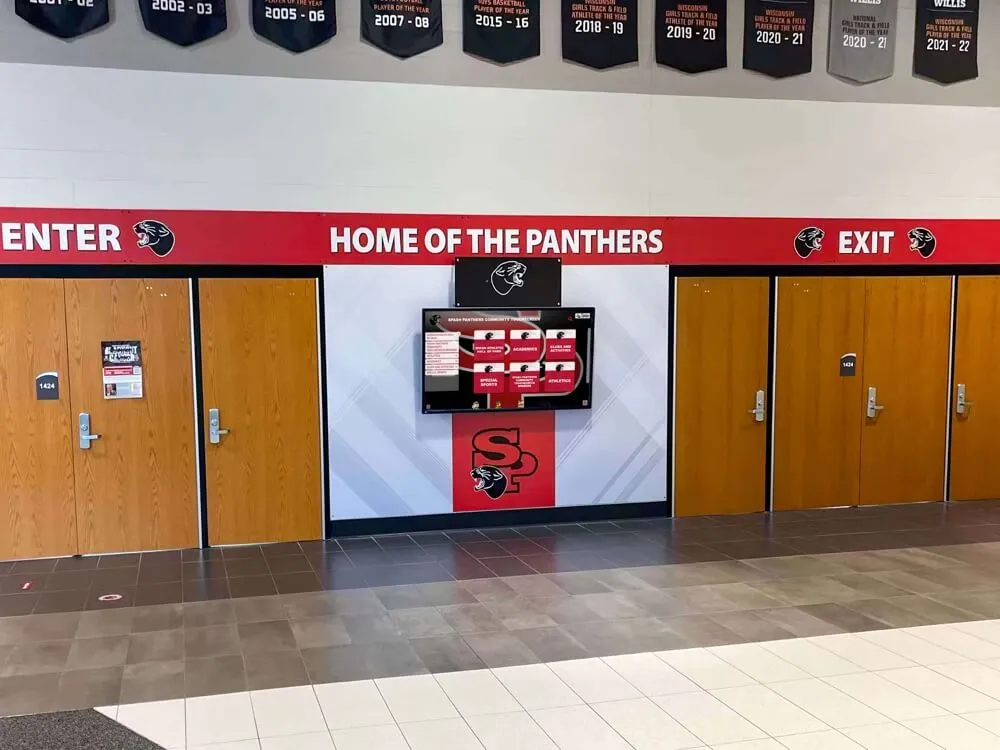
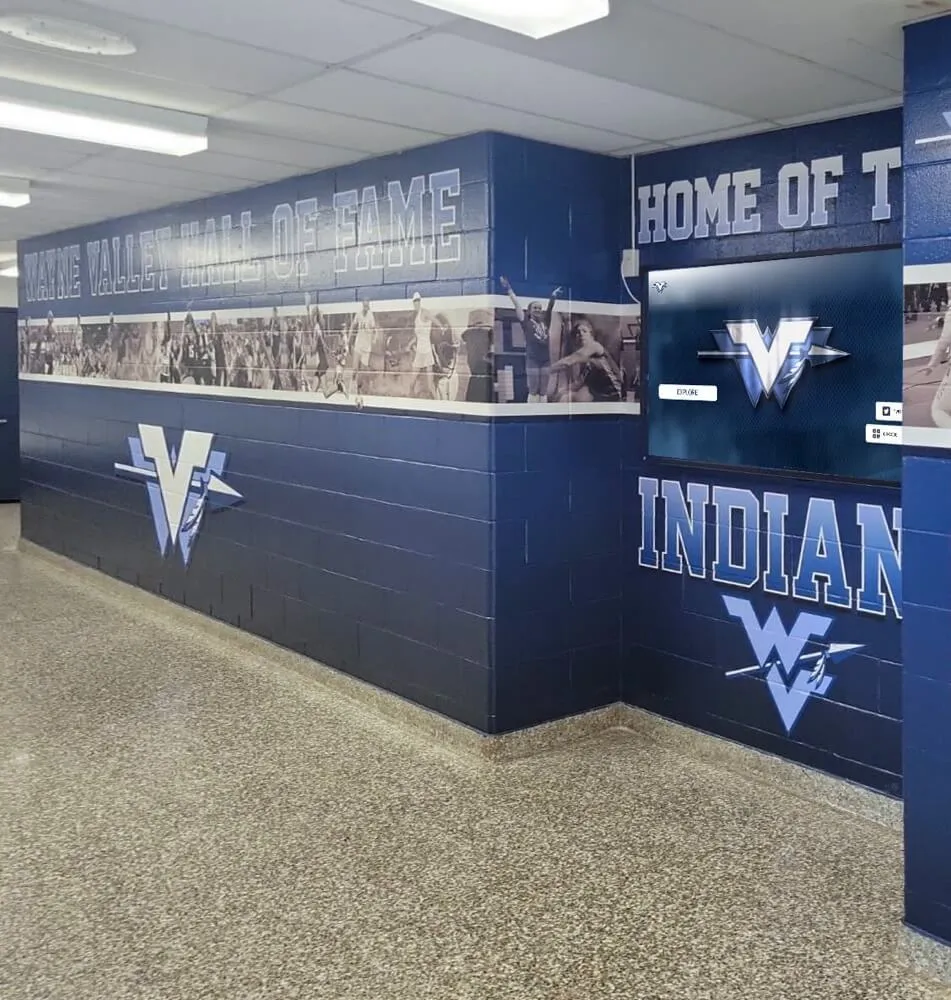
A well-organized award wall in a school hallway invites interaction and makes recognition visible to every student who passes through
Award Wall Display Taxonomy: Five Categories Every School Should Distinguish
Before choosing a specific display format, it helps to separate recognition goals into five distinct categories. Most schools blend these, which is where clutter starts.
1. Athletic Award Walls
Athletic award walls honor competitive achievement: state championships, regional titles, conference awards, and individual athletic milestones such as school records and all-state selections. These walls are the most visible recognition infrastructure in most schools because they tend to occupy the most prominent hallway or lobby locations.
The challenge with athletic award walls is volume. A school with 20 varsity sports generating 10 to 15 significant awards per sport per year accumulates 200 to 300 recognitions annually. Over 30 years, that is 6,000 to 9,000 individual data points — impossible to surface in any physical case or plaque installation.
Athletic award wall ideas that address this scale problem:
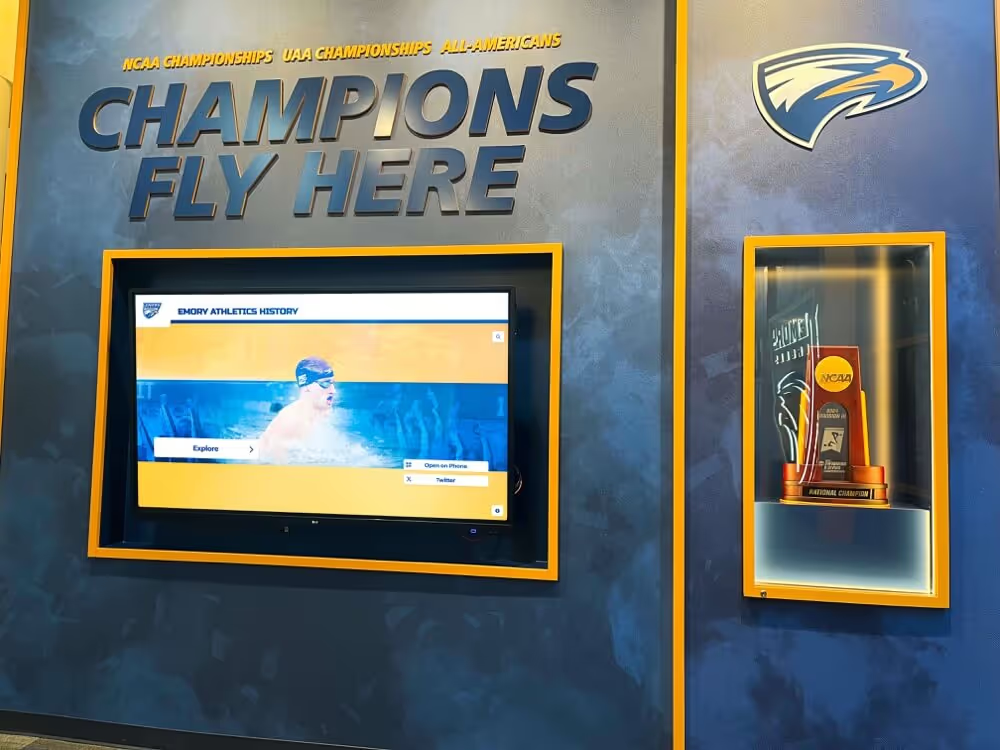
- Trophy and banner combination walls: Physical trophies in a case paired with championship banners on the wall above. The case holds hardware; the banners communicate era and identity. This format works well for programs that want physical presence without the expectation that every award fits in the case.
- Record board displays: Dedicated walls or panels listing sport-by-sport records — the all-time leaders in yards rushed, points scored, race times, or batting average. Auto-ranking record boards that update automatically when a new record is broken eliminate the maintenance labor of manual updates.
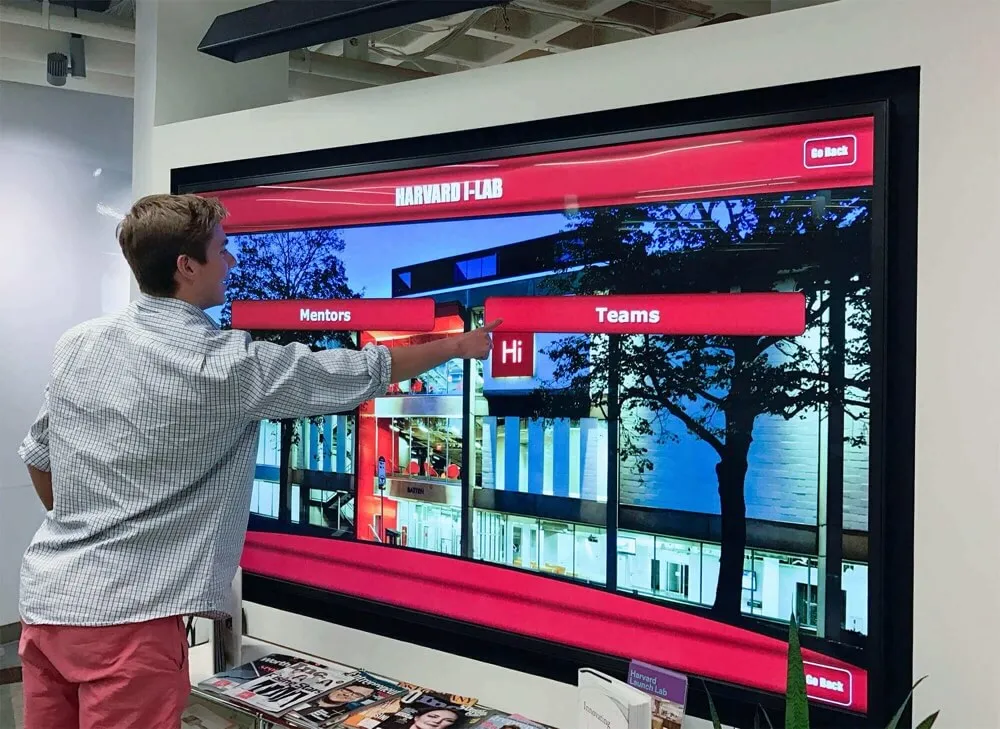
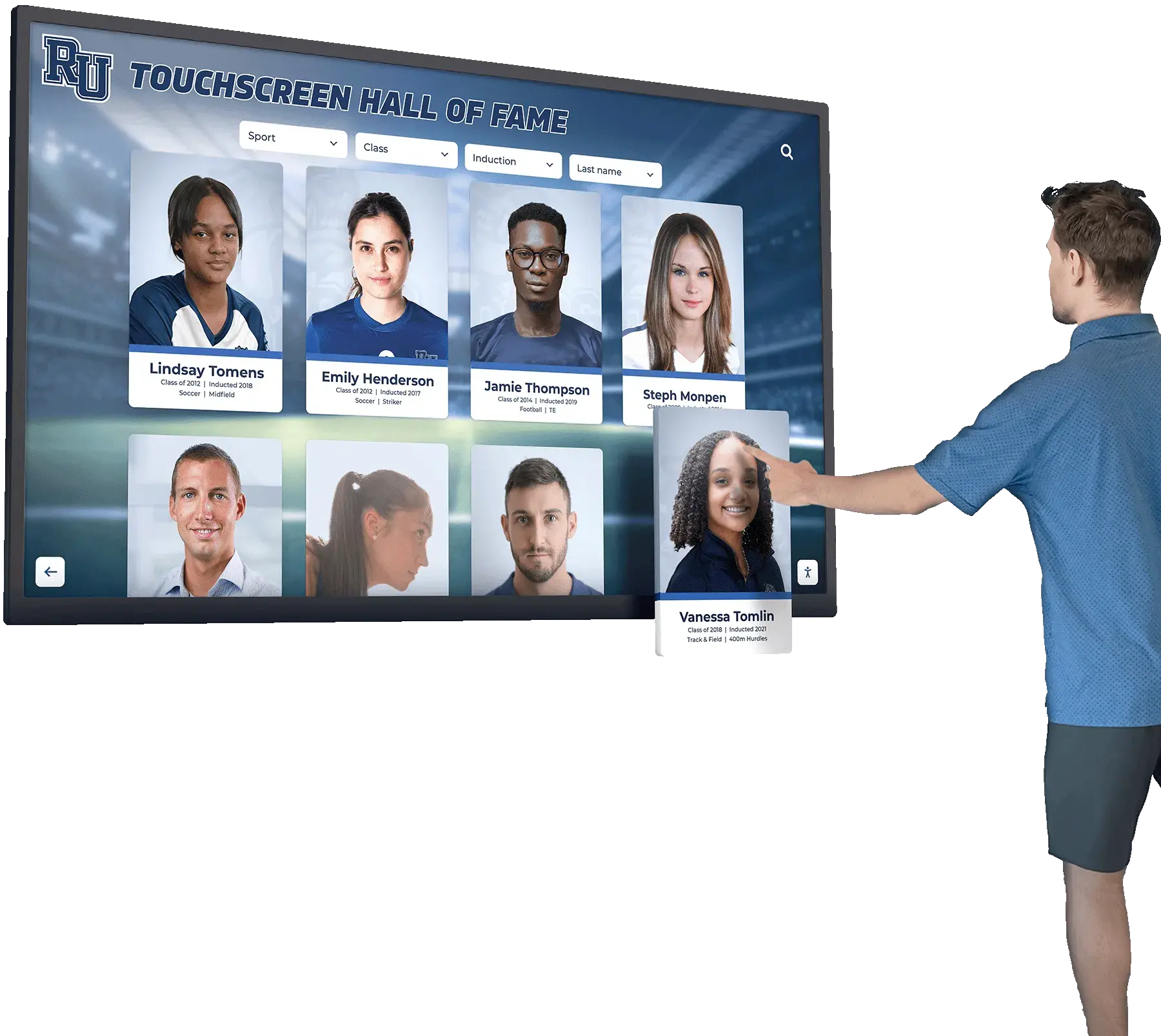
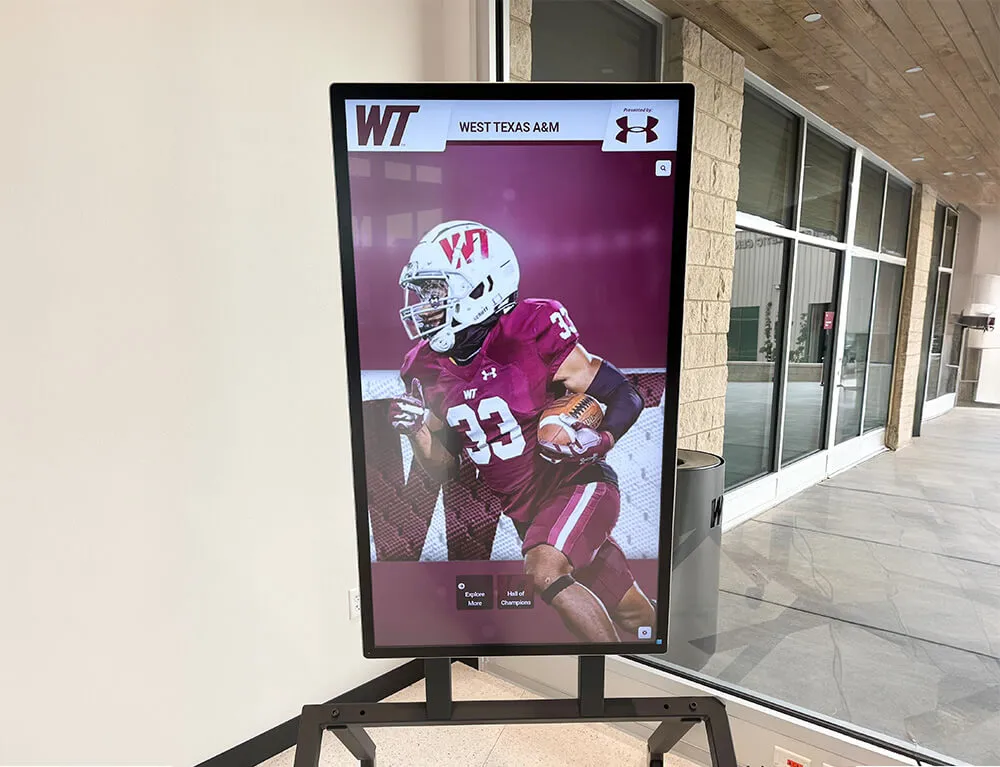
- Interactive touchscreen athletic halls of fame: A single touchscreen panel can hold every athlete, every award, and every season statistic from the program’s entire history. Visitors filter by sport, year, or athlete name. For programs with deep history, this format removes the space constraint entirely.
For guidance on how academic achievement awards connect to broader recognition structures, the frameworks that apply to athletic awards translate closely — the categorization logic is the same even when the achievement criteria differ.
2. Academic Award Walls
Academic award walls recognize curricular achievement: honor roll, National Merit, valedictorians, academic letter recipients, subject-area award winners, and scholarship recipients. These walls appear most often near counseling offices, library entrances, or main administrative hallways.
The organizing challenge for academic award walls is not depth — it is breadth. Schools honor dozens or hundreds of academic achievers per year across dozens of categories. Displaying them all in equal visual prominence is physically impossible in most buildings. The result is a cramped, hard-to-read display that inadvertently communicates hierarchy: the names printed largest or placed highest become the ones that matter.
Academic award wall ideas that address the breadth problem:
- Category-separated panels: Dedicated wall sections for each recognition tier — honor roll, academic letters, departmental awards, national scholarships. Each section is readable at a glance because it contains one type of recognition.
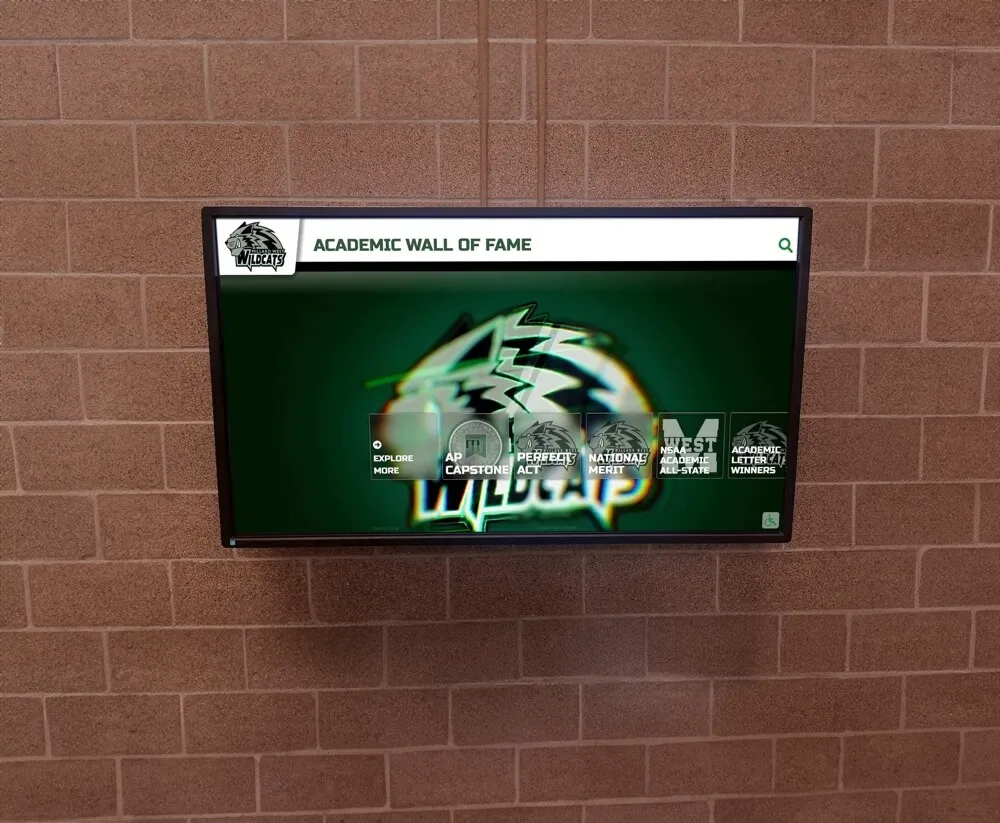
- Rotating digital academic displays: A screen-based display cycling through academic honorees organized by category and year. Students see their name in a recognizable format; the display updates each semester without requiring new plaques.
- Digital academic walls of fame: Searchable displays that allow students and families to find any academic honoree by name, year, or award category. For schools with a history of strong academic programs, this format surfaces recognition from 20 or 30 years ago alongside current honorees.
Understanding how academic letters are awarded and displayed provides useful context for schools building academic recognition walls that connect physical certificates with a permanent digital record.
3. Team Honor Walls
Team honor walls recognize collective achievement rather than individual awards. They are distinct from athletic award walls in that the emphasis is on the team’s history and identity, not on individual statistics or titles.
Team honor walls work best when they create a sense of program continuity — a visual narrative that connects current athletes to predecessors who wore the same uniform and competed under the same banner.
Team honor wall ideas:
- Season history panels: Year-by-year season records displayed in a consistent format — wins, losses, postseason results, and coaching staff. A program with 40 years of history can display that narrative in approximately 16 square feet using a well-designed table format.
- Captains and senior recognition walls: Some programs maintain dedicated walls that list team captains or senior class members by year. These walls create a connection across generations without requiring trophy hardware.
- Multi-sport recognition corridors: For schools with 15 or more varsity sports, corridor-length installations assign each sport its own section of wall space — equal visual weight regardless of program size or revenue.
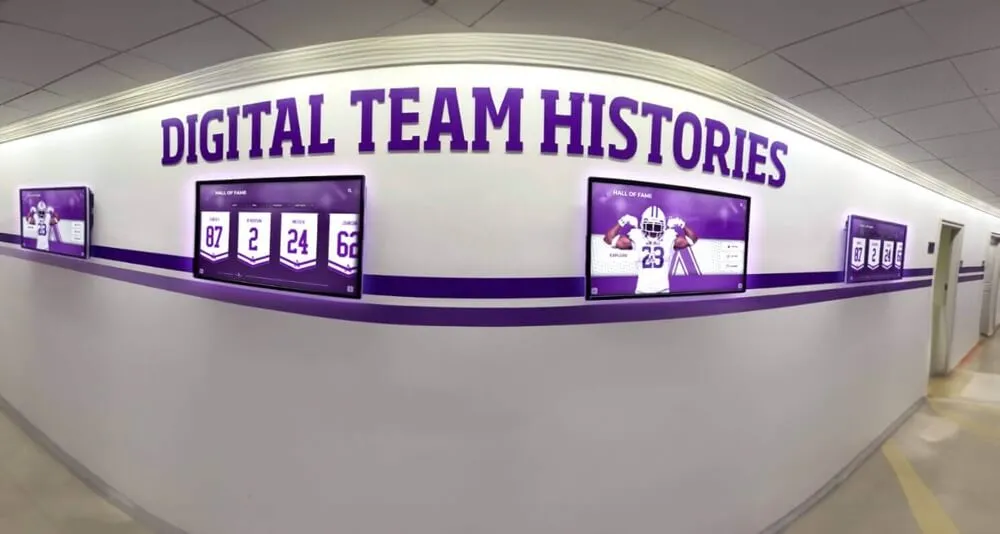
- Digital team histories: Screen-based displays showing team photos, season statistics, and milestone moments organized by sport and year. These allow programs to include junior varsity and freshman teams alongside varsity without running out of physical space.
Resources covering team recognition categories and how organizations build award programs around collective achievement outline how the same taxonomy logic applies to non-athletic programs — relevant for schools that want to extend team recognition to academic teams, performing arts ensembles, and activity groups.
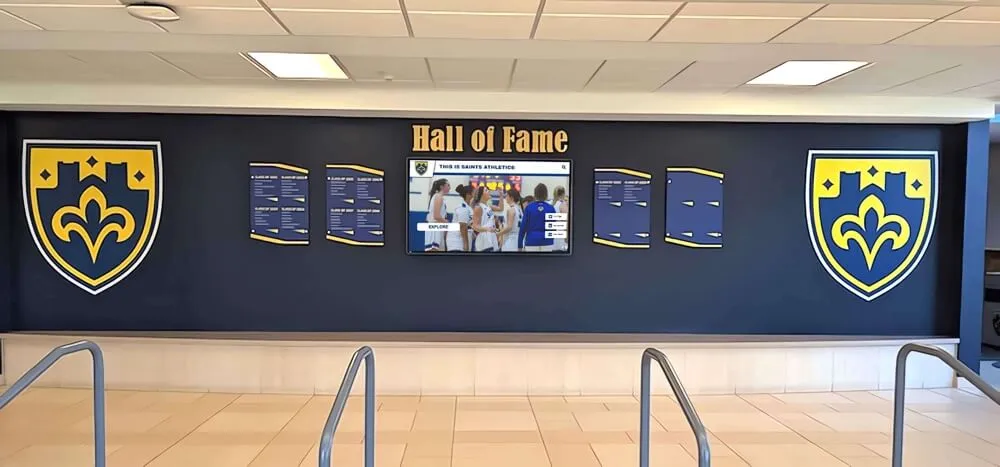
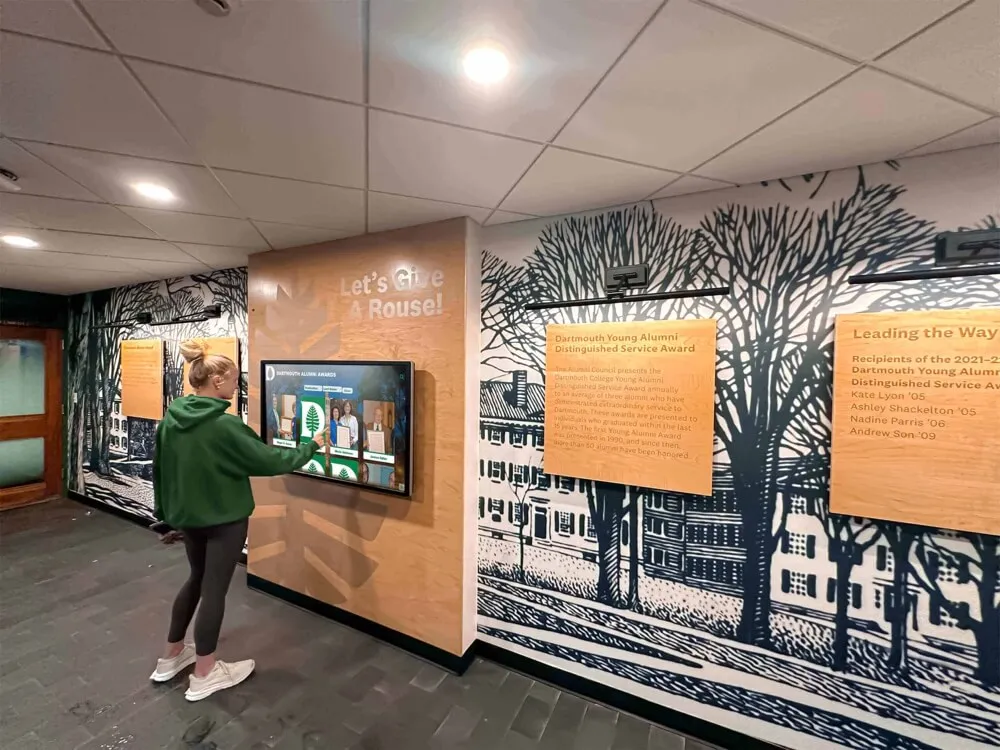
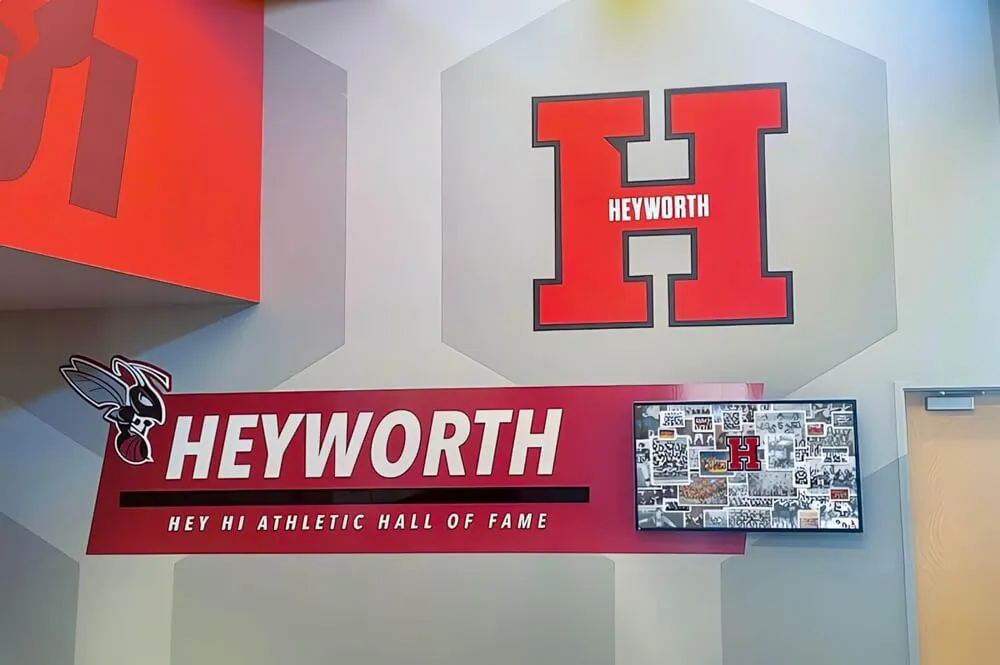
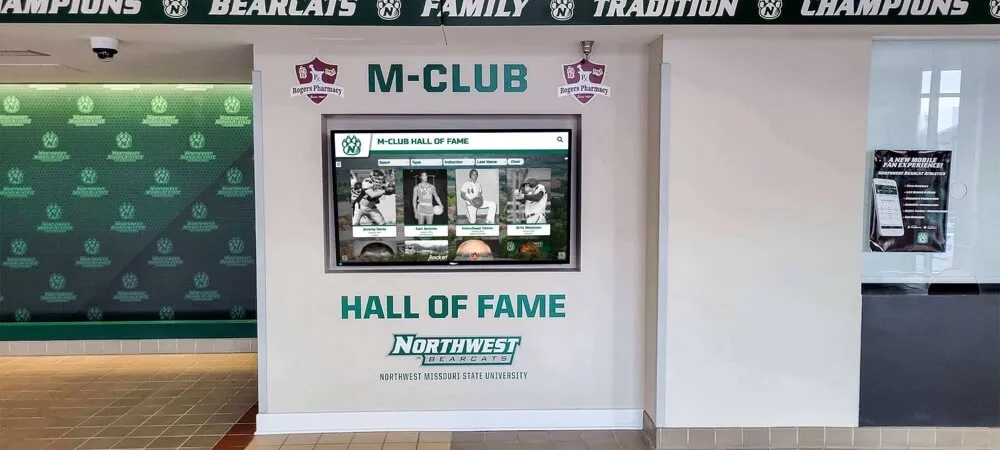
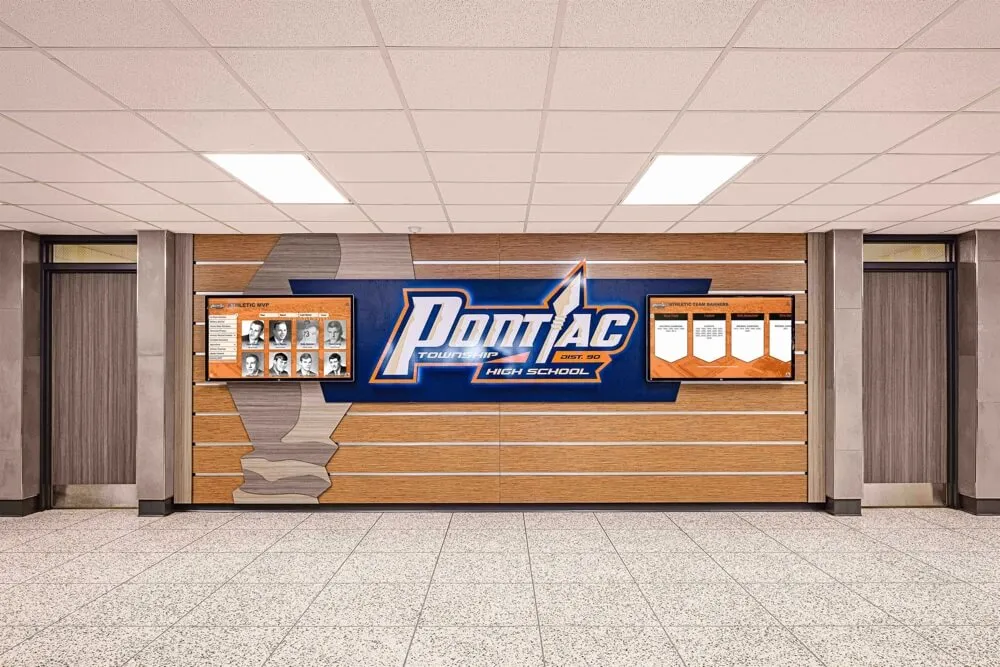
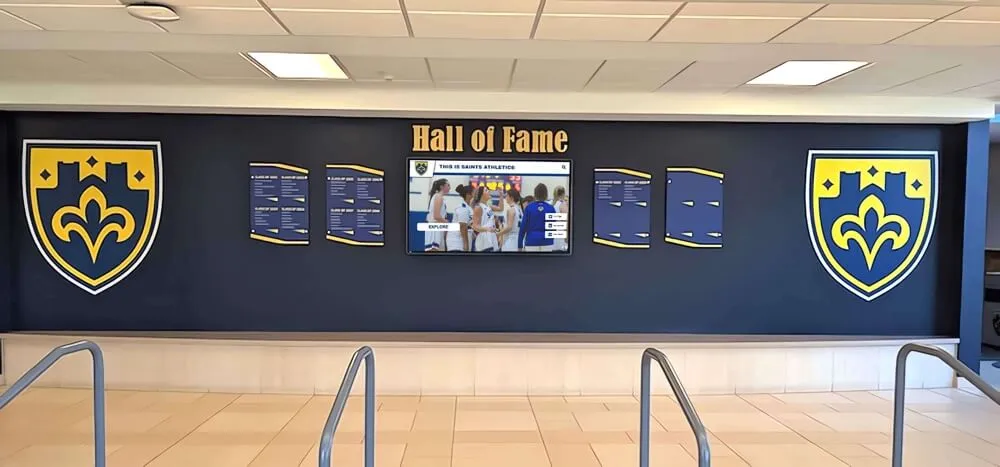
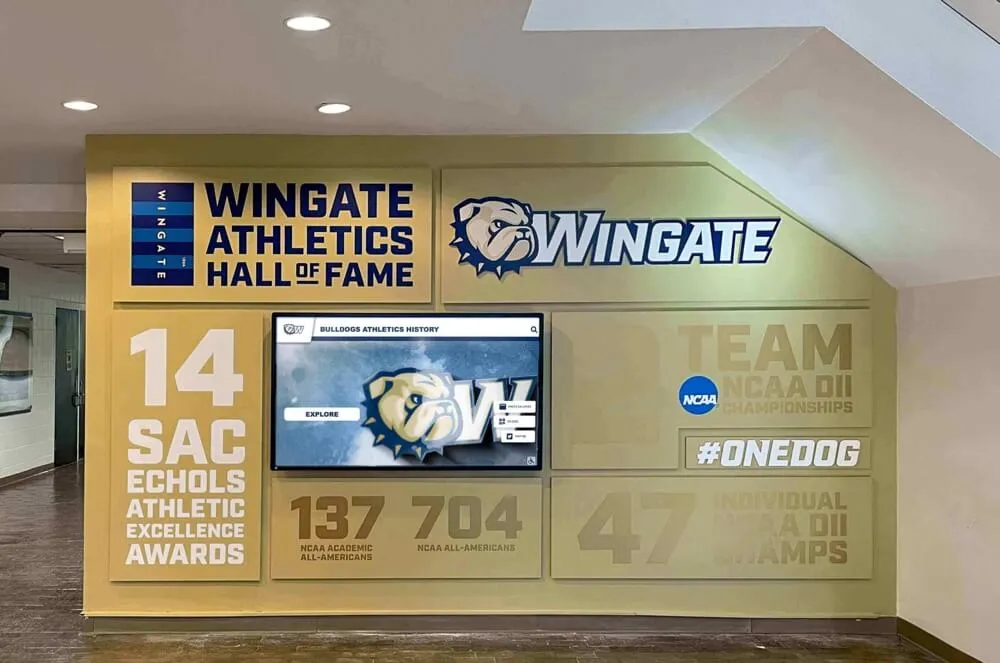
Combining physical shields or plaques with an integrated digital screen gives award walls both visual identity and unlimited information depth
4. Hall of Fame Walls
Hall of fame walls are distinct from general award walls in an important way: they are curated. Induction into a hall of fame implies a selection process — criteria, a committee, and a decision — rather than automatic recognition for meeting a threshold. This curation creates both the wall’s prestige and its most difficult operational challenge.
Hall of fame walls require two things that most award walls do not: a governance process that justifies each inductee and a display format that can accommodate new classes indefinitely without running out of physical space.
Hall of fame award wall ideas:
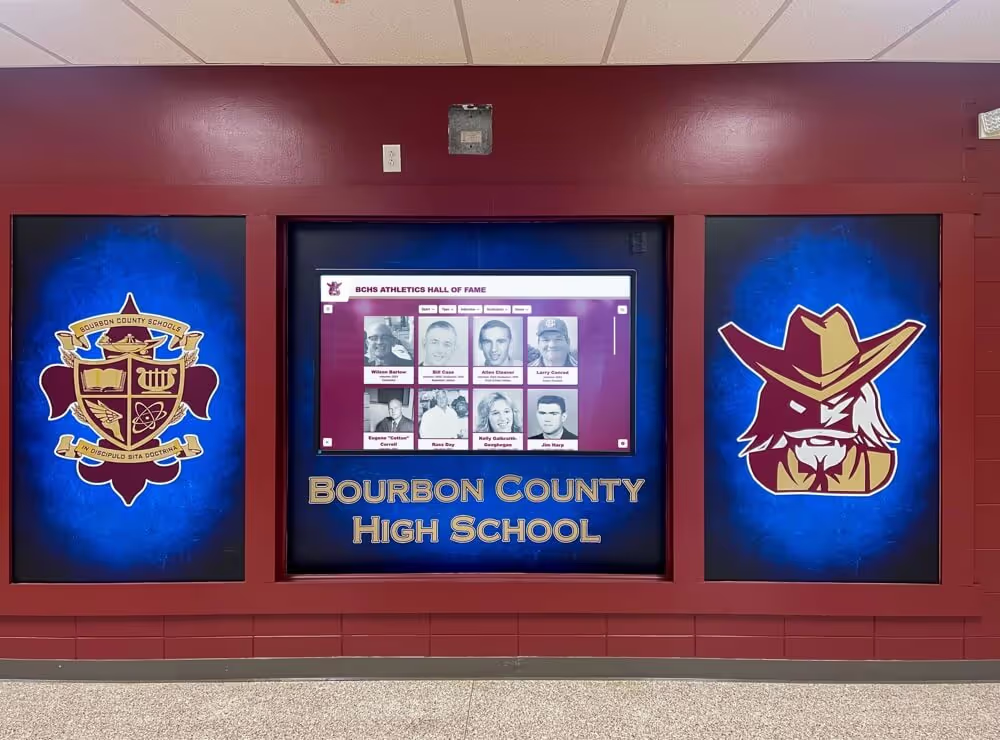
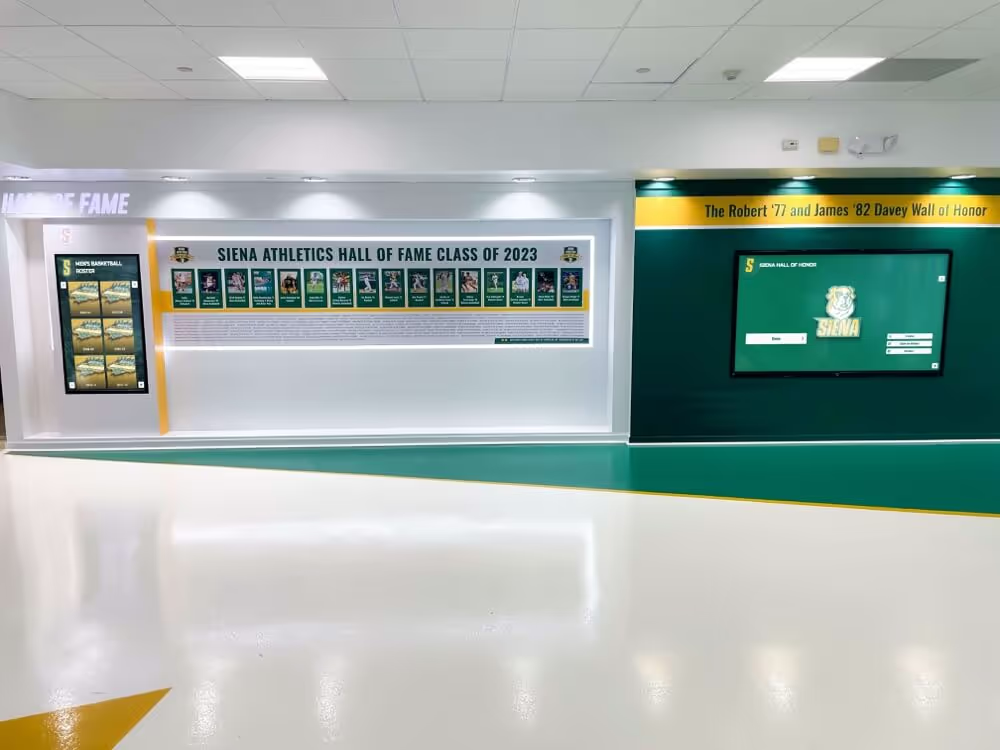
- Plaque-plus-digital hybrid walls: Physical plaques for each inductee, paired with a digital screen that allows visitors to access the full inductee profile — career statistics, photos, video highlights, and personal details that a physical plaque cannot hold. The plaques create visual weight; the screen provides depth.
- Portrait gallery walls: Framed photographs of inductees arranged chronologically or alphabetically. This format works well for halls of fame with 50 or fewer inductees but becomes unmanageable at 200.
- Touchscreen-only installations: For programs with large or rapidly growing inductee classes, a touchscreen-only installation eliminates the physical space problem entirely. All inductees receive equal visual presence; the display scales to any number of entries.
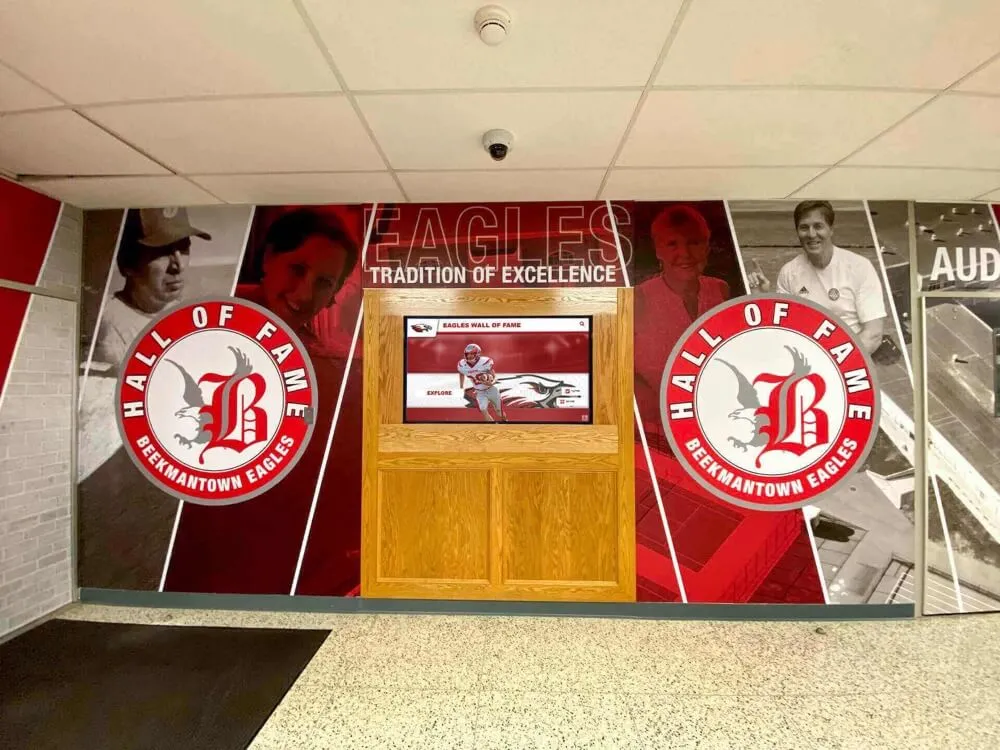
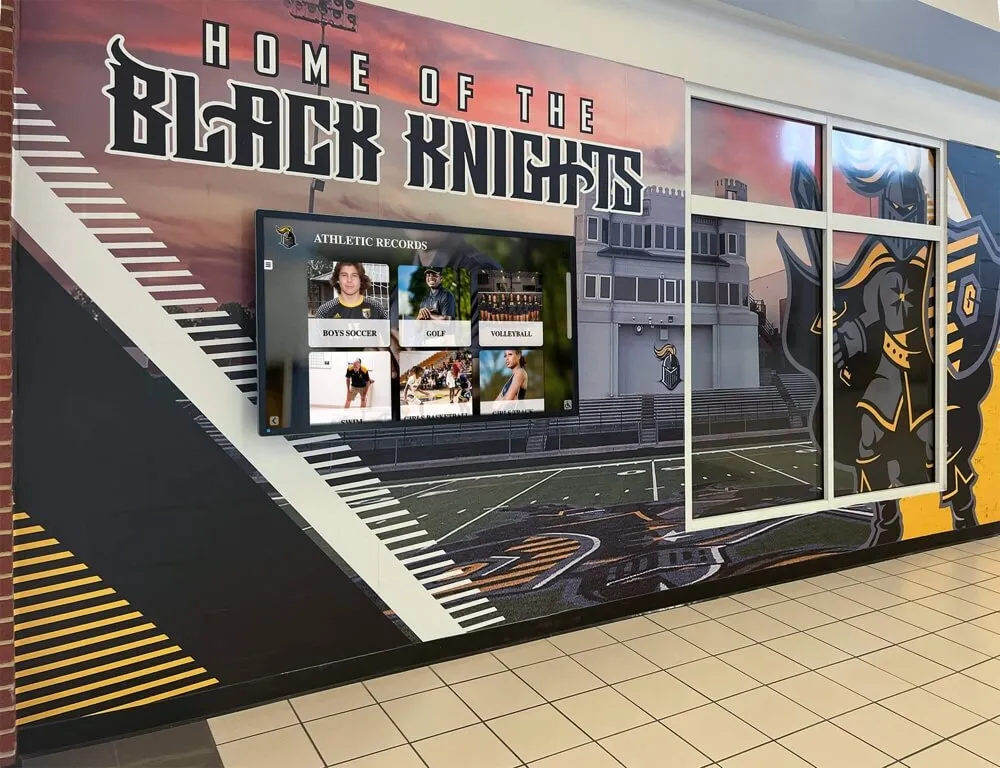
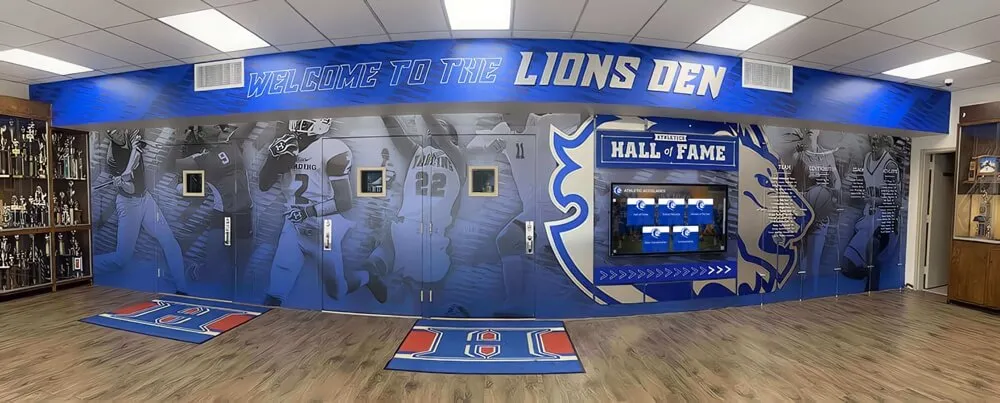
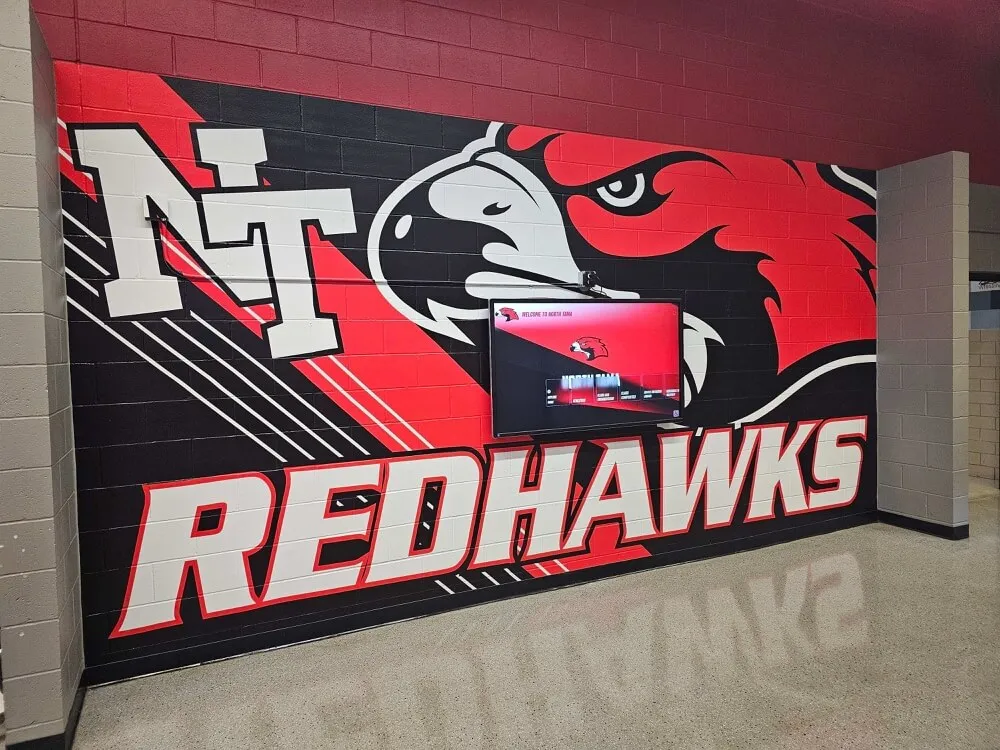
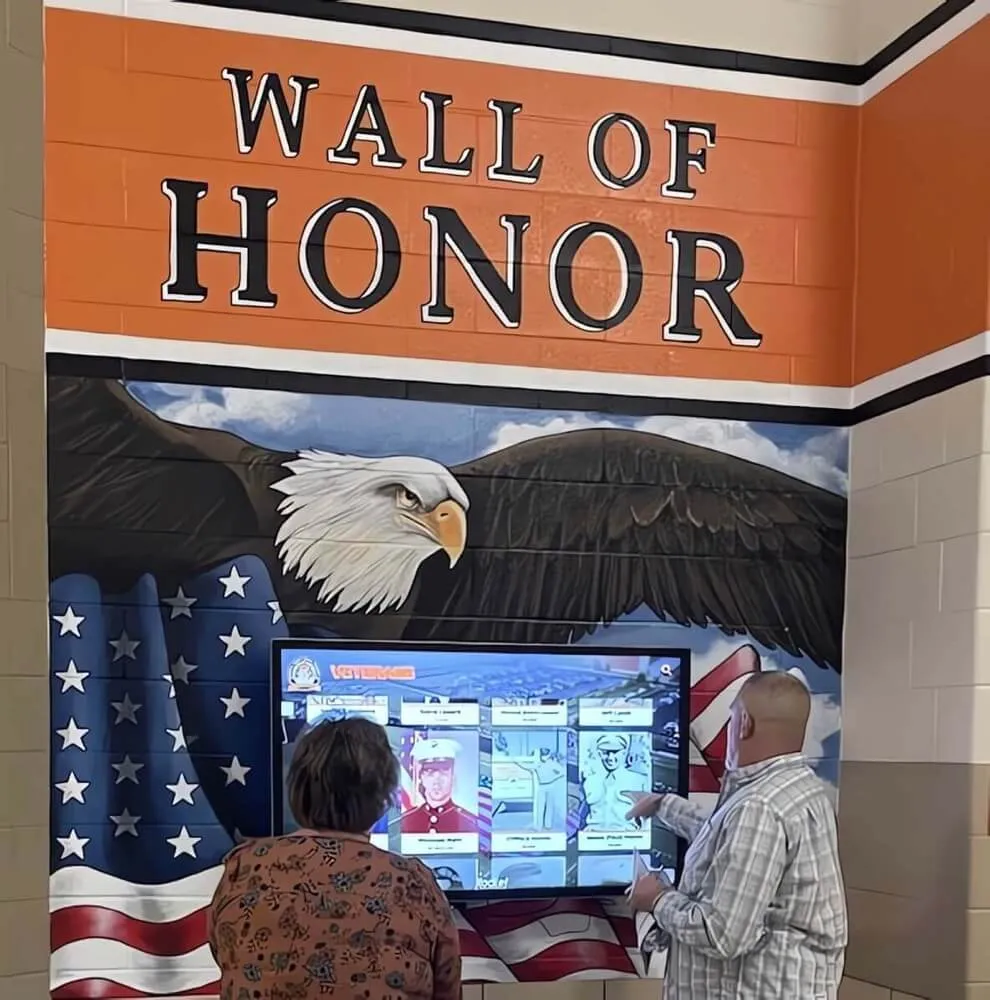
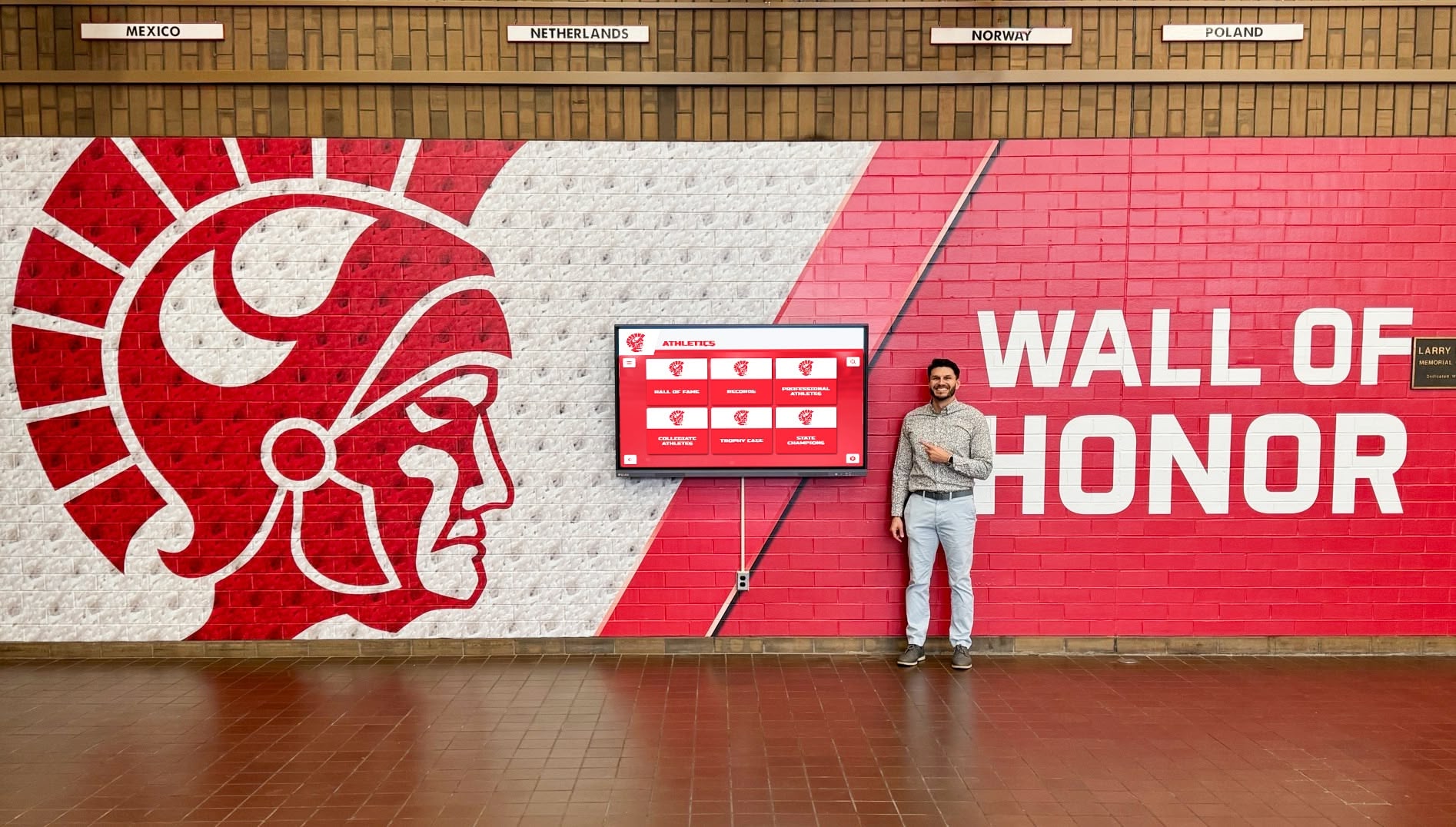
- Mural-plus-screen installations: Custom athletic murals pairing program identity graphics with embedded touchscreen panels. These are the premium format — common in new construction and renovation projects — and provide both institutional identity and functional recognition depth.
For schools building or rebuilding their hall of fame processes, the guide to organizing award walls and digitalizing physical plaques, photos, and winners provides a practical step-by-step approach to migrating physical installations to digital formats.
5. Donor and Sponsor Recognition Walls
Donor and sponsor recognition walls are distinct from athletic and academic displays in purpose: they acknowledge financial support and require a different display logic. Donors expect permanent, prominent, visible recognition in proportion to the size of their gift. Recognition walls that fail to deliver permanence risk damaging fundraising relationships.
Donor and sponsor award wall ideas:
- Named space recognition: Plaques on the walls of athletic facilities, gymnasiums, or academic wings naming the donor whose gift funded the space. These are the most common format and the most permanent.
- Cumulative giving recognition tiers: A tiered wall display — organized by giving level — that adds new names as donors reach thresholds. Tiered displays create an incentive structure for incremental giving.
- Digital donor walls: Screen-based displays that allow unlimited donors to be recognized without physical space constraints. These work especially well for large annual giving programs where dozens of donors give at similar levels each year.
- Sponsorship recognition with digital signage integration: For athletic facilities, digital displays that rotate sponsor recognition alongside program content. Some platforms — including Rocket Alumni Solutions — include a sponsorship suite that allows schools to generate revenue by offering sponsor visibility on recognition screens.
10 Specific Award Wall Ideas That Reduce Clutter
With the taxonomy in place, here are ten specific implementations that address the clutter problem directly.
1. Separate your display by recognition type, not by sport. Mixing athletic trophies, academic plaques, and donor recognition on the same wall creates visual chaos. Assign each recognition type its own wall section or display zone, even if those zones are adjacent.
2. Establish a physical trophy retirement policy. Define in writing which trophies remain in the case permanently (state championships, school records) and which rotate to storage after a set period (seasonal runner-up plaques, participation awards). Without a written policy, every item stays indefinitely.
3. Add a dedicated record board display for each major sport. Record boards solve the “what happened to the old records” problem. A school that posts all-time leaders in a fixed format — and updates the board annually — never needs to choose between honoring old records and recognizing new ones.
4. Use portrait-style academic recognition panels for honor roll. Rather than listing hundreds of names in small print, display honor roll using a grid of portrait cards — photo, name, year, recognition category. Portrait-style recognition is more engaging and more personal than name lists.
5. Install a touchscreen hall of fame to replace overflowing plaque walls. A 55-inch touchscreen panel holds an unlimited number of inductee profiles and replaces what would otherwise require hundreds of square feet of wall-mounted plaques.
6. Create sport-specific recognition sections in athletic corridors. Each sport gets a defined wall section with its season history, record board, and current-year awards. Equal allocation creates equity across programs; defined sections eliminate the accumulation of mismatched hardware.
7. Add QR codes to physical trophies and plaques. A QR code affixed to each physical trophy links to the full digital profile — team photos, season statistics, game highlights. The physical object provides presence; the QR code provides depth without crowding the display.
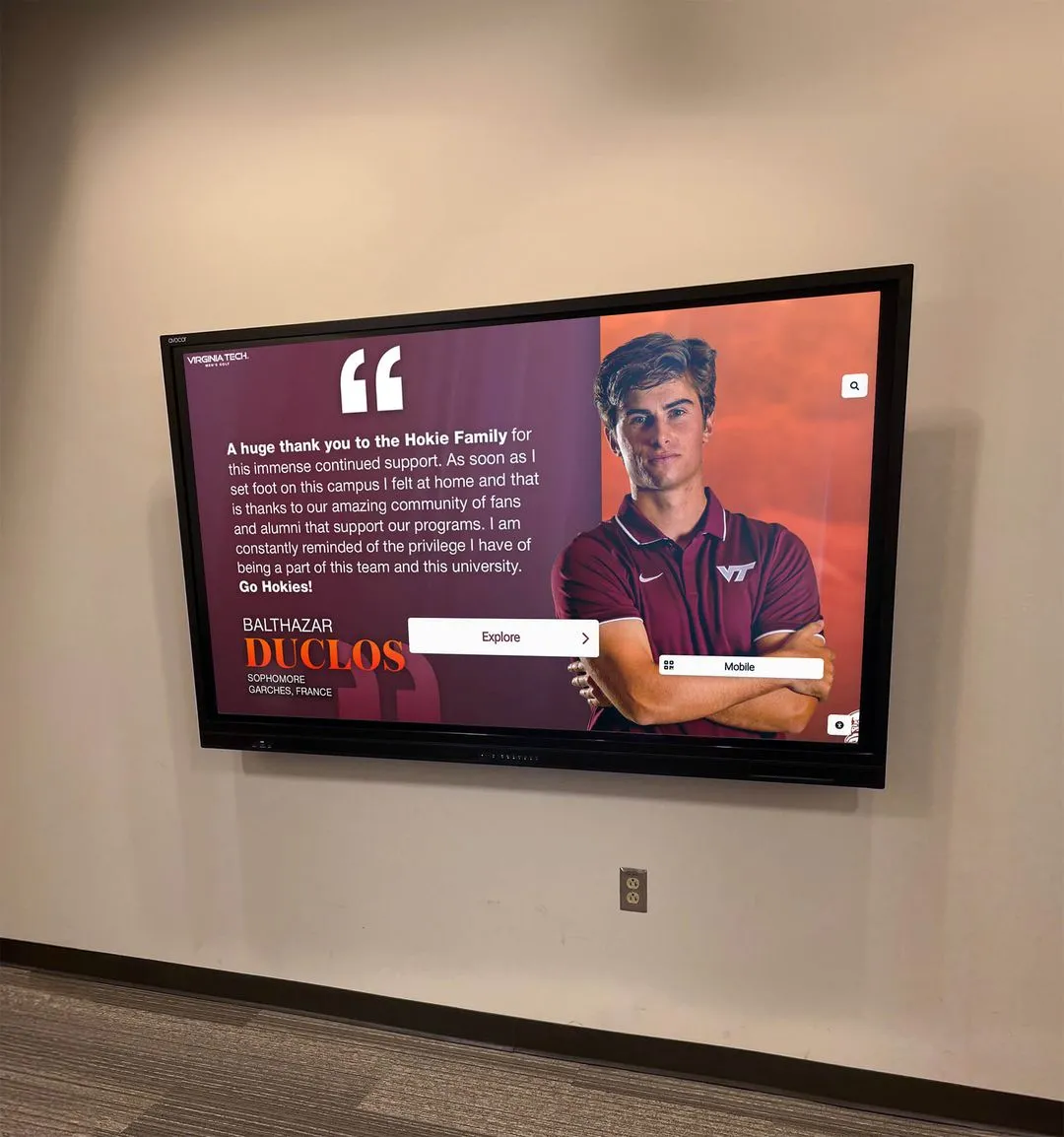
8. Use digital signage for rotating recognition content. A large-format screen cycling through academic honorees, athletic award winners, and upcoming recognition events creates a living display that doesn’t require new physical materials each semester.
9. Build a dedicated donor recognition wall separate from athletic and academic displays. Mixing donor recognition with athletic trophies creates visual conflict and can feel like it diminishes either the athletic achievement or the donor’s gift. A dedicated wall — even a modest one — communicates appropriate seriousness.
10. Digitize historical records before expanding physical displays. Before ordering more plaques or adding another trophy case, audit what’s in storage. The most impactful improvement many schools can make is making existing history visible — not adding new hardware to the wall.
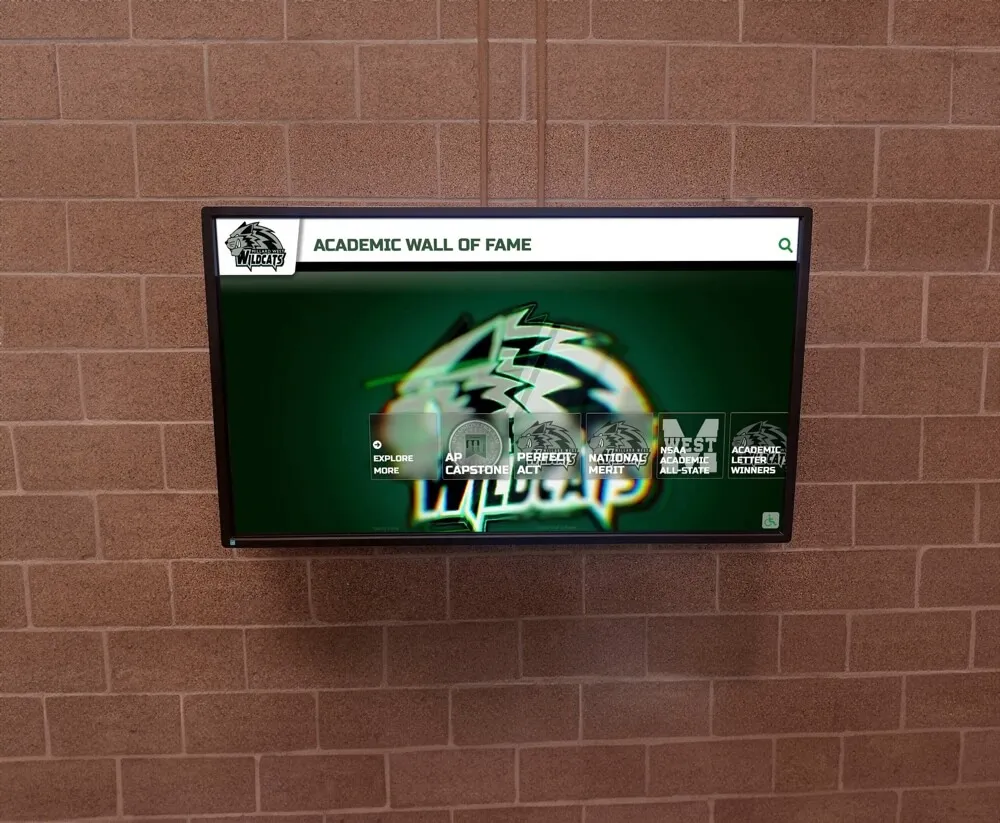
A dedicated academic wall of fame gives curricular achievement the same permanent visibility as athletic recognition — without mixing the two and creating display confusion
How Digital Displays Solve the Award Wall Clutter Problem
The underlying cause of award wall clutter is a mismatch between recognition volume and physical display capacity. Schools generate more recognitions per year than their walls can hold, and every year the gap widens. The only structural solution is a display format that scales without requiring additional square footage.
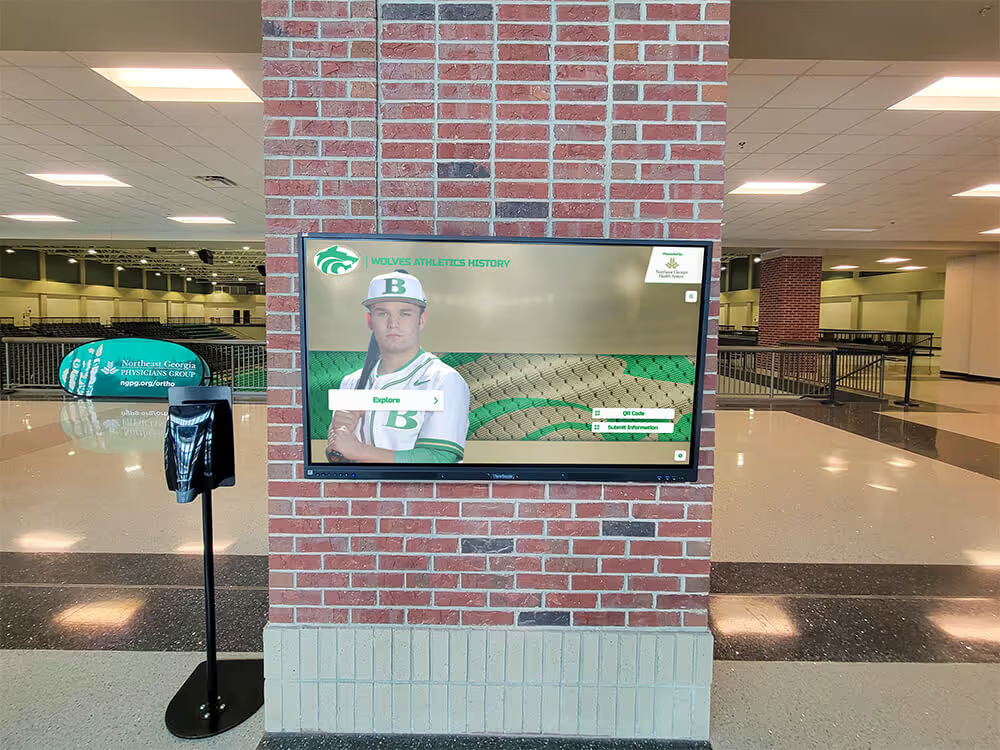
Digital awards displays are that format. A single touchscreen panel installed in a school lobby or hallway can hold every athletic award, every academic honoree, every hall of fame inductee, and every donor recognition from the program’s entire history. Unlike physical plaques, the display does not get full. Unlike rotating case installations, nothing is removed to make room for something new.
The functional advantages extend beyond storage:
Remote content management. Cloud-managed systems allow staff to add new award winners, update records, and upload photos from any browser. No vendor lead times, no contractor scheduling, no physical hardware to order. The recognition wall updates in the same week as the ceremony.
Accessibility compliance. The Americans with Disabilities Act requires that recognition displays be accessible to all visitors. Touchscreen systems built to ADA WCAG 2.1 AA compliance standards meet this requirement in ways that plaque walls — set at fixed heights with small print — often do not. Screens with adjustable font sizes, screen reader compatibility, and mobile access via QR code serve visitors with visual or mobility limitations that traditional displays cannot.
QR code mobile access. Visitors who want to explore recognition content while away from campus — alumni at home, families before a ceremony, prospective students evaluating a program — can access the full recognition database from any mobile device through a QR code. No physical presence required.
Unlimited inductees, records, and media. There is no practical limit to the number of entries a cloud-managed digital recognition system can hold. A school with 60 years of athletic history and 3,000 individual award recipients can surface all of it in the same installation footprint as a school with a 5-year program and 50 awards.
Understanding how digital displays transform academic all-American and achievement award recognition shows the same capacity logic applied to academic recognition programs — the scale argument is identical.
Connecting Physical Award Walls to Digital Archives
The best award wall implementations treat physical and digital displays as a single system rather than two alternatives. Physical trophies, plaques, and banners provide presence and identity — they communicate to a first-time visitor that this is a serious program before they interact with anything. Digital systems provide depth and scale — they hold the full history that physical infrastructure cannot.
This hybrid approach typically works as follows:
- Physical display holds the flagship hardware. The most significant trophies — state championships, major conference titles, retired jersey numbers — remain in the physical case. These are the anchors.
- Digital display holds everything else. Individual awards, historical seasons, academic honorees, alumni profiles, and record boards all live in the cloud-managed digital system.
- QR codes bridge the two. Each physical trophy or plaque carries a QR code linking to its full digital profile, turning the physical display into a gateway rather than a terminal point.
- Annual updates flow into the digital system. New award winners added at the end of each season, semester, or year feed directly into the display with no physical materials required.
The effect is a recognition program that grows without clutter and surfaces history without requiring storage excavation.
For schools exploring how graduation academic honors connect to year-round recognition walls — how the same student who earned Latin honors at graduation gets recognized in the academic wing — the complete guide to graduation honor cords and academic display provides useful context on how these recognition streams can be unified.
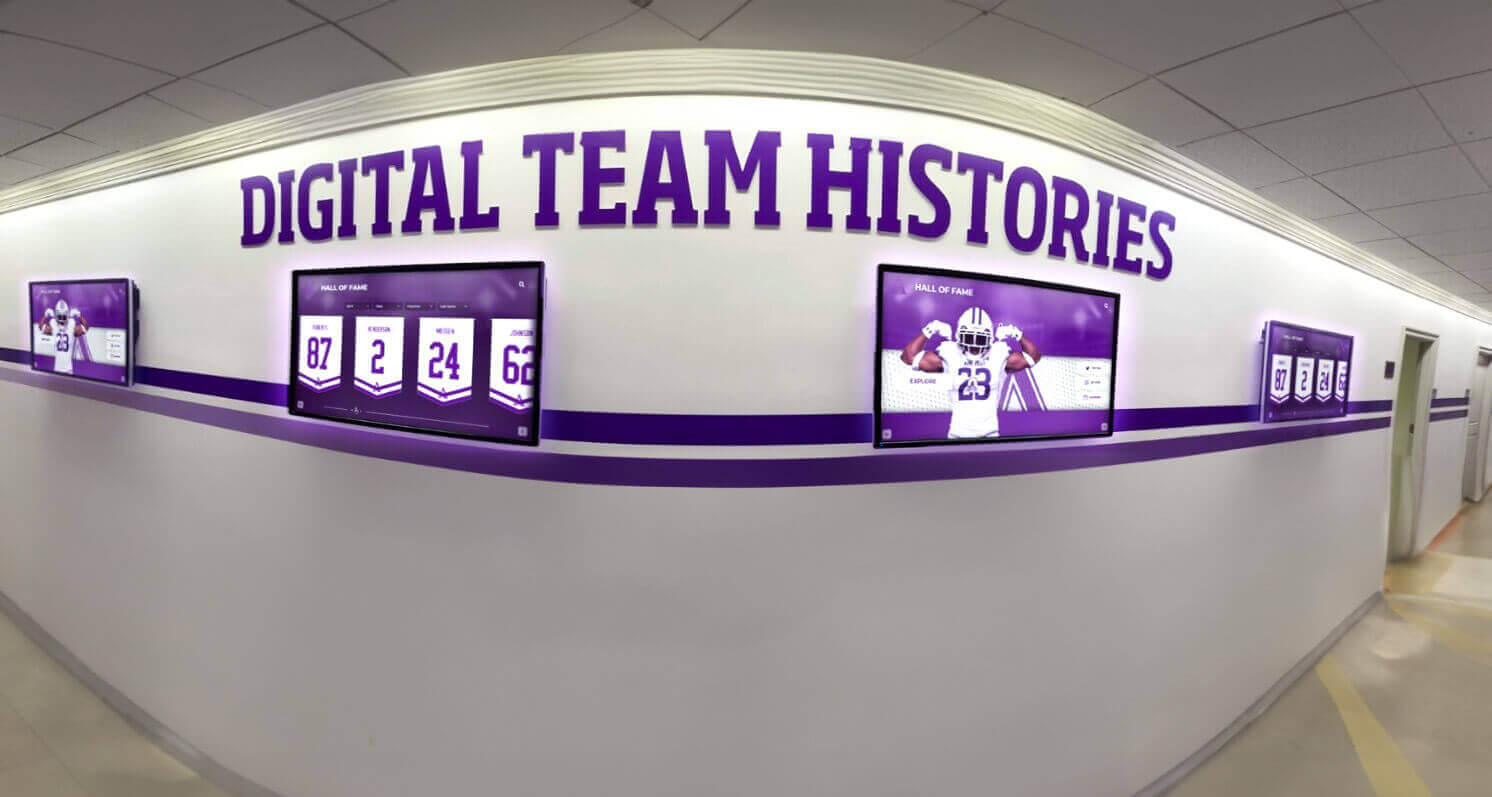
Coordinated hallway digital displays turn a single corridor into a comprehensive recognition environment — updated remotely without new hardware each season
Rocket Alumni Solutions: What a Full Award Wall System Looks Like
Rocket Alumni Solutions builds interactive recognition systems specifically designed for school award walls. Their platform covers the full taxonomy: touchscreen athletic halls of fame, digital trophy cases, auto-ranking record boards, academic honor walls, and donor recognition displays — all managed through a single cloud content system.
Key capabilities relevant to school award wall planning:
- Unlimited entries and media. No cap on inductees, award records, photos, or video content. A school with 80 years of athletic history and a school in its fifth year of operation use the same platform.
- Auto-ranking record boards. When a new school record is broken, the record board updates automatically — no staff intervention, no contractor, no manual entry required.
- ADA WCAG 2.1 AA compliance. The only web-based touchscreen recognition platform certified to meet full accessibility standards. Relevant for any school with ADA compliance obligations on public-facing displays.
- Sponsorship suite. Schools can offset display costs by selling sponsor visibility on recognition screens — a feature unique to platforms designed for revenue generation alongside recognition.
- Cloud-based management. Staff update award walls from any browser, from anywhere. No physical access to the screen is required to add new recognition content.
Rocket’s system is also designed for academic achievement recognition alongside athletic programs — allowing schools to manage both recognition streams in a single platform rather than maintaining separate systems for athletics and academics.
The award wall planning guide at digitalwalloffame.com covers the organizational logic in depth — the step-by-step process of auditing what exists, determining what belongs in physical versus digital formats, and setting up a maintenance workflow that doesn’t require a full-time staff member.
Frequently Asked Questions
What is the best format for an award wall in a high school? The best format depends on what you’re recognizing and how much history the program has. Athletic programs with 15 or more years of history benefit most from digital systems — touchscreen panels that hold unlimited records without requiring wall expansion. Programs in their early years can start with a well-organized physical case and plan for digital migration. Academic award walls work best as category-separated displays: distinct sections for honor roll, academic letters, departmental awards, and national scholarships, rather than a single mixed list. Schools with any donor recognition component should keep that display separate from athletic and academic walls to avoid mixing recognition types.
How do you prevent an award wall from getting cluttered over time? Three practices prevent long-term clutter. First, establish a written retirement policy for physical trophies — define which items stay permanently (state championships) and which rotate out (seasonal runner-up hardware). Second, add a digital display for any recognition category that generates more than 20 to 30 new entries per year. Third, assign each recognition type — athletic, academic, team, hall of fame, donor — its own dedicated wall space rather than mixing categories on the same display.
How much does a digital award wall cost for a school? Entry-level digital recognition kiosks from established platforms start in the range of $5,000 to $10,000 for hardware and software. Custom multi-panel installations — the kind common in new athletic facility construction — can reach $25,000 or more. Annual cloud management fees apply for platforms with ongoing software and content management. The relevant cost comparison is not one digital screen versus one physical plaque wall; it is one digital screen versus the cumulative cost of case expansions, trophy ordering, engraving, and storage management over a decade.
Can a digital display work alongside existing physical trophy cases? Yes — most schools implement digital displays as additions to existing physical cases rather than replacements. The physical case continues to showcase flagship hardware; the digital system handles historical depth, individual profiles, and categories that don’t fit in a case. QR codes on physical trophies link visitors to the full digital profile. This hybrid approach is the most common implementation because it preserves the visual identity of the physical display while removing the space constraint.
What types of awards should schools include on an academic recognition wall? Academic recognition walls typically cover honor roll (by term or year), academic letters, departmental subject awards, national recognition programs (National Merit, AP Scholar, Academic Decathlon), scholarship recipients, and graduation academic distinctions. Schools with strong academic programs also include valedictorian and salutatorian recognition by year, going back as far as records exist. For a complete overview of how graduation academic honors translate to year-round recognition displays, the taxonomy of academic recognition types maps directly to the categories appropriate for a dedicated academic wall.
See What a School Award Wall Looks Like Without the Clutter
Rocket Alumni Solutions builds touchscreen walls of fame, digital trophy cases, auto-ranking record boards, and academic honor walls for schools managing athletic, academic, and team recognition. If your award wall is running out of space or mixing recognition types that belong in separate displays, see what a purpose-built digital system looks like for a school similar to yours.
Request a DemoConclusion: Award Wall Ideas Start With Recognition Goals, Not Display Formats
The most common award wall mistake is choosing a display format before clarifying what the wall is supposed to accomplish. A school that orders another trophy case before auditing what’s in storage is repeating the same decision that created the current clutter. A school that installs a touchscreen without a plan for entering historical data has purchased hardware that shows empty screens for the first year.
Award wall ideas work best when they follow a clear taxonomy — athletic, academic, team, hall of fame, and donor recognition each in their own space, each in a format appropriate for the volume of content it needs to hold. Physical displays anchor the visual identity. Digital systems provide the scale and depth that physical infrastructure cannot.
The practical starting point is an honest audit: how much recognition content does your school generate each year, how much of it is currently visible, and how much is in storage or filing cabinets? For most schools with programs older than ten years, the answer reveals that the majority of the program’s history is invisible — not because the school doesn’t value it, but because the display infrastructure ran out of room.
Solving that problem is not complicated. It requires a taxonomy, a format decision, and — for most programs — a digital layer that removes the space constraint from recognition for good.
For schools comparing display formats across recognition types, the comprehensive overview of academic achievement awards and how schools honor recipients and the guide to academic all-American recognition and digital display both cover the format decisions that translate directly to award wall planning.
Building award walls that last — that honor this year’s students and last decade’s alumni with equal visibility — is a solvable problem. The award wall ideas above are the starting point.