



Every time a high school marching band steps onto a football field or competition floor, their marching band uniform design speaks before a single note sounds. The combination of colors, silhouette, symbolism, and ornamentation communicates school pride, program prestige, and competitive seriousness to audiences, adjudicators, and fellow musicians simultaneously. Uniforms are not merely performance clothing — they are a living expression of institutional identity that students wear during some of the most memorable and photographed moments of their high school careers.
For band directors, booster organizations, and school administrators, marching band uniform design is a significant undertaking with long-range consequences. Decisions made today will represent the program for a decade or more, appearing in yearbooks, alumni photographs, competition footage, and eventually in the historical archives that tell the story of your school’s performing arts legacy. A thoughtfully designed uniform system rewards that investment with lasting visual identity that generations of students will wear with genuine pride.
This guide covers the full scope of marching band uniform design — from foundational style choices and color strategy to practical budget considerations and how schools can preserve their uniform history through modern digital recognition systems. Whether you’re designing from scratch or refreshing an existing program, these principles will help build a uniform program that genuinely represents who your school is.
Marching band uniform design sits at the intersection of performance function, visual art, and school identity. Unlike athletic uniforms that primarily serve individual competitors, marching band uniforms operate as components of a collective visual system — dozens or hundreds of individual garments that must achieve cohesion at distance while functioning comfortably during physically demanding performances.

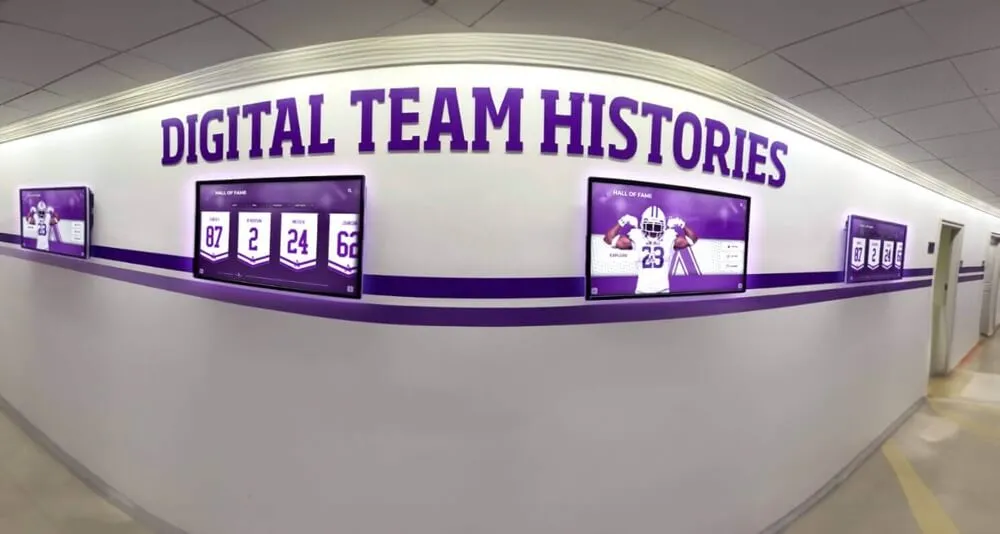
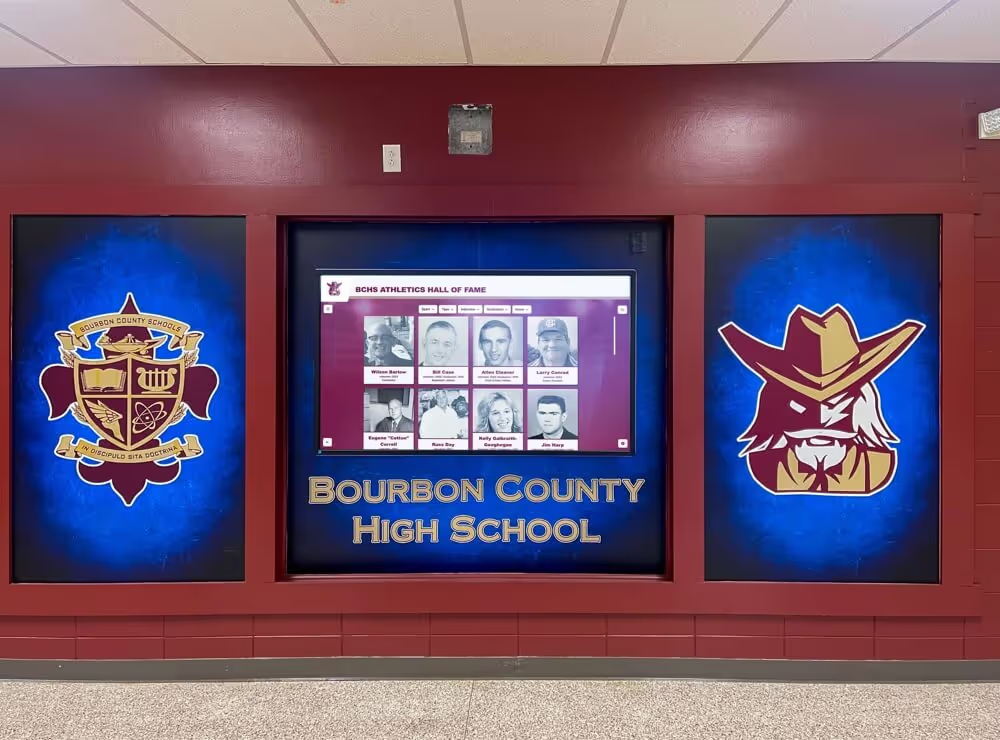
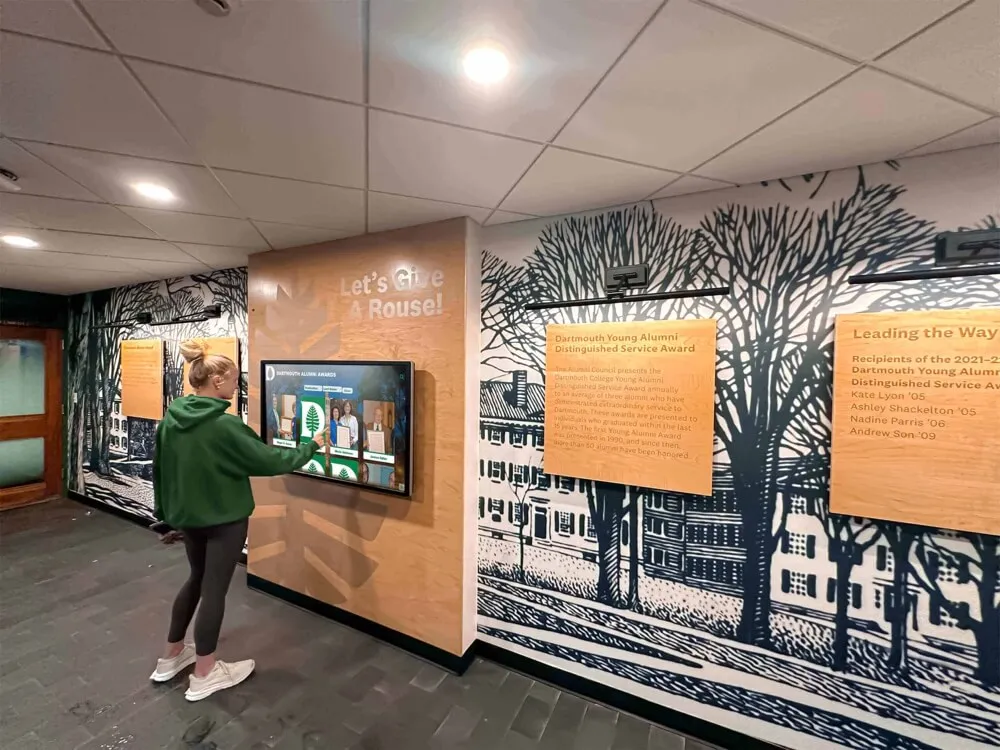
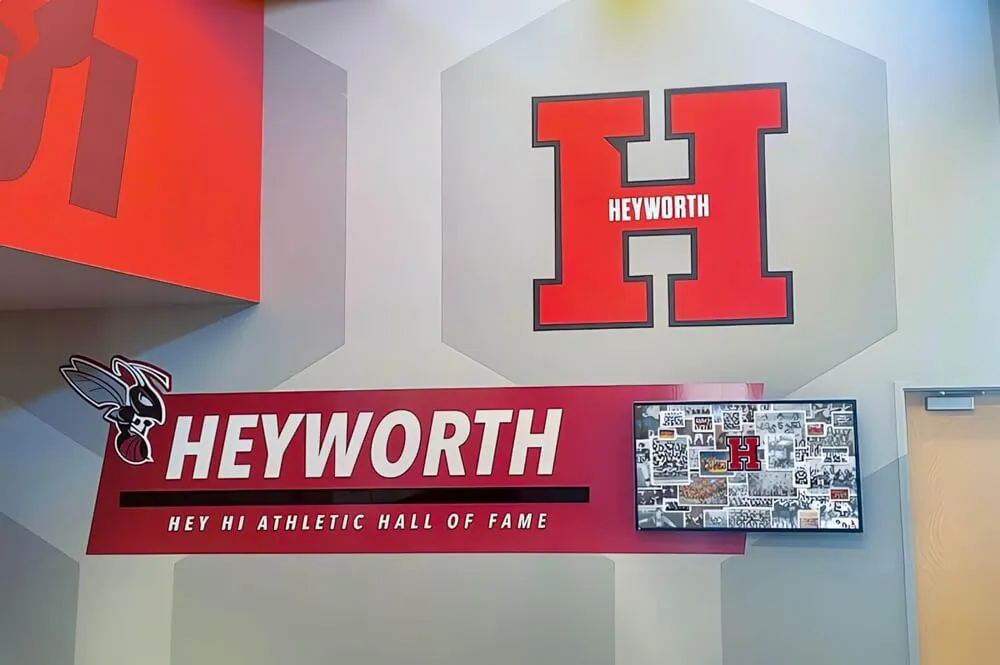
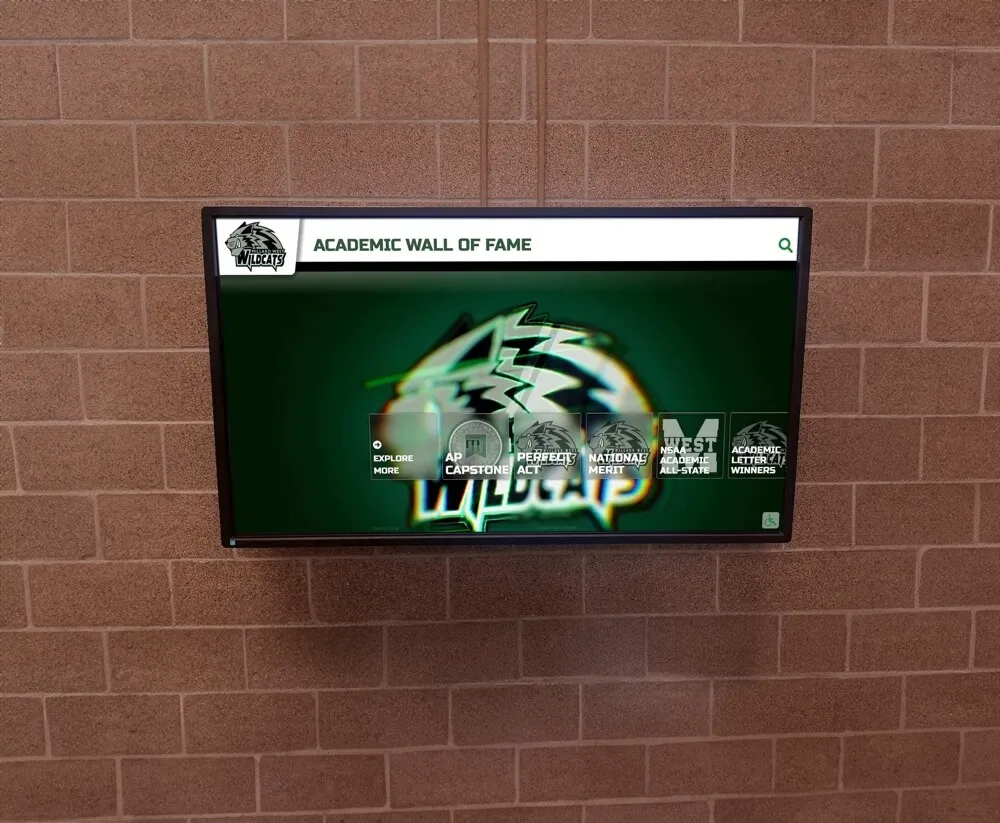
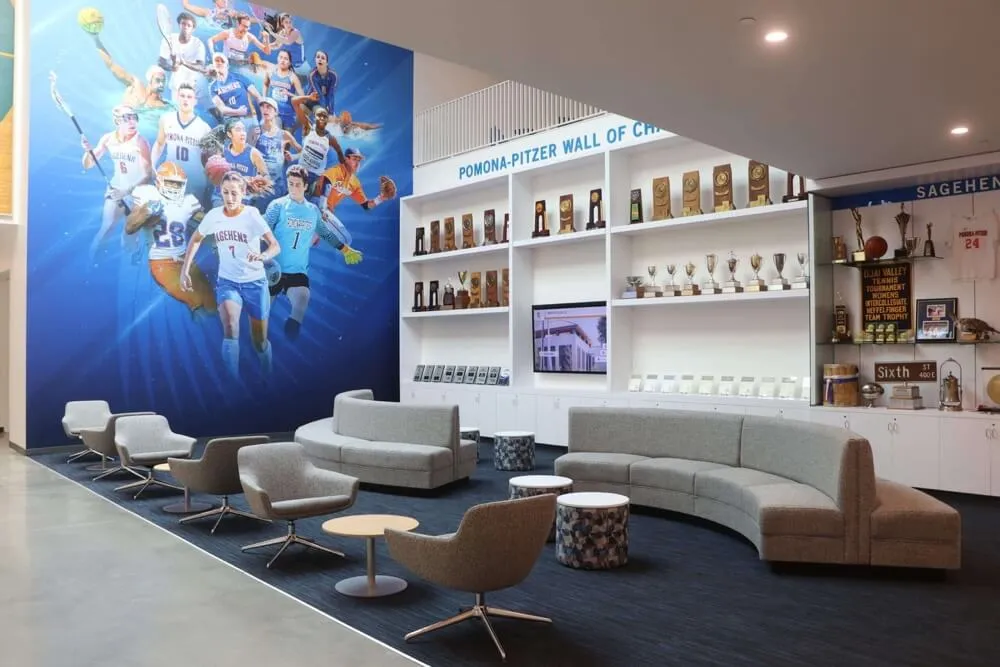
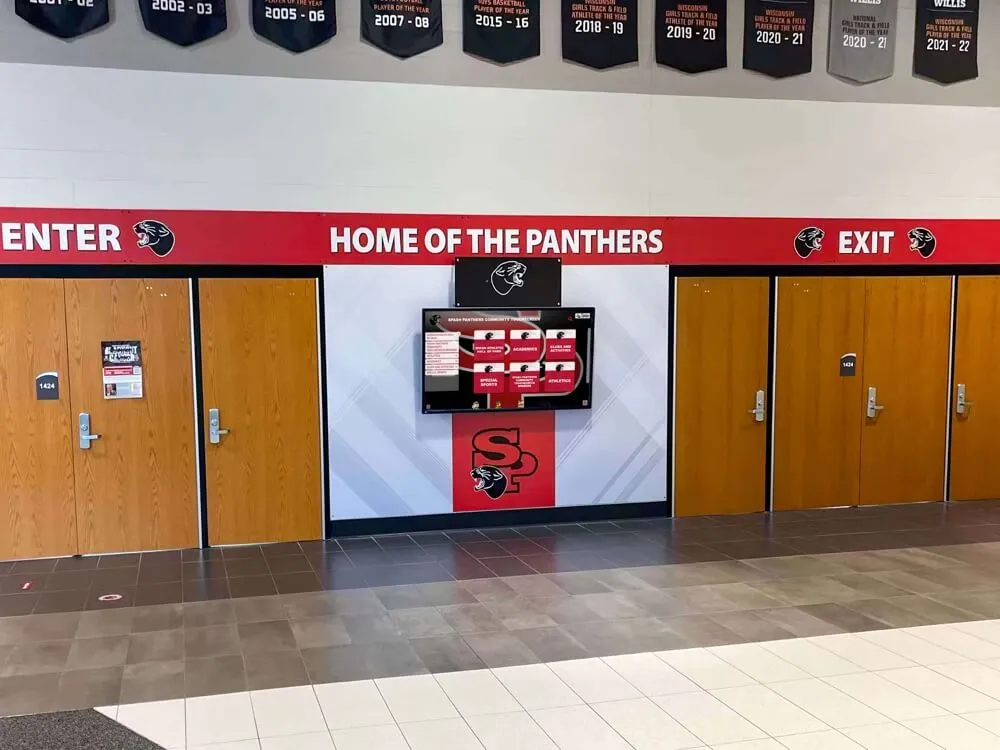
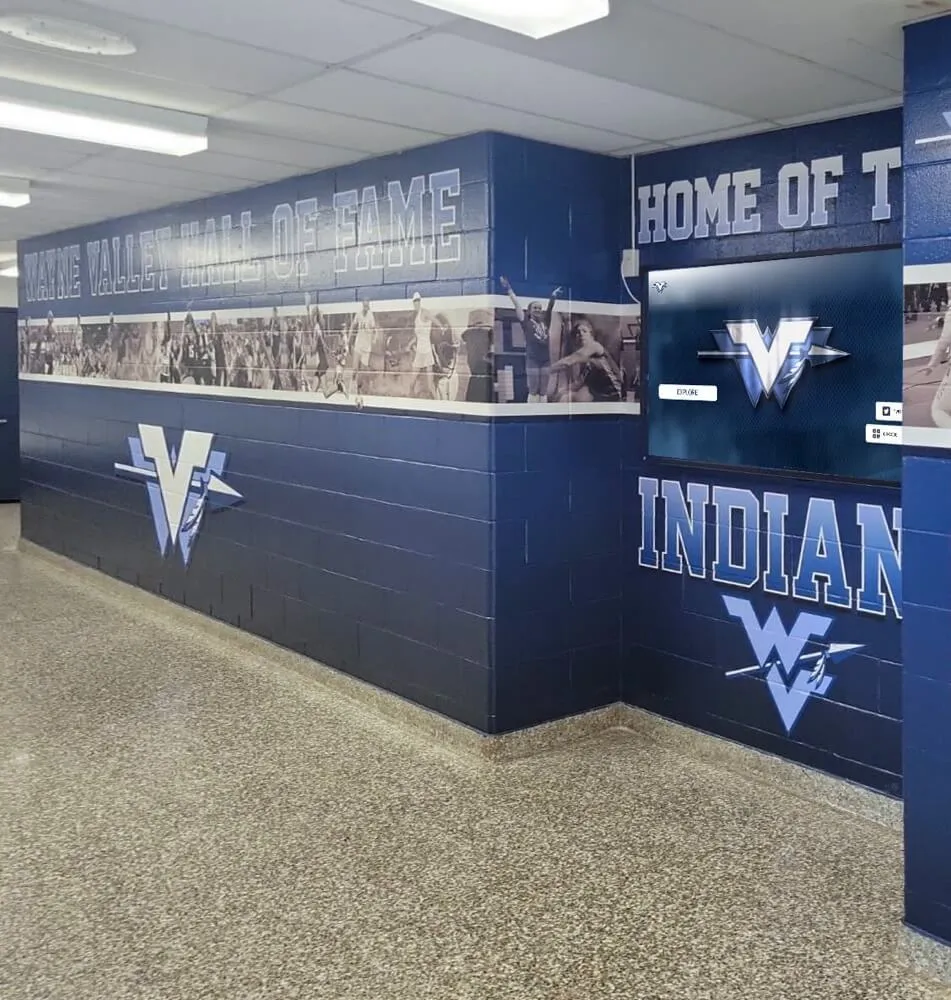
School identity elements — colors, mascots, and institutional pride — that define marching band uniforms also appear in recognition spaces throughout campus, creating cohesive visual brand systems
Why Marching Band Uniform Design Matters for School Identity
Marching band uniform design is one of the most powerful visual identity investments a school can make. Unlike classroom environments or administrative spaces, band uniforms carry school identity into public community spaces — parades, competitions, halftime shows, and civic celebrations — where school pride is on display for thousands of observers who may never set foot inside the building.
The Public-Facing Role of Band Uniforms
The National Federation of State High School Associations (NFHS) consistently lists marching band among the leading school-based activities by student participation, with programs operating across the vast majority of American high schools. That scale means marching bands frequently serve as the most visible representatives of a school’s identity in the broader community, performing at events where students, parents, alumni, and community members gather in large numbers.
Unlike trophies displayed in cases or banners hung in gymnasiums, band uniforms are living, moving representations of school identity. When a marching band takes the field, every member becomes part of a coordinated visual statement that reinforces the school’s colors, mascot, and character to everyone watching from the stands or sidelines.
Uniforms as Long-Term Identity Investments
Industry consensus among uniform manufacturers and band directors’ associations suggests most high school marching band uniforms have a practical lifespan of 10–15 years under regular use and proper care. That lifespan means every design decision is a long-term commitment — an investment that will represent the school through multiple generations of students, directors, and community members.
This longevity makes thoughtful initial design decisions especially important. Uniforms that align closely with established school brand guidelines maintain relevance across the full replacement cycle, while designs that chase short-term trends can feel dated within just a few years. The goal is a design that would feel equally appropriate photographed in year one or year fourteen of active service.
For schools thinking about how to highlight student accomplishments across all programs — athletics, arts, and academics — uniform design represents the performing arts program’s equivalent of a championship jersey: visible, meaningful, and community-defining.
Core Elements of Effective Marching Band Uniform Design
Effective marching band uniform design integrates five core elements that work together to create a cohesive, durable visual system. Each element decision compounds across the full ensemble — what reads subtly at close range can appear dramatically from stadium seating.
Color Palette: Anchoring to School Identity
Color is the single most powerful identity element in marching band uniform design. School colors should anchor every design decision, providing the primary and secondary palette from which all other choices derive.
Primary color application principles:
- Apply the school’s primary color to the largest visual surfaces — jacket body, bibber sides
- Use the secondary color for contrast elements: trim, piping, collar, cuffs, and plume
- Maintain official PMS or CMYK color specifications to ensure consistency with all other school brand materials
- Avoid introducing tertiary colors that appear novel but dilute brand recognition at distance
Color combinations that read well from distance:
- High-contrast pairings (navy and gold, black and silver, maroon and white) maintain visual crispness across a full performance field
- Low-contrast combinations (light gray and white, forest green and navy) cause individual performers to blur into the ensemble from viewing distance — this is rarely desirable
- Metallic accents — gold braid, silver buttons, metallic trim — catch light during movement and add visual dynamism without introducing new colors to the palette
Symbolism and Mascot Integration
Marching band uniforms offer multiple opportunities to embed school mascot and symbolic elements in ways that strengthen identity without compromising performance functionality.
Common placement strategies:
- Hat or shako insignia: The front panel of the hat is prime symbolic real estate — a metallic badge, embroidered mascot, or school crest creates immediate identity recognition
- Chest emblem: A centered chest emblem works particularly well on jacket designs where the logo registers at competition distance
- Collar and shoulder treatment: Stylized design elements at collar or shoulder that reference mascot shapes without literal representation add sophisticated identity depth
- Back panel: Less common but memorable — a large mascot graphic or school name on the back of the jacket registers visibly during ensemble drill transitions
Design principle for mascot integration: The most effective mascot adaptations translate the school symbol into a form that functions at two scales — readable as a specific mascot at close range, and registering as a distinct visual mark from 100 yards away. A design that only works at one scale will underperform at the other.
Silhouette and Style
The overall silhouette of a marching band uniform — the visual shape the ensemble creates standing at attention — defines the aesthetic personality of the program. Modern uniform design has evolved beyond the traditional military-derived jacket-and-bibber combination, though many programs continue choosing classic forms for their timeless association with band tradition.
Primary silhouette styles in contemporary marching band:
Traditional military-inspired: Formal jacket with standing collar, decorative buttons, epaulettes, and matching bibbers. This silhouette communicates tradition, precision, and formal prestige. A strong choice for programs with deep historical roots seeking visual continuity with their own legacy.
Contemporary performance-focused: Streamlined jacket or vest designs with active-fit construction, lower collar profiles, and performance fabric technology. This silhouette communicates modern sophistication and athletic performance capability, well-suited for shows requiring significant physical movement.
Hybrid formal/contemporary: Combines traditional elements (formal collar, decorative front panel) with contemporary construction and performance fabrics. This approach allows programs to honor tradition while delivering the comfort and range of motion that demanding contemporary drill requires.
Construction and Fabric Considerations
Beyond aesthetics, marching band uniform design must account for practical performance realities — physical exertion, outdoor weather conditions, and the rigors of regular use across an extended season.
Key fabric considerations:
- Polyester and polyester-blend fabrics dominate for performance durability and colorfast properties across multiple seasons
- Technical moisture-wicking materials improve comfort during physically demanding shows but may affect surface sheen and color depth in some lighting conditions
- Heavyweight fabrics read better on camera and from distance; lightweight performance fabrics prioritize student comfort in warm climates
- Stretch panels at shoulders, underarms, and waist improve range of motion for contemporary drill that requires athletic-level movement
Marching Band Uniform Color Strategy: Maximizing Visual Impact
Color strategy in marching band uniform design goes beyond simply applying school colors — it involves managing how those colors behave across a performance field during movement, in different lighting conditions, and as part of an ensemble visual system viewed from hundreds of feet away.
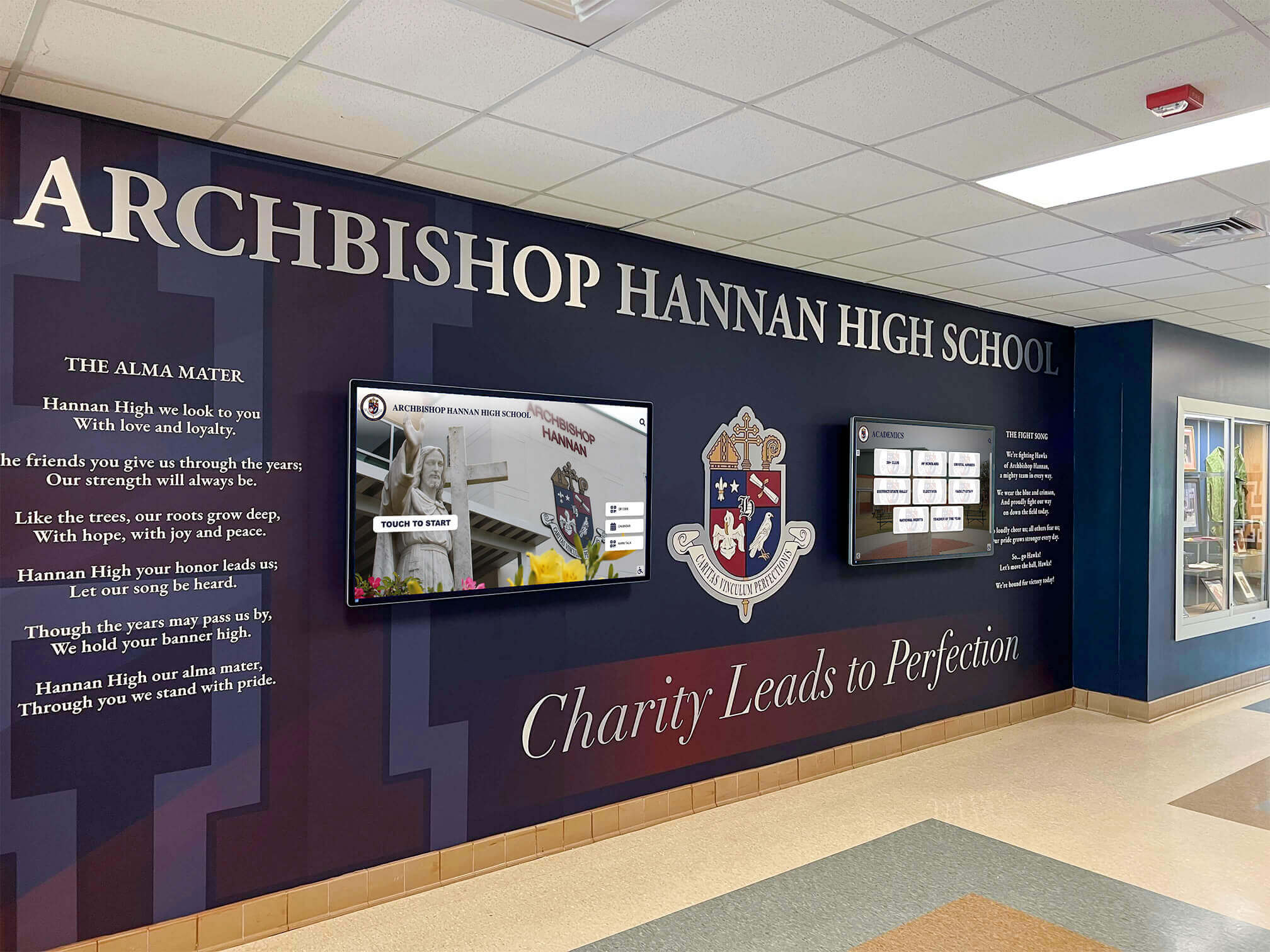
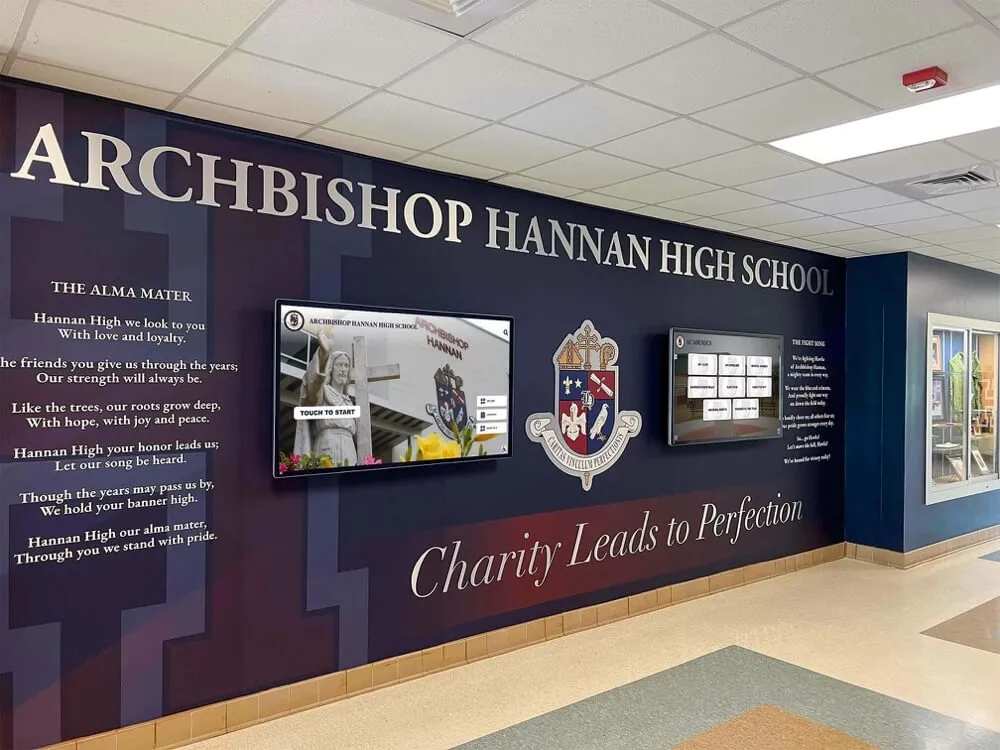
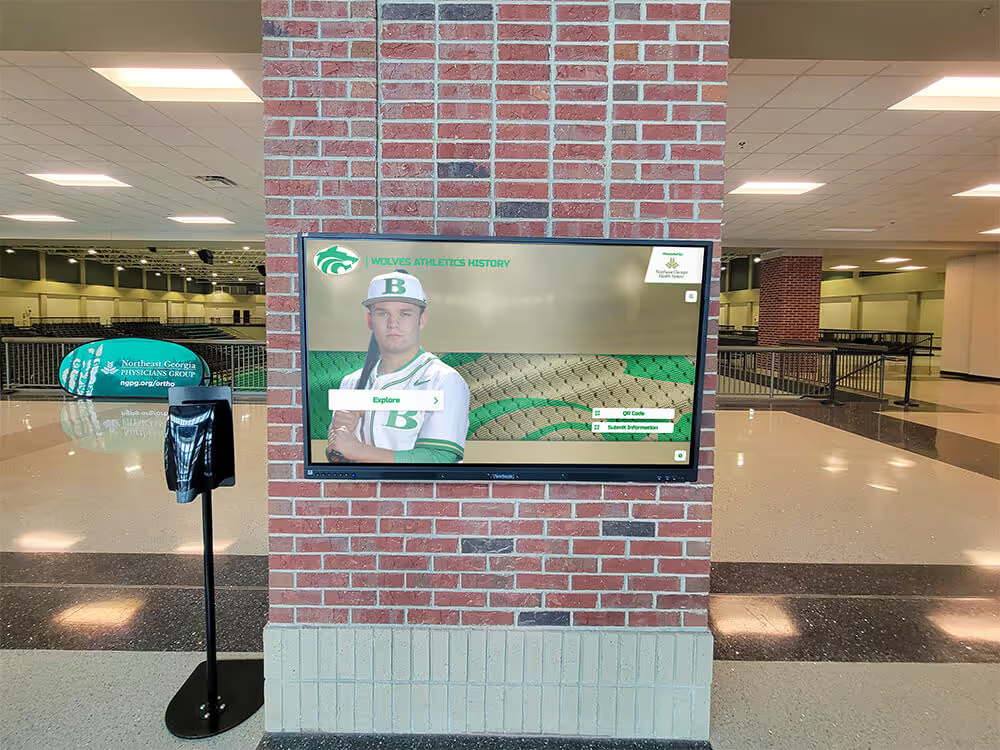
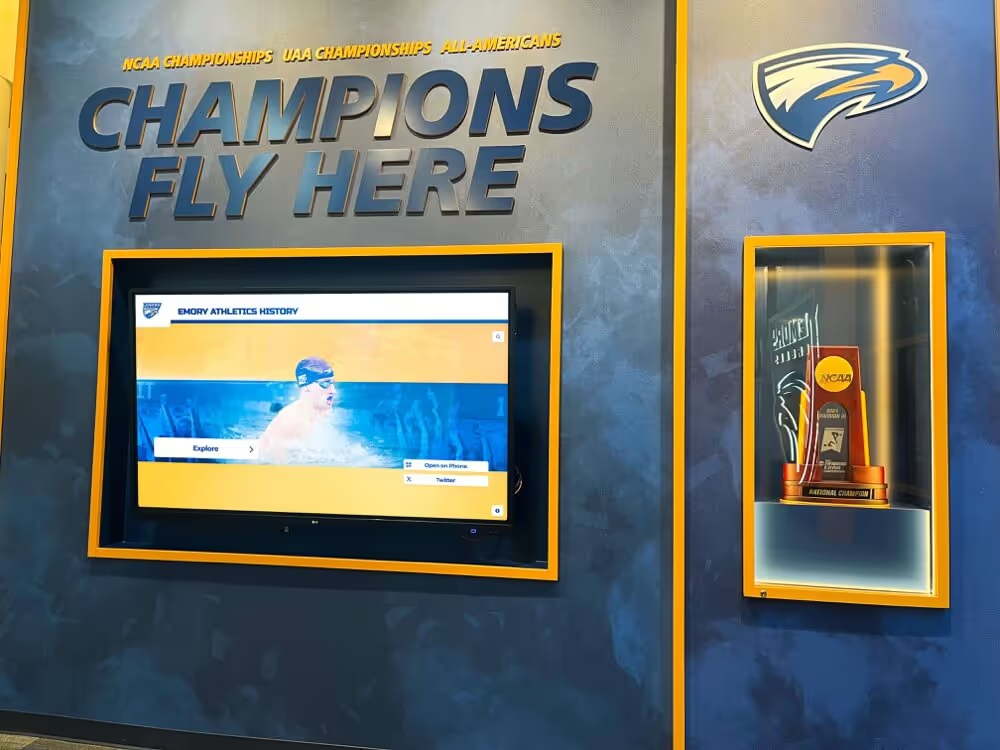
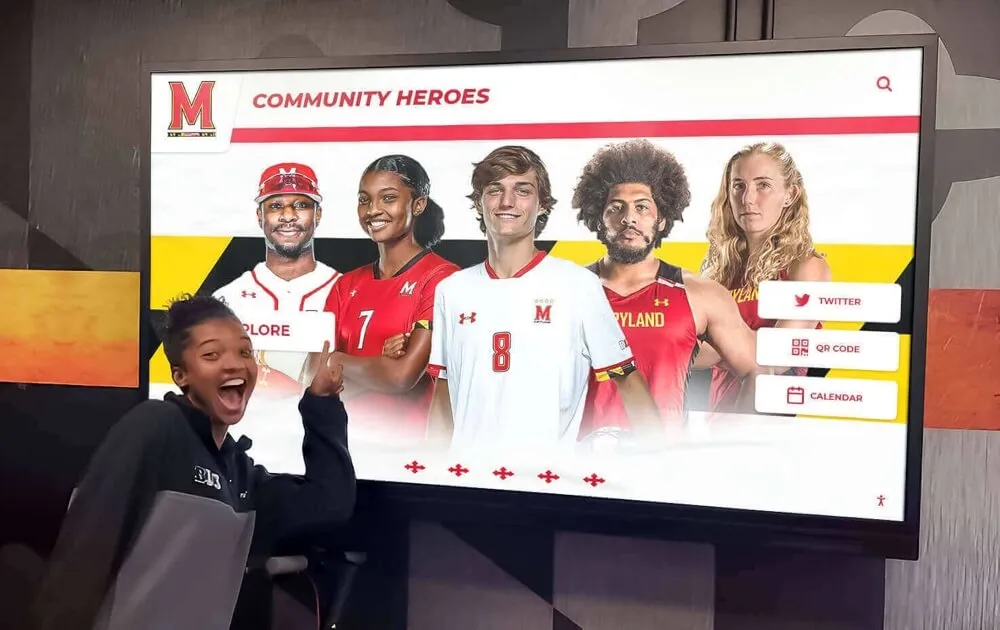
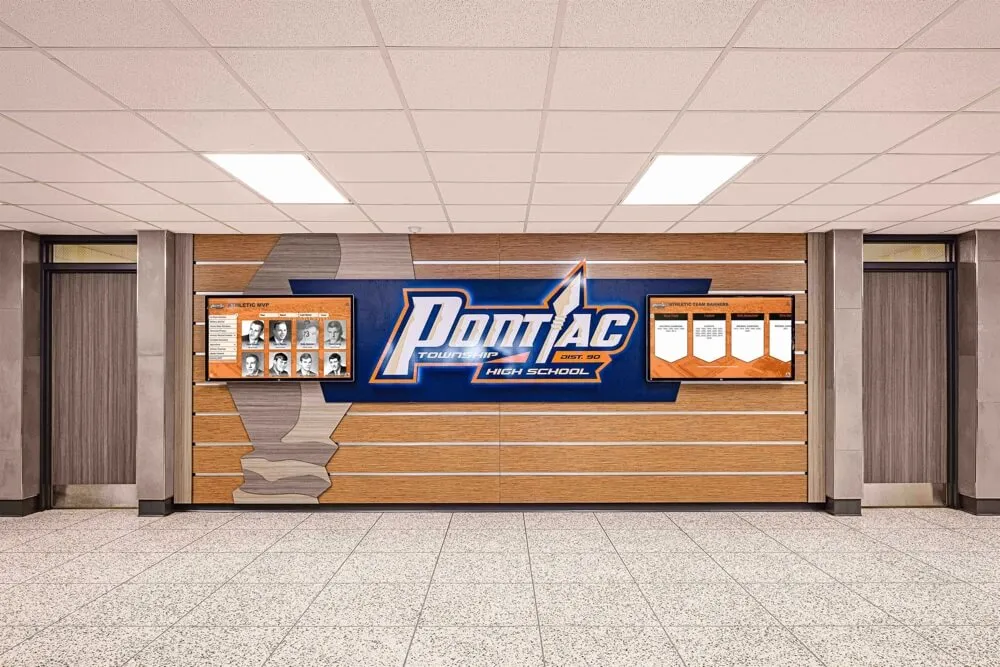
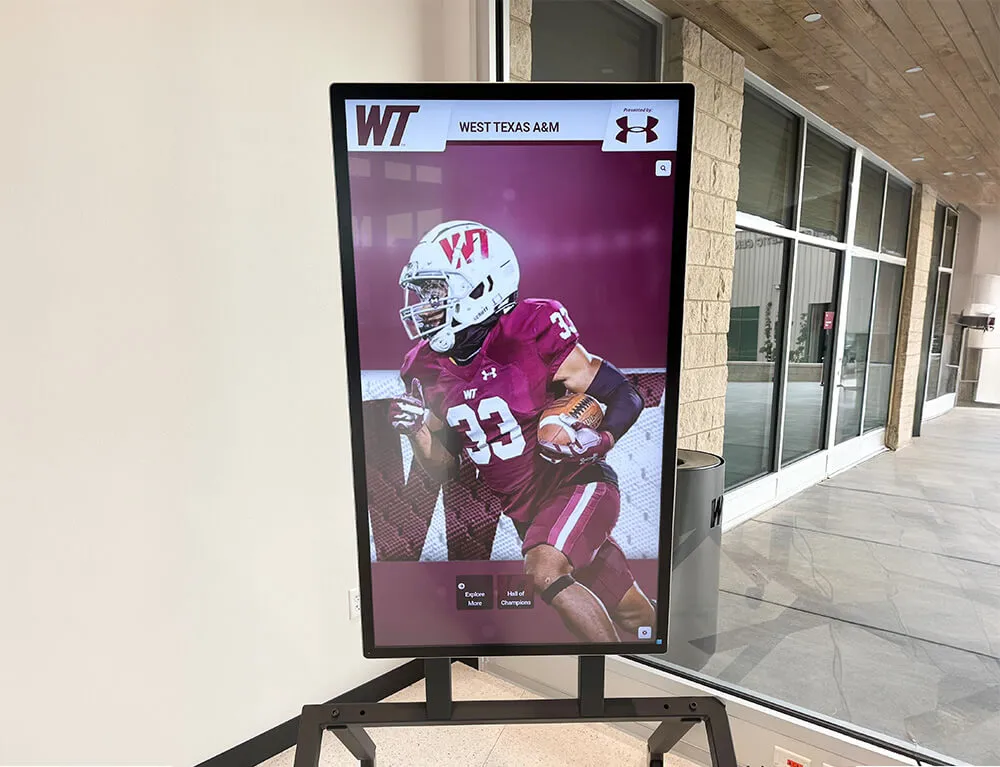
Strong institutional visual identity systems — school crest, colors, mascot — that appear in lobby recognition displays should directly inform marching band uniform design for cohesive brand consistency across all school programs
Distance Legibility and Field Presence
Marching band uniforms must function effectively across a 100-yard performance field viewed from elevated stadium seating. Design elements that appear subtle or sophisticated at close range often disappear entirely from competition viewing distance.
Distance design principles:
- Contrast is more important than detail: Bold color blocking reads clearly at distance where fine embroidery does not
- Large color areas define visual identity; small details add refinement at close range
- Test any proposed design with photo simulations at simulated viewing distance before finalizing production
- Shako height significantly affects ensemble presence — taller shakos add visible height to each performer as seen from stadium seating
Visual Scoring in Competitive Marching
Competitive marching organizations like Bands of America (BOA) formally adjudicate visual programs as a separate scored caption, recognizing the central role ensemble visual presentation plays in competitive performance. Uniform design directly influences competitive scores in several areas:
- Color guard integration: Band uniforms must complement guard costuming for a unified visual ensemble. Clashing or disconnected band-and-guard visual approaches cost scores in visual ensemble captions
- Ensemble clarity: Consistent, well-maintained uniforms allow audiences and adjudicators to read musical hierarchy and drill form clearly
- Overall visual effect: Design sophistication contributes to the visual vocabulary of the show concept — uniforms that tell a visual story aligned with the musical narrative score higher than purely generic designs
For programs competing in BOA events, state association championships, or local festival circuits, uniform design is genuinely a competitive variable, not only a tradition or pride consideration. This is a particularly compelling argument for booster funding conversations where return-on-investment language resonates.
Embedding School Identity: Continuity Across Generations
The most successful marching band uniform designs feel unmistakably specific to their school rather than generic. That specificity comes from deliberate, layered integration of school identity elements that extend from the colors to the symbolic details.
Building from Your School’s Visual Brand
Before designing a new uniform, gather your school’s complete visual brand documentation:
- Official PMS color codes for all school colors
- Licensed mascot artwork in vector format at multiple scales
- Official school typography used in athletics and school communications
- Visual examples from other school programs (athletics, cheerleading, spirit wear) to ensure cross-program brand consistency
Consistency between band uniforms and other school visual identity applications — gymnasium signage, athletic uniforms, hallway recognition displays — creates cohesive institutional identity that community members immediately recognize. A school where football jerseys, band uniforms, and lobby recognition walls all reflect the same colors, mascot, and visual language presents a unified institution rather than a collection of separate, visually disconnected programs.
For programs thinking about how school spirit programs and pep rally traditions connect with visual identity, band uniform design often anchors school color visibility at major community events where multiple programs appear together — making uniform consistency with the broader school brand especially impactful.
Historical Elements and Legacy Design
Programs with long histories have an opportunity to reference previous uniform generations through deliberate design choices that honor continuity without limiting contemporary design quality.
Legacy integration strategies:
- Archive photographs of previous uniform generations, noting distinctive elements that defined each era — a specific trim pattern, collar treatment, or emblem style
- Identify recurring design elements that could serve as threads of continuity in the new design without requiring literal replication
- Commission your designer to reference historical elements in contemporary forms, creating visual heritage through sophisticated interpretation rather than nostalgic copying
- Document the connection explicitly in program materials so current students understand the historical continuity they’re wearing
The connection between uniform design and program legacy extends well beyond the current season. Honoring program milestones and retired uniform eras is a practice athletic programs have long formalized — retiring jersey numbers, displaying championship memorabilia — that performing arts programs can adapt to honor pivotal seasons, legendary directors, or historically significant uniform generations.
Uniform Recognition Traditions
Just as letterman jackets and recognition traditions create tangible symbols of student achievement and program membership, marching band uniforms serve as a recognition tradition in their own right. Students who earn section leadership positions, achieve first chair status, or represent the school at regional or state competitions wear the same visual identity as generations of predecessors — a continuity of belonging that constitutes genuine, lasting recognition.
Programs that formalize this recognition aspect — celebrating students who wear the uniform in distinguished service, honoring the uniform’s role in memorable performances, or creating a tradition around passing the responsibility of wearing it — add meaningful ceremony to what might otherwise be treated as pure equipment management.
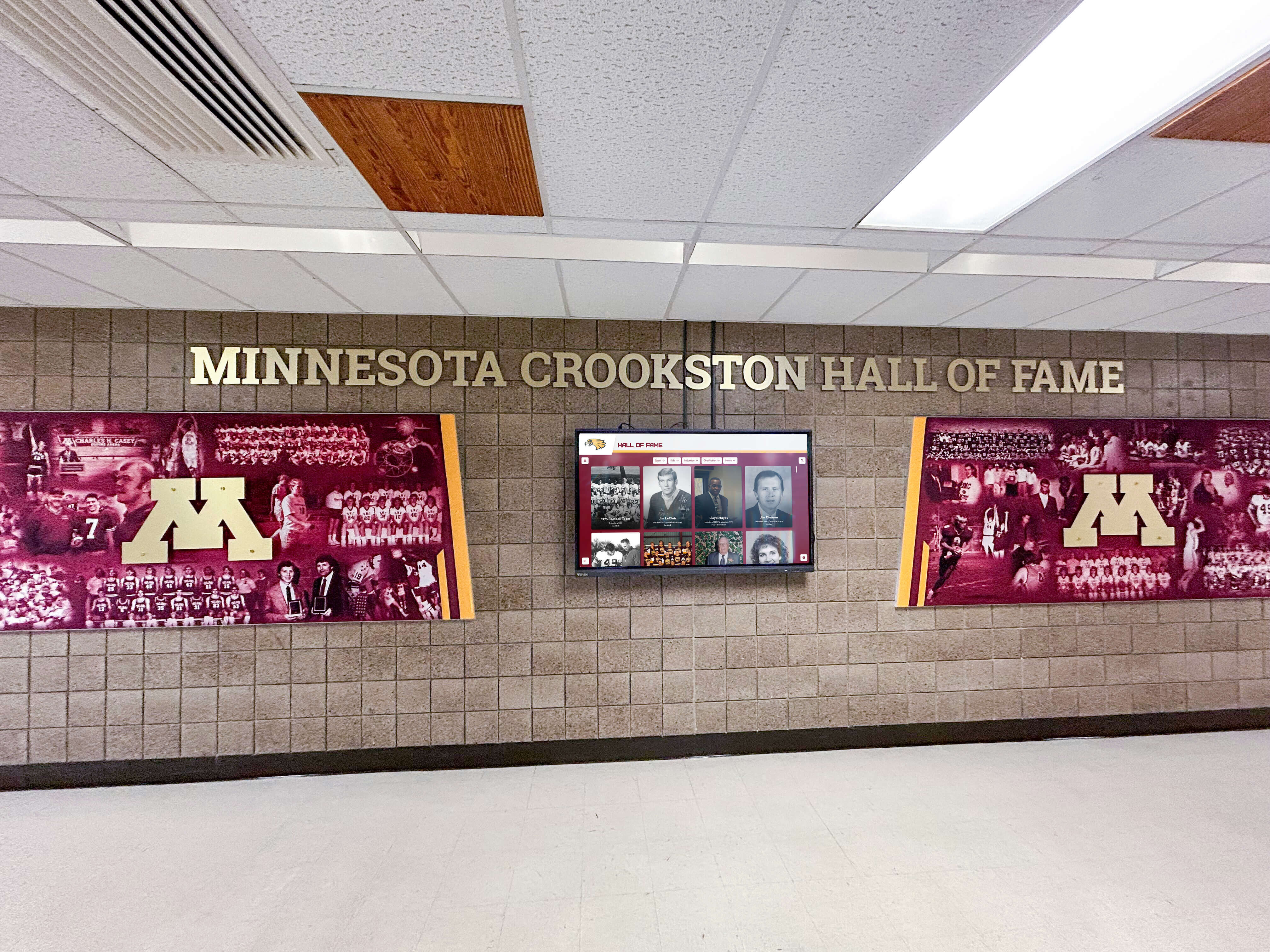
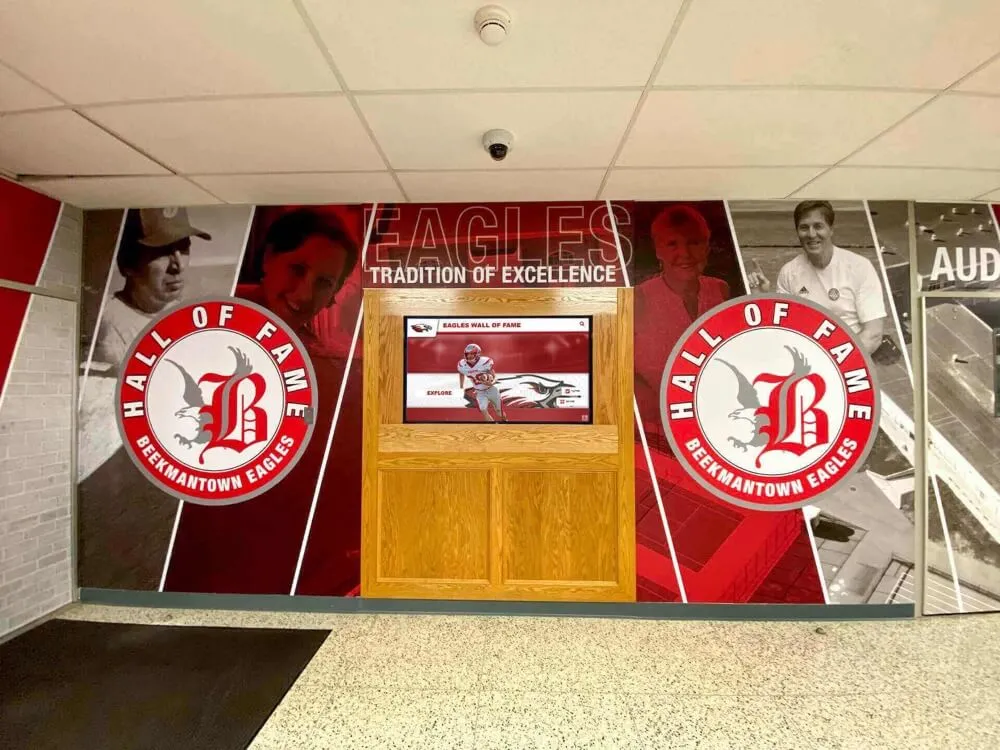
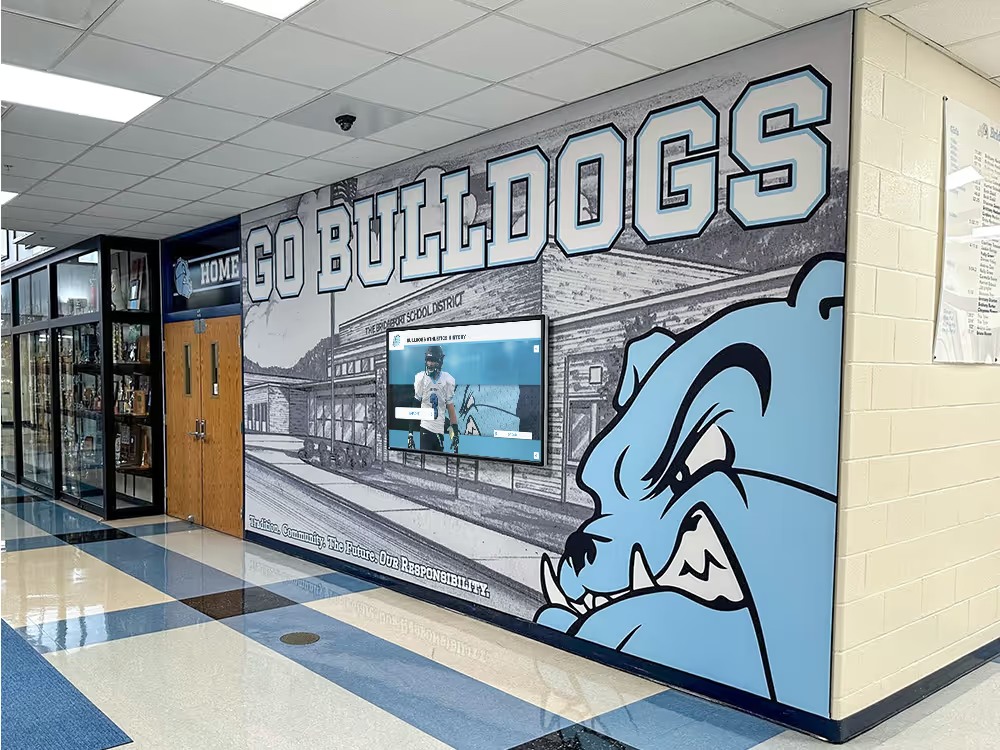
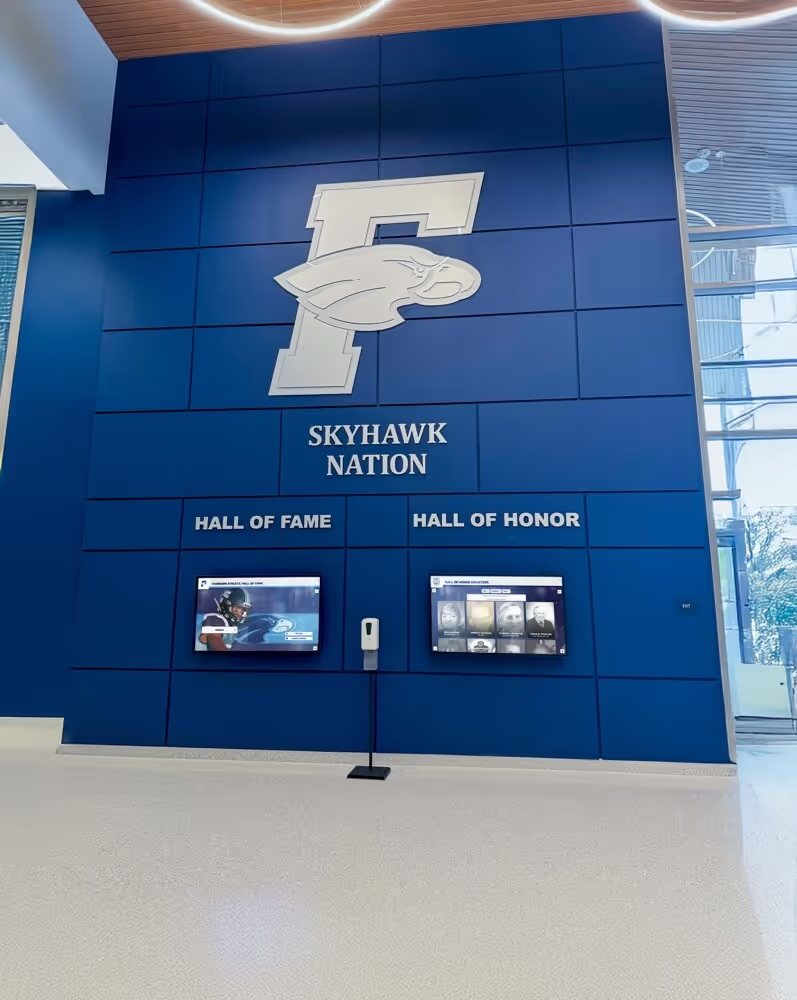
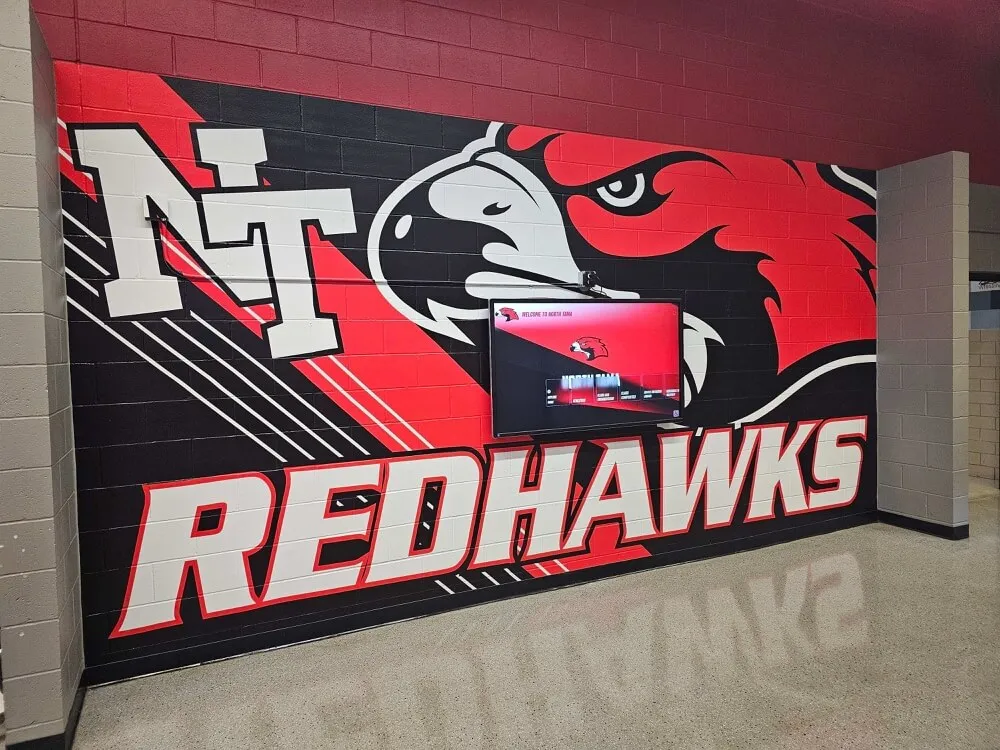
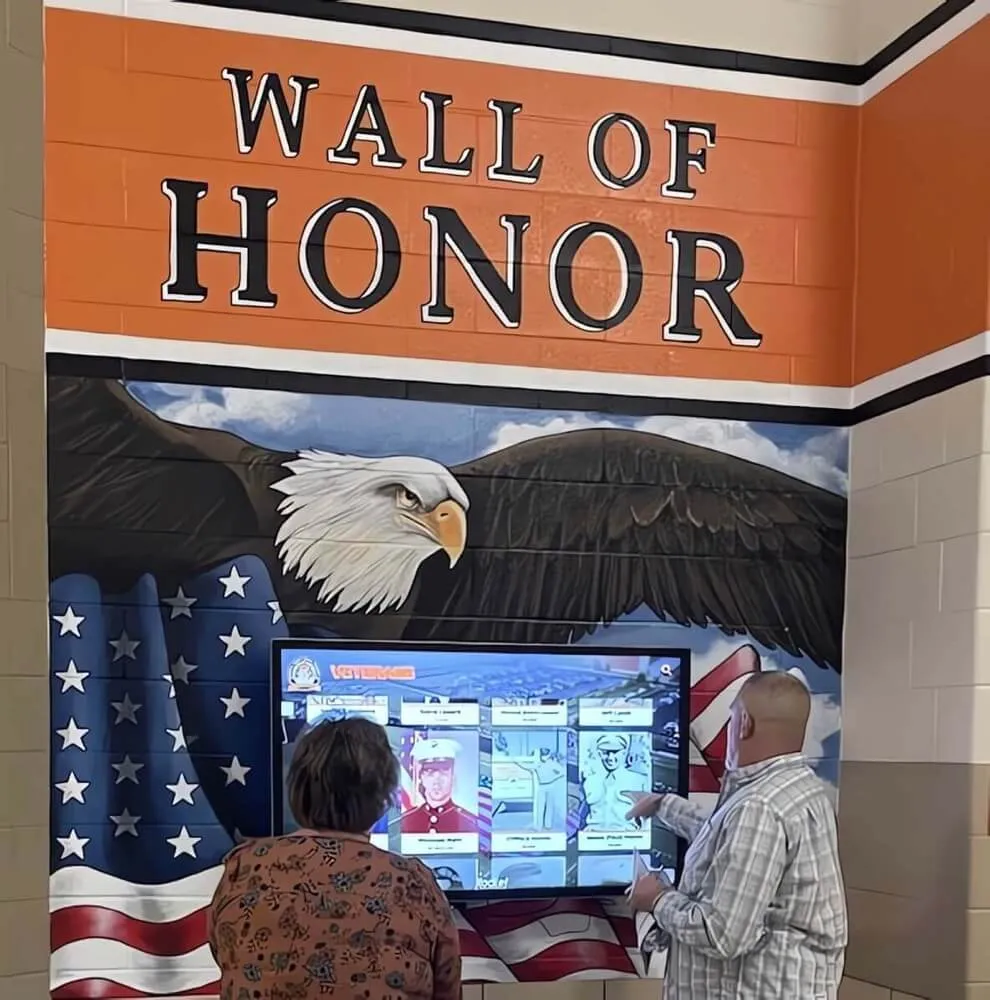
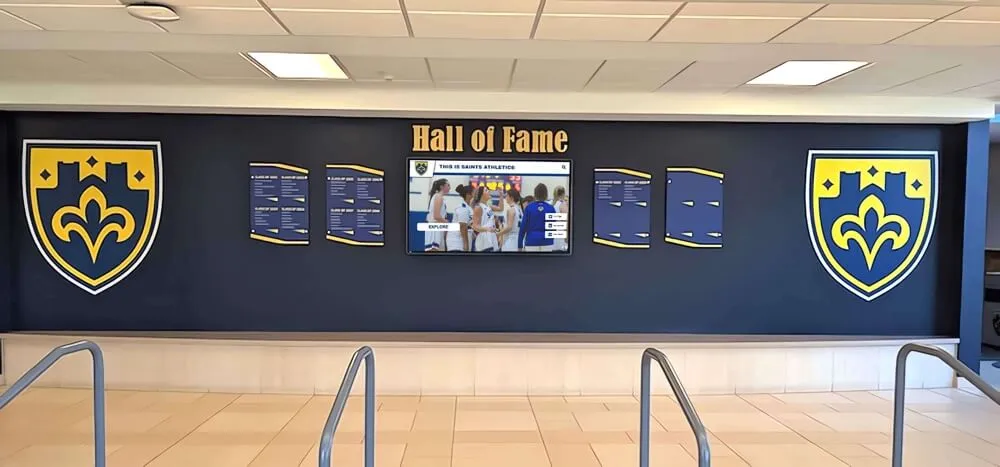
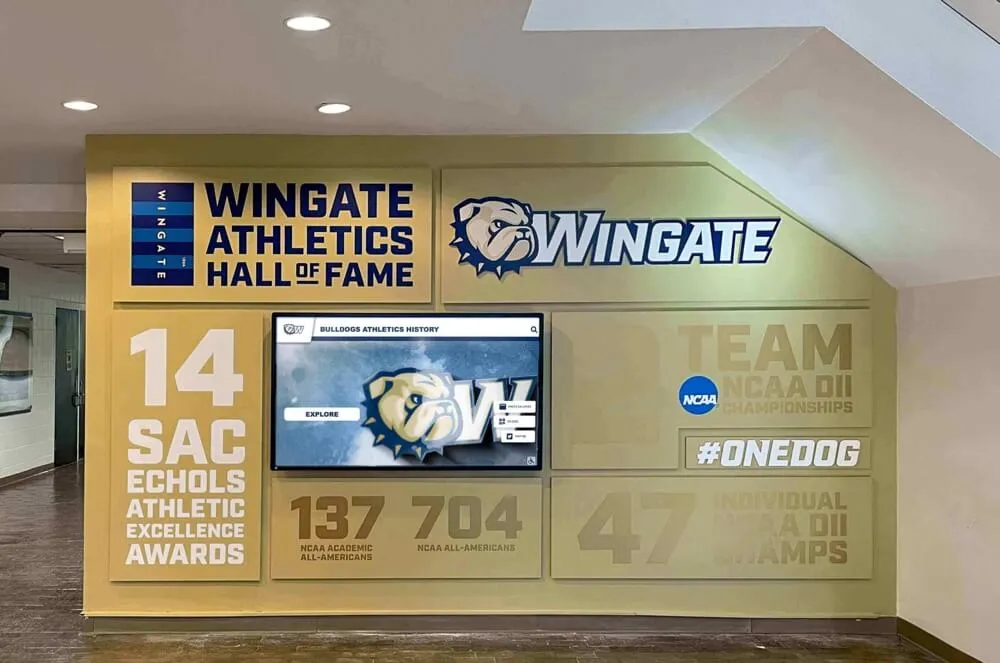
School identity display systems featuring program colors, recognition murals, and digital history archives demonstrate how uniform visual choices connect marching programs, athletics, and institutional history into unified brand identity
Practical Planning: Budget, Sourcing, and Replacement Strategy
Marching band uniform design operates within real budget constraints that vary dramatically across school programs. Effective planning accounts for both initial acquisition costs and the longer-term replacement economics that determine sustainability.
Budget Framework for High School Programs
Marching band uniform costs range widely based on design complexity, materials, manufacturer, and level of customization:
Complete uniform system costs per student:
- Entry-level: $300–$600 per student for catalog designs with basic customization (jacket, bibbers, shako included)
- Mid-range: $600–$1,200 per student for custom color blocking and program-specific design elements
- Premium custom: $1,200–$2,000+ per student for fully original designs from specialized performance uniform manufacturers
For a typical high school band of 80–150 students, full uniform replacement represents a $25,000–$300,000 investment depending on quality tier and ensemble size. Most programs address this through one or more funding mechanisms:
- Multi-year booster campaign with dedicated uniform replacement fund
- School capital budget allocation for program equipment
- Community partnership or donor recognition opportunities
- Phased replacement distributing cost across multiple seasons
Budget allocation by component:
- Jacket and bibbers: 65–75% of per-unit cost — where quality investment yields the most visible return
- Shako/hat: 15–20% — high visibility with significant impact on ensemble presence; worth prioritizing quality
- Accessories (gloves, shoes, plume): 10–15% — coordinate carefully but easier to replace incrementally
Vendor Selection and Design Process
Established band uniform manufacturers — companies that have specialized in high school and collegiate band uniforms for decades — offer varying levels of design customization, from catalog selection with modifications to fully original design commissions.
Full custom design programs typically involve working with a design consultant to develop original patterns, color blocking, and embellishment approaches before production begins. Custom designs offer maximum differentiation and school specificity but require longer lead times — often 12–18 months from approved design to delivered garments — and higher per-unit costs.
Key vendor evaluation criteria:
- Request actual manufactured samples, not only design renderings, before committing
- Ask for references from comparable programs about quality and service during production and delivery
- Clarify warranty terms and repair service policies explicitly
- Confirm realistic lead times — production backlogs regularly extend to 12+ months during peak ordering cycles
- Evaluate alteration and resizing capability for adapting existing uniforms across successive class sizes
Phased Replacement Strategy
Programs replacing uniforms incrementally — prioritizing the most visible items first, or replacing a section per season — can manage cash flow while improving visual consistency over time. Successful phased approaches require careful planning to maintain ensemble visual unity during transition periods when some performers wear the new design and others wear the previous generation.
Documenting your phasing plan, communicating it to the school community through booster materials, and connecting each phase to specific fundraising milestones keeps the project momentum alive across multiple school years.
Preserving Your Band’s Uniform Legacy Through Digital Recognition
The value of marching band uniform design extends far beyond its active performance life. Historic uniforms document a school’s visual identity evolution across decades — connecting current students to generations of band members who wore the same school colors in service of the same program traditions.
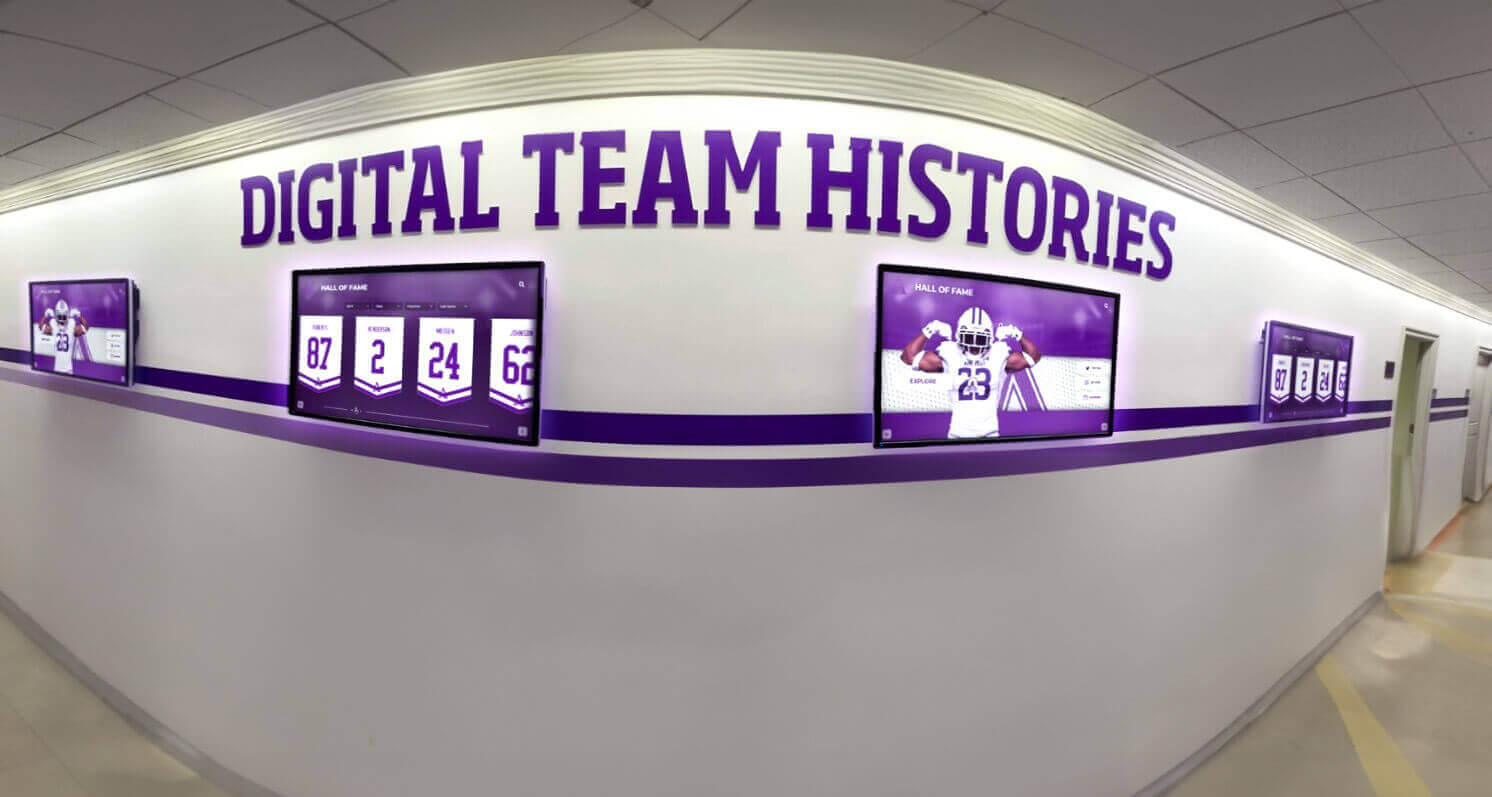
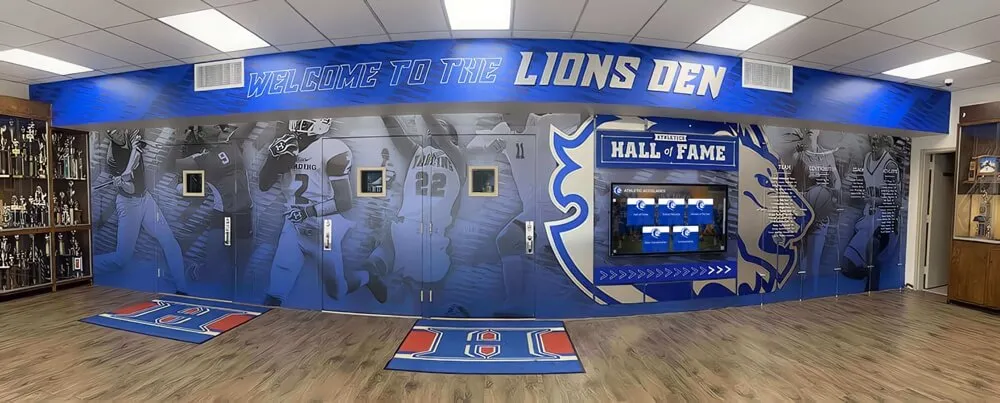
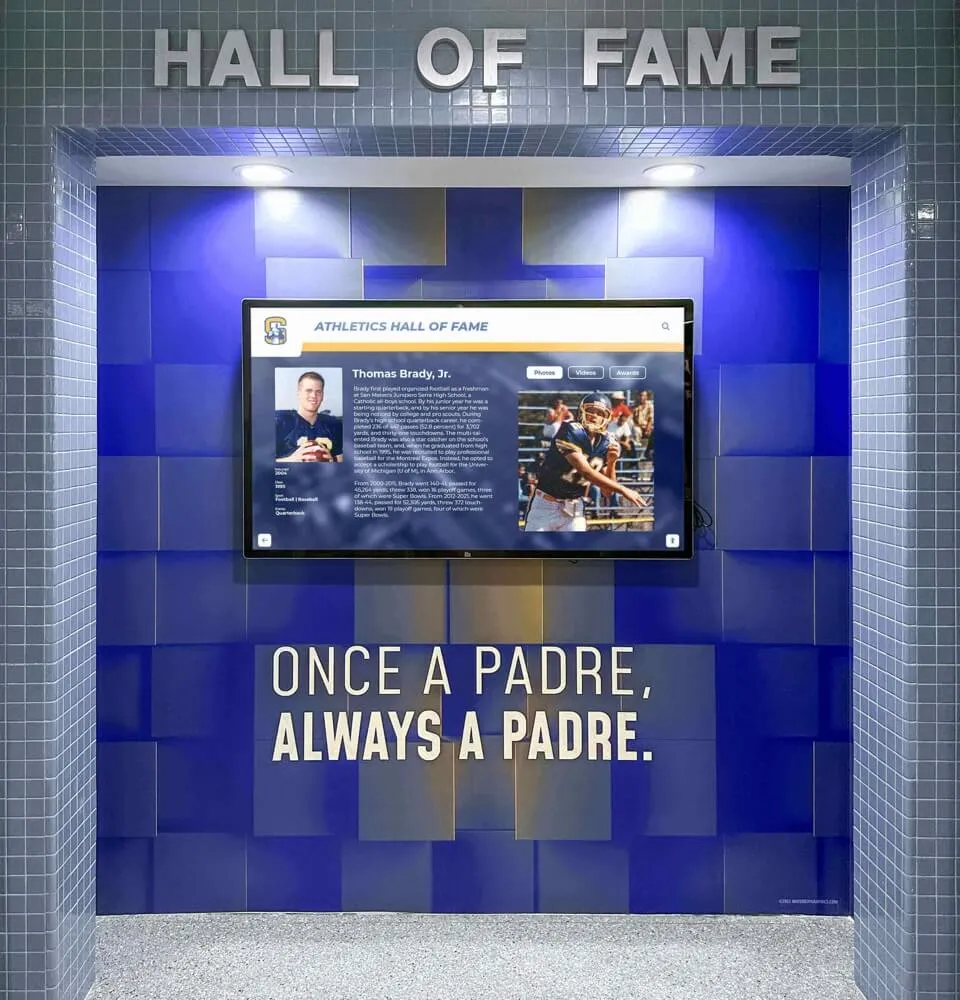
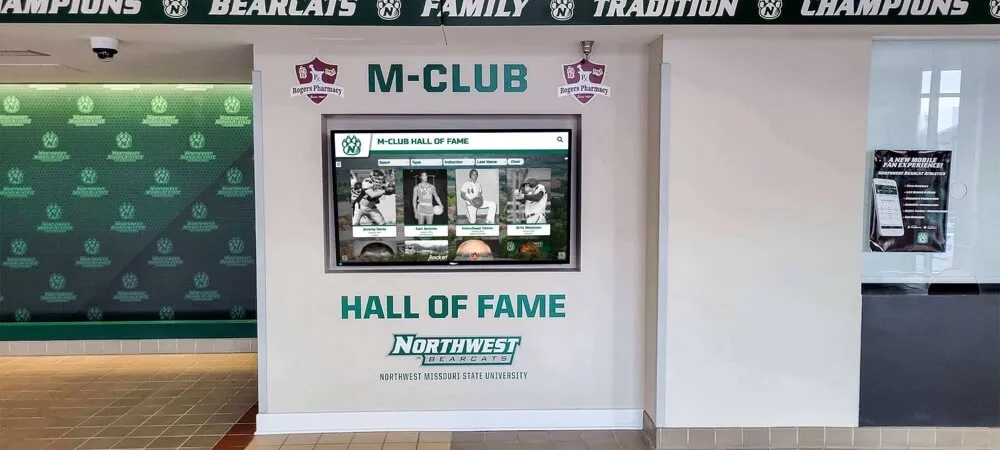
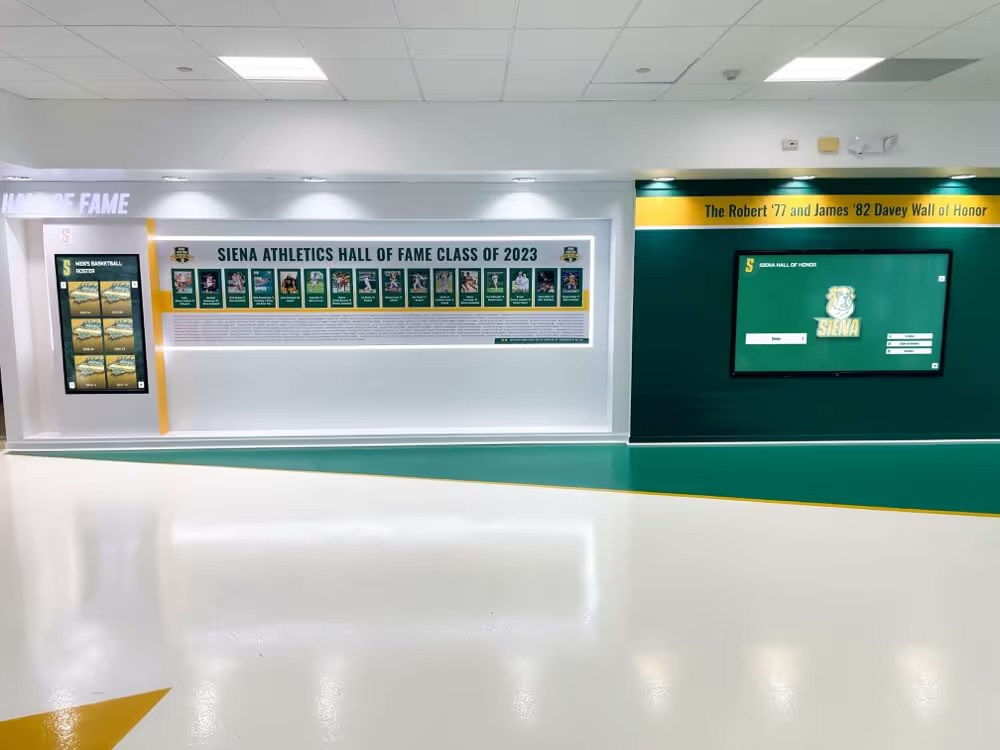
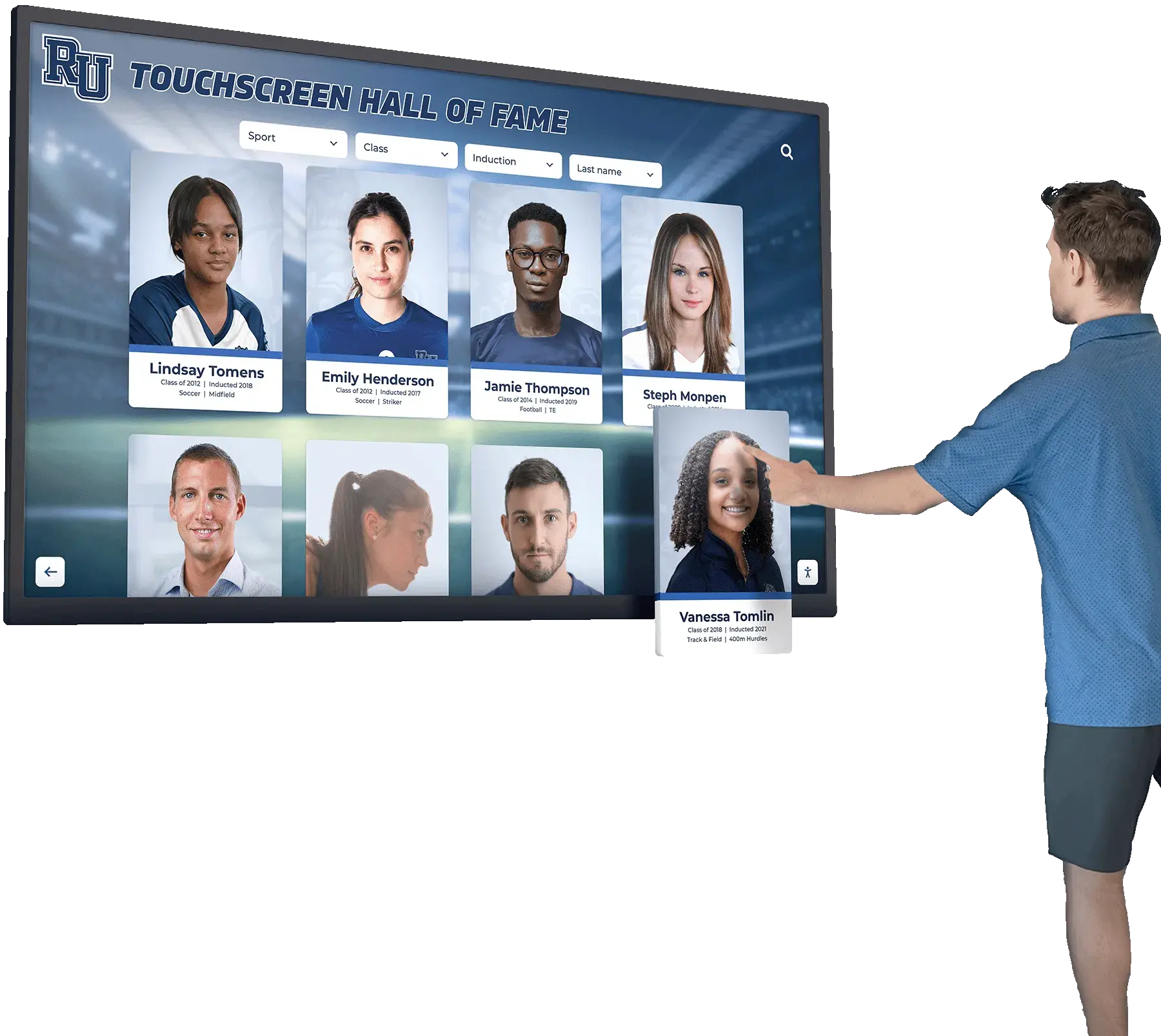
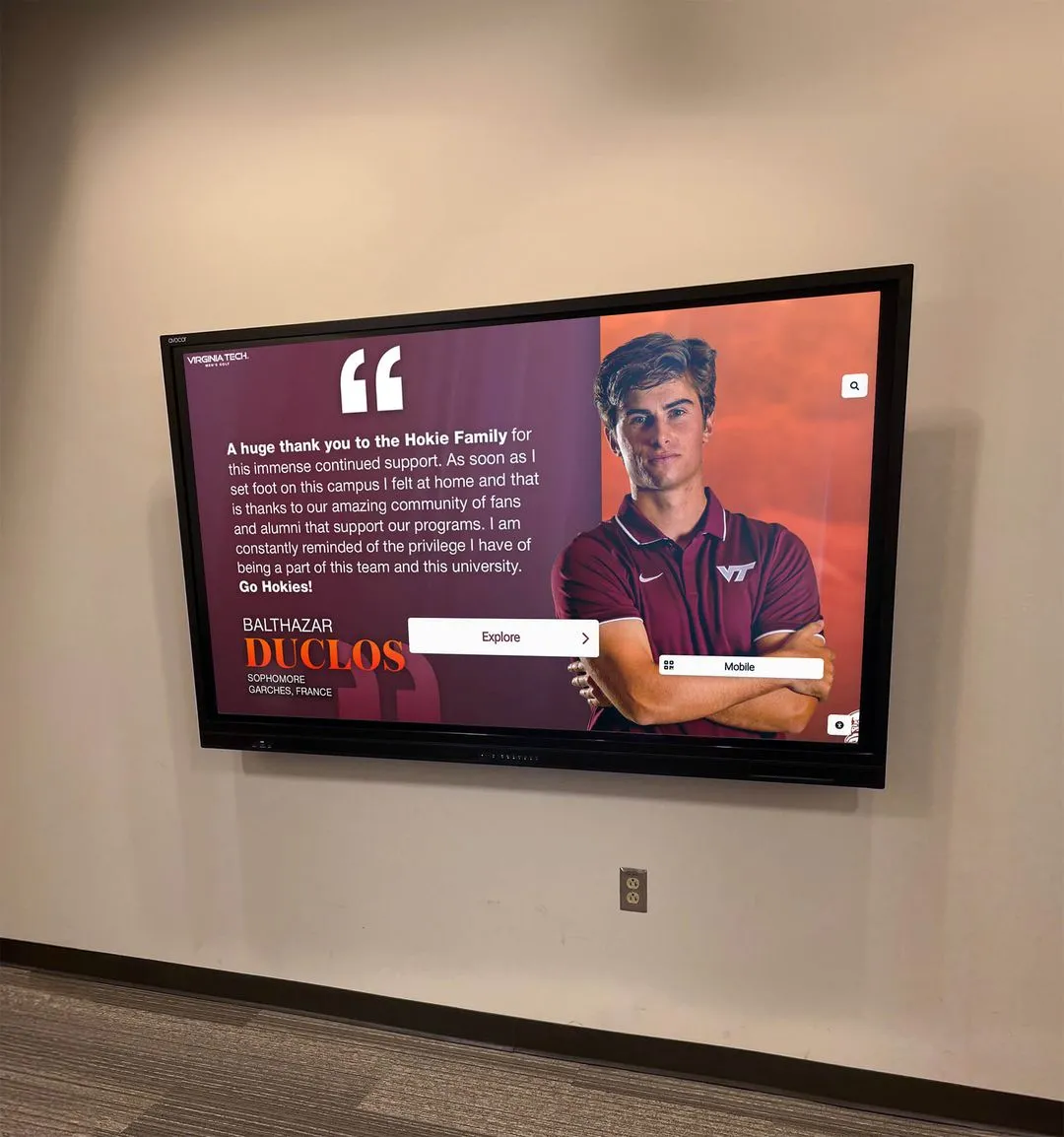
Digital displays in school hallways provide powerful platforms for preserving and showcasing marching band program history, including uniform evolution and performance milestone archives, alongside athletic recognition
Archiving Uniform History as Program Legacy
Just as athletic programs archive championship uniforms, game-worn jerseys, and team photographs as recognition artifacts, band programs benefit significantly from systematic documentation of uniform history:
- Photograph each uniform generation with representatives in formal performance stance, capturing front, back, and close-up detail views in consistent lighting conditions
- Maintain design documentation recording the design brief, manufacturer, year of adoption, any modifications made during service, and seasons worn
- Preserve sample pieces — ideally one complete uniform — from each generation in school archives as physical legacy objects
- Record the performance stories associated with each uniform era: major competitive achievements, directorial transitions, milestone performances, and community events the uniform represented
Digitizing photo archives for school programs provides practical guidance for systematically collecting, scanning, and organizing historical performance photographs — foundational work that creates the infrastructure for meaningful long-term legacy displays.
Digital Displays for Arts Program Recognition
Performing arts programs — band, choir, theater, orchestra — have historically received less institutional recognition infrastructure than athletic programs. Physical trophy cases, banner spaces, and hallway recognition walls have predominantly served athletics, leaving performing arts achievements less visible in the school environment even when competitive or artistic accomplishments are equally impressive.
Digital display systems offer a powerful solution for expanding performing arts recognition to include marching band program milestones:
- Competition placement histories and major achievement seasons documented year by year
- Historical uniform displays showing visual identity evolution from program founding to present
- Director recognition honoring long-serving program leaders whose decisions shaped generations of students
- Individual achievement spotlights for section leaders, soloists, and students who earned regional or state recognition
- Photo archives from significant performances — championship competitions, special community events, milestone celebrations
Theatre and arts wall of honor programs provide established models for how performing arts programs can develop recognition systems that carry the same permanence and prestige as athletic hall of fame programs.
Touchscreen Recognition Systems for Performing Arts
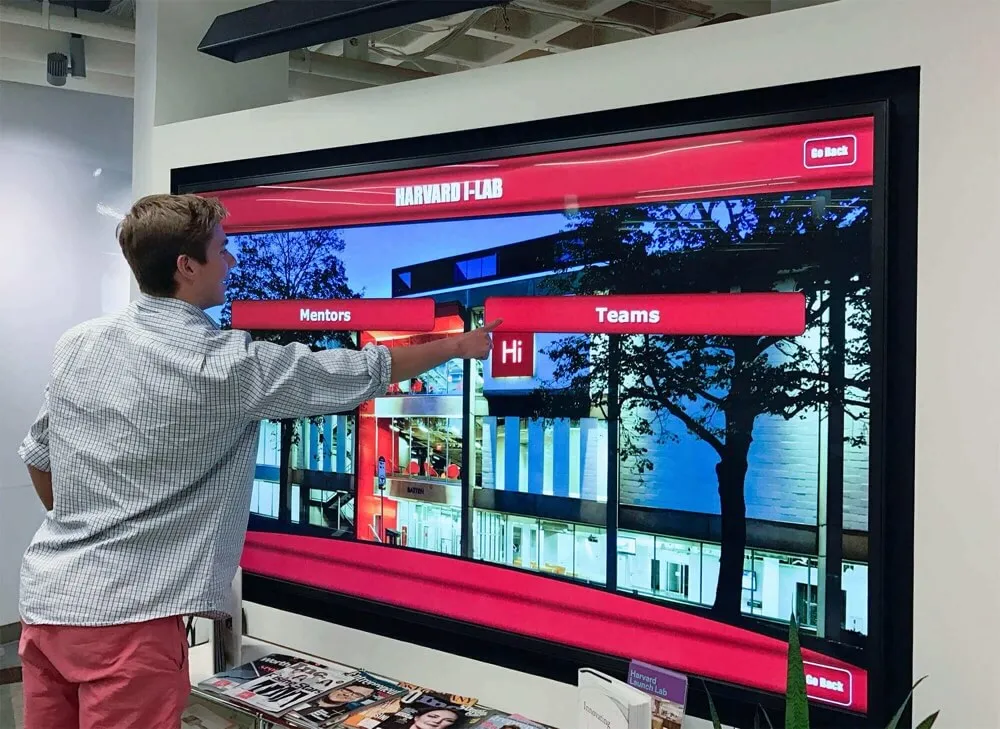
The most comprehensive recognition platforms for schools — interactive touchscreen wall systems — allow multiple programs to share recognition infrastructure while maintaining distinct program identities within the same physical display space. A touchscreen recognition wall in a school’s main lobby or fine arts wing can feature a dedicated marching band section with:
- Decade-by-decade program history with photographic documentation of each uniform era
- Competition achievement archives searchable by season, event, or placement level
- Individual recognition profiles for program alumni who pursued music professionally or achieved specialized recognition
- Director and leadership legacy recognition honoring those who built the program across long tenures
Hall of fame induction ceremonies and recognition systems for school programs offer frameworks directly applicable to performing arts recognition — creating formal induction processes for distinguished band alumni, legendary directors, and milestone seasons that deserve permanent commemoration.
Schools that have invested in systems to recognize famous alumni consistently find that performing arts alumni — musicians, composers, music educators, and industry professionals who trace their development to high school band — respond with particularly strong engagement when recognition specifically documents the program’s formative role in their development.
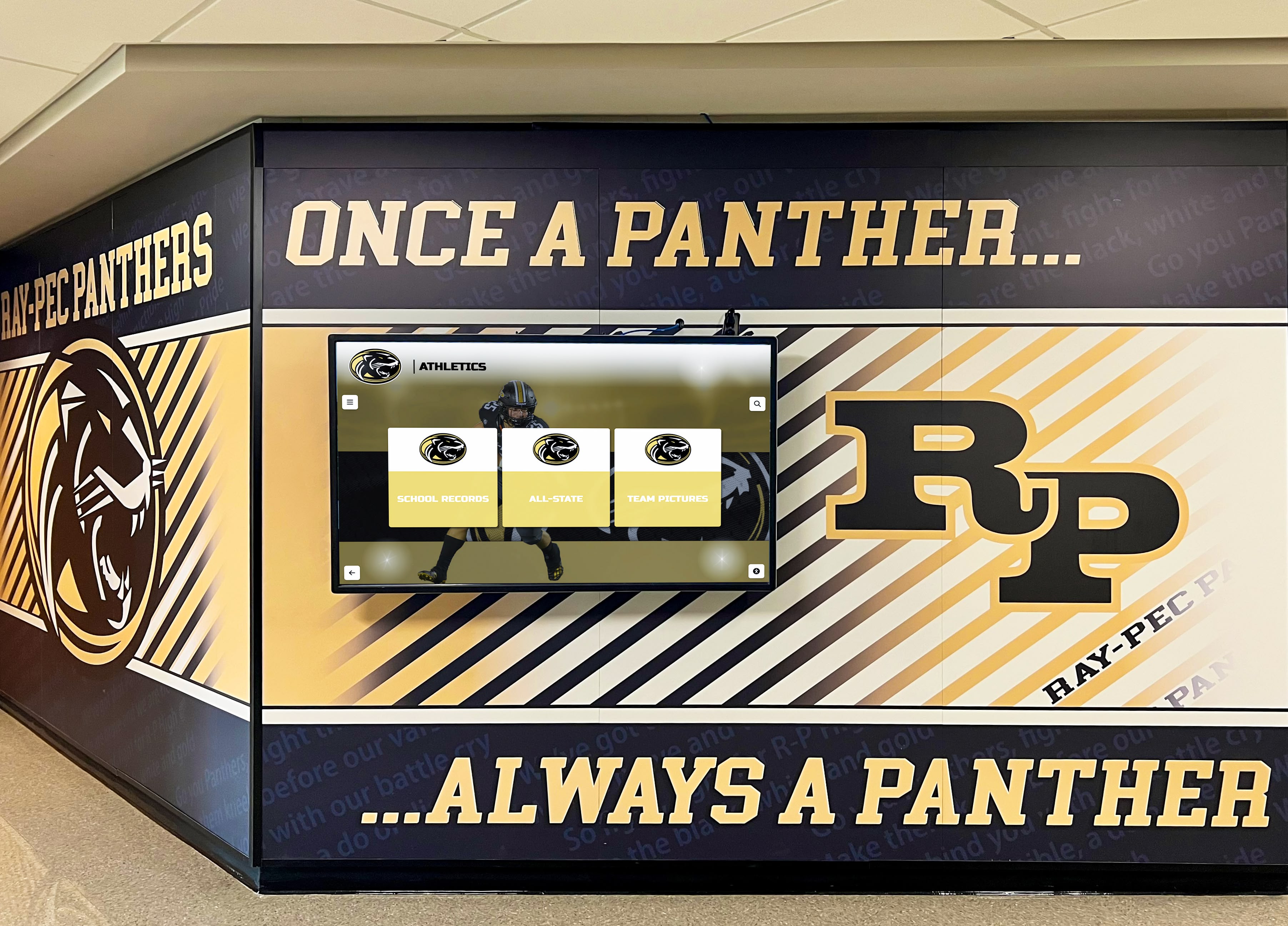
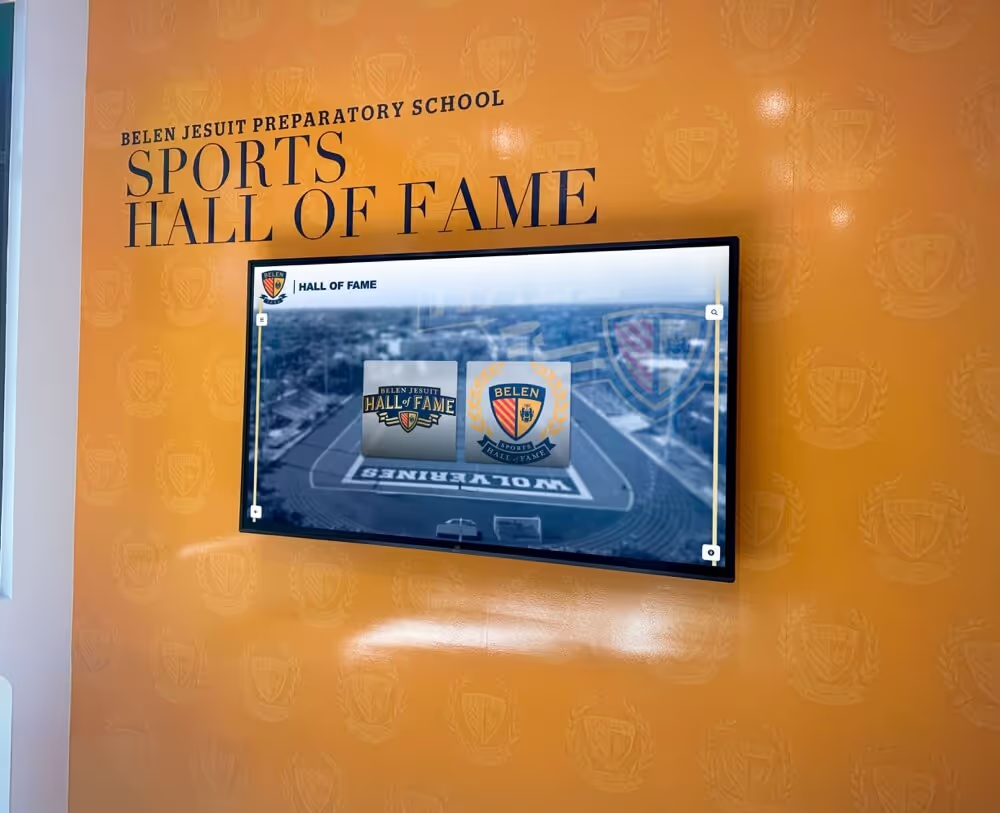
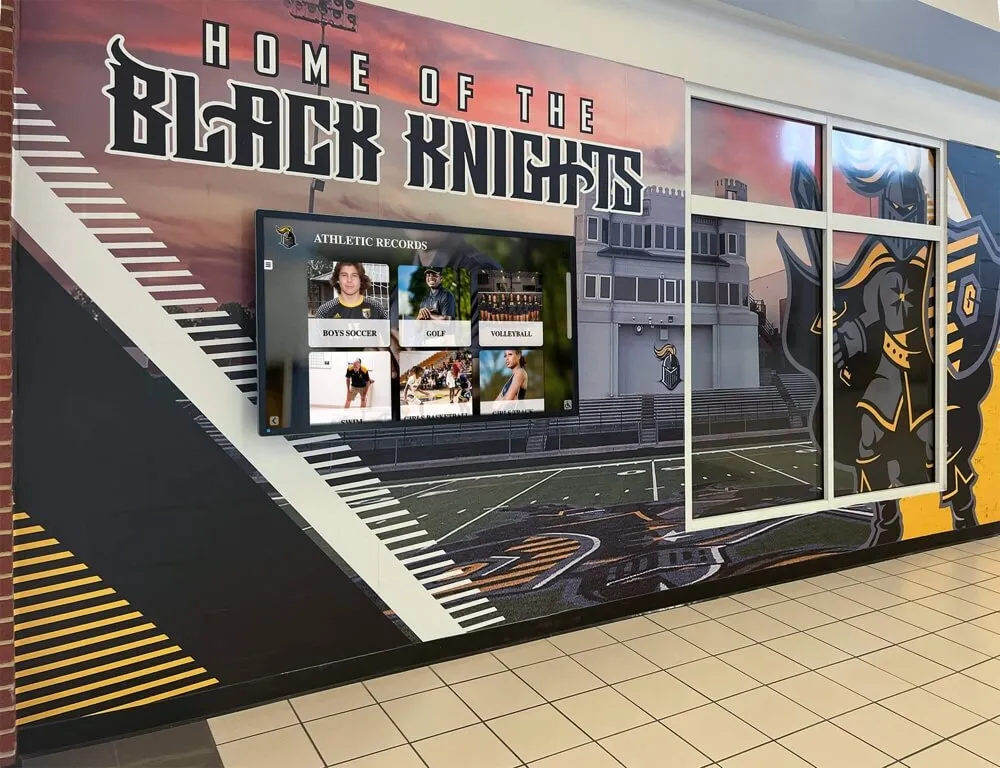
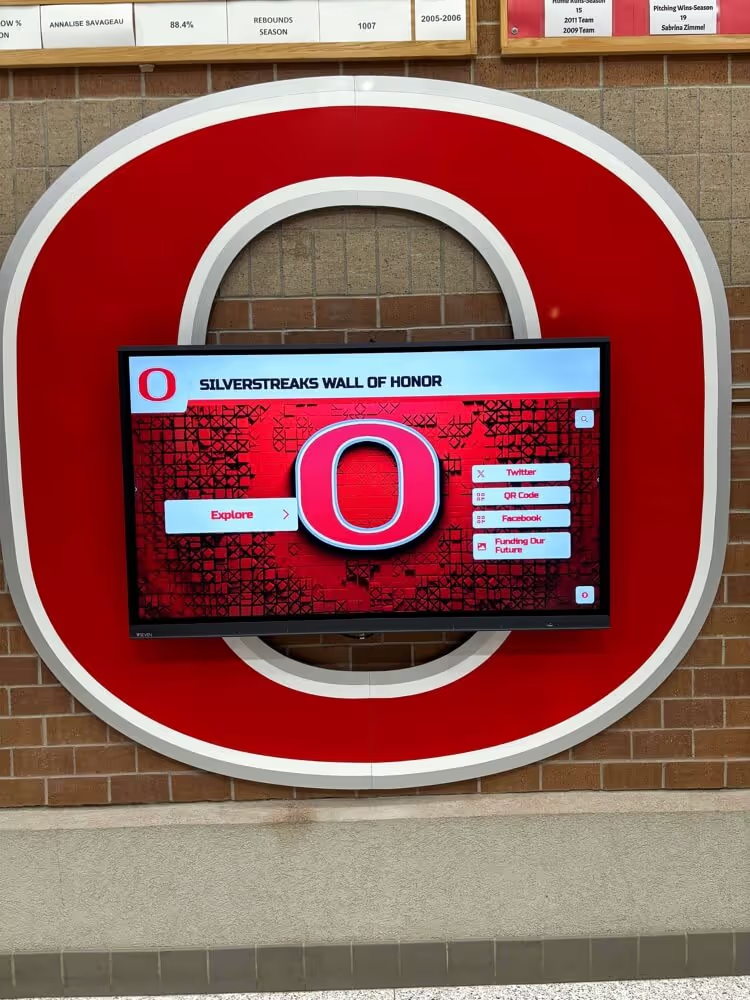
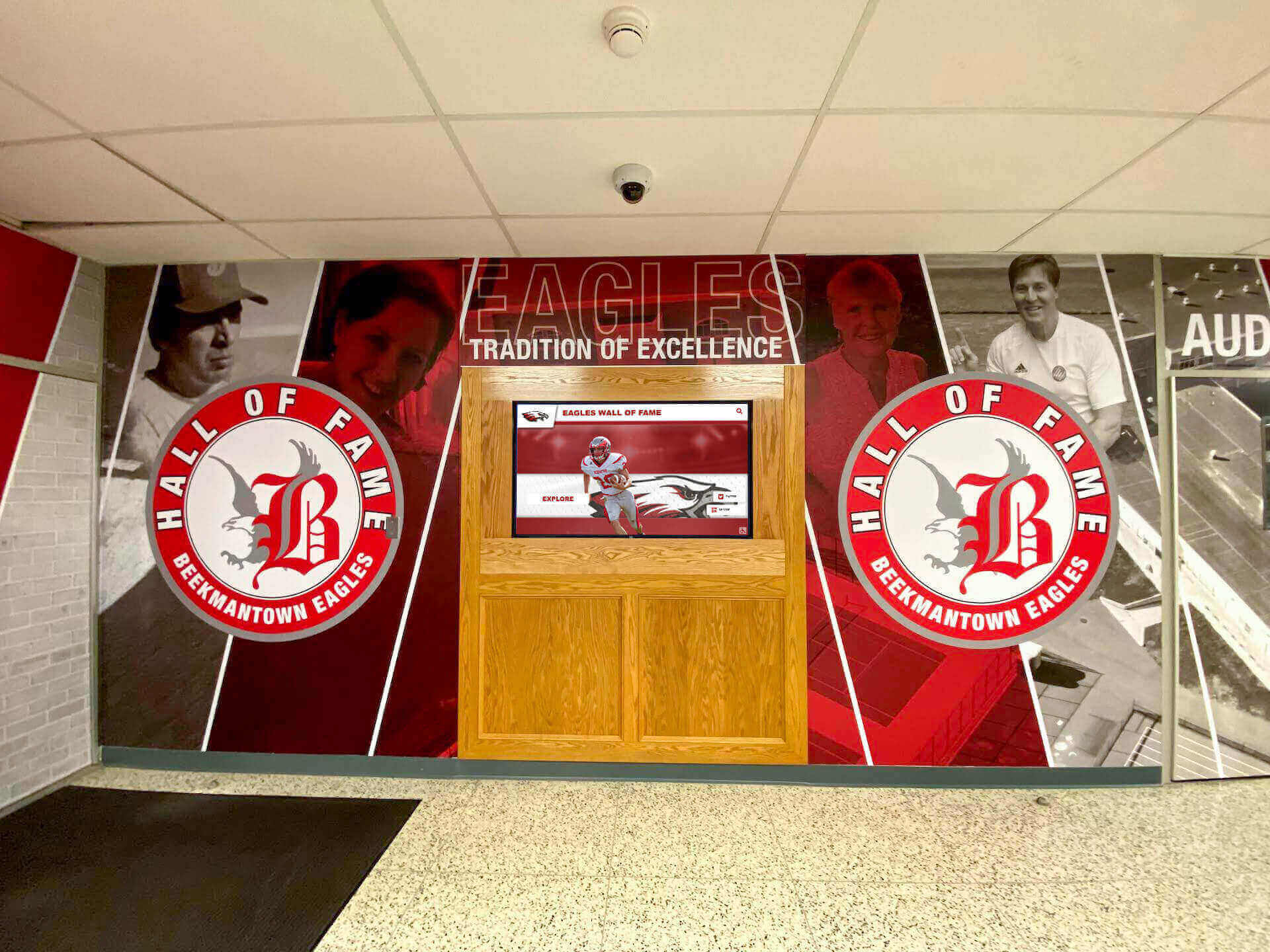
Hallway recognition systems that combine school identity murals with digital display technology offer performing arts programs the same lasting recognition infrastructure athletic programs have long used to preserve and celebrate their histories
Uniform Heritage as a Recruitment and Retention Tool
High school band programs with documented visual histories and accessible legacy recognition systems hold a meaningful advantage in recruiting incoming students and retaining current ones. When a prospective freshman sees that the band program has 25 years of performance photographs displayed in the hallway — capturing older siblings, parents, or community members wearing the school colors — the program’s identity and longevity become immediately personal.
Digital displays for academic and performing arts recognition explain how schools use recognition infrastructure to build the kind of institutional pride that makes students want to join and remain part of the programs being honored. When a program’s history is visibly honored rather than stored in filing cabinets, it communicates that the institution takes the performing arts seriously as a source of student achievement and school identity.
The uniform is often the first thing a prospective band member sees at a recruitment event. When that uniform is paired with a recognition environment that clearly demonstrates the program’s history, achievement culture, and respect for its members, the combination becomes a powerful enrollment argument that administrative recruitment efforts alone cannot replicate.
Frequently Asked Questions
What are the most important elements of marching band uniform design?
The most important elements are color palette anchored to school colors, silhouette style (traditional, contemporary, or hybrid), mascot integration, construction quality, and distance legibility. Color is the single most powerful identity element — high-contrast combinations maintain visual clarity across a full performance field, while embellishments add refinement at close range. Every element should work together as a cohesive visual system.
How long do high school marching band uniforms typically last?
High school marching band uniforms typically last 10–15 years under regular use and proper maintenance. Lifespan depends on fabric quality, care practices, storage conditions, and frequency of use. Most programs plan replacement based on visible wear, color fading, and changing ensemble sizes rather than on a fixed calendar.
How much does it cost to design and purchase marching band uniforms?
Costs vary widely by quality tier: $300–$600 per student for basic catalog uniforms, $600–$1,200 for mid-range custom designs, and $1,200–$2,000+ for premium custom performance uniforms. For an 80–150 student band, full replacement runs $25,000–$300,000 depending on size and quality. Most programs phase replacement or secure funding through booster campaigns and school capital budgets.
How can high school band programs preserve their uniform history?
Programs can preserve uniform history by photographing each uniform generation, documenting design details and seasons worn, archiving sample pieces in school collections, and digitizing historical performance photographs. Digital recognition display systems allow schools to make band program legacy as publicly visible as athletic recognition — presenting decade-by-decade history, competition records, and individual achievements in an accessible public platform.
What role does uniform design play in competitive marching band scoring?
Competitive organizations like Bands of America (BOA) formally adjudicate visual programs as a separate scored caption. Uniform design influences color guard integration scores, ensemble clarity, and overall visual effect. For competitive programs, uniform design is a genuine competitive variable that directly affects placement — not solely a tradition or pride consideration.
Conclusion: Designing Uniforms That Represent Your Program’s Full Story
Marching band uniform design is ultimately an act of institutional identity-building — a decision about how your school will present itself to the community, to competitors, and to the generations of students who will wear the uniform in the years ahead. The best designs anchor firmly to school colors and mascot identity, choose a style that reflects the program’s personality and competitive context, and build in the construction quality that sustains visual impact across an extended lifespan.
The uniform’s role in school identity doesn’t end when it’s retired from active service. Programs that document their uniform history, preserve performance photographs across decades, and invest in recognition systems that make that history visible create a legacy that recruits new members, honors program alumni, and demonstrates institutional respect for the performing arts equal to that shown for athletics and academics. The uniform that students wear on the field is the same one that, with thoughtful archiving, tells the program’s story to future generations through digital recognition displays and school history exhibits.
High school state championship celebrations — whether in athletics or the performing arts — are defined in part by the visual identity of the school doing the celebrating. A strong marching band uniform design ensures that when your program achieves something worth celebrating, they’ll be doing it in something that looks exactly like who they are.
Ready to Preserve Your Band Program's Visual Legacy?
Rocket Alumni Solutions helps schools create digital recognition walls and interactive touchscreen displays that celebrate performing arts programs alongside athletics — preserving band history, uniform archives, and student achievements for generations to come.
Explore Recognition Solutions